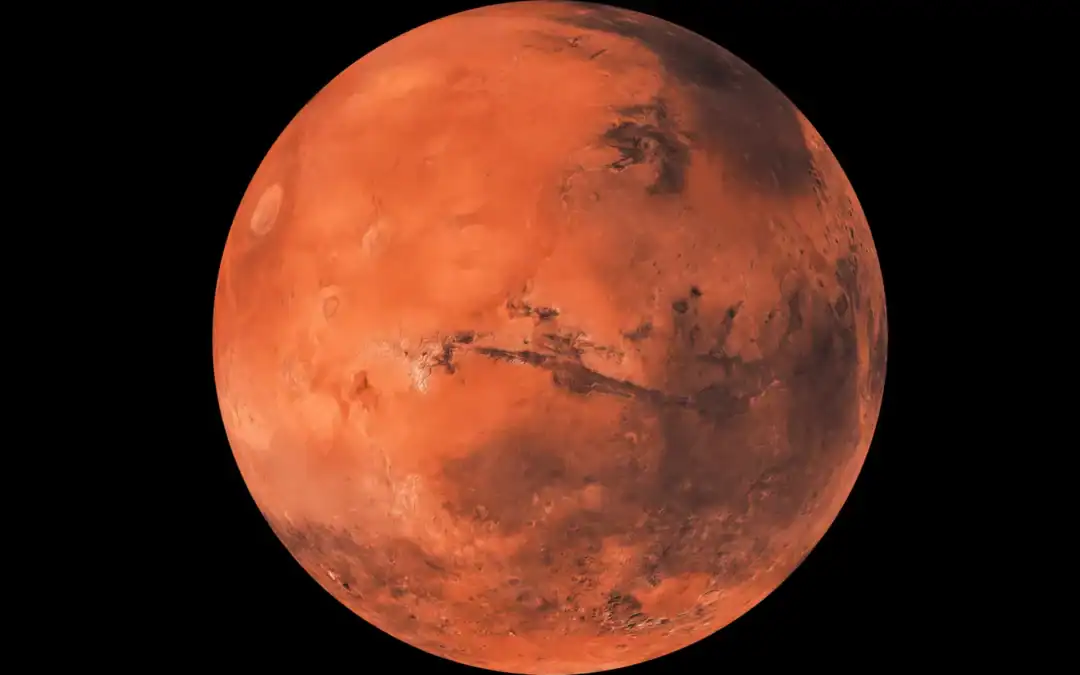
If you’ve ever looked up at the night sky and noticed a bright reddish object shining among the stars, you’ve probably wondered why Mars looks so different from everything around it.
Known as the Red Planet, Mars has fascinated humans for thousands of years. Ancient civilizations noticed its distinctive color long before telescopes existed.
The Romans associated it with their god of war because its reddish appearance reminded them of blood. Even today, Mars remains one of the easiest planets for beginners to identify in the night sky.
But why is Mars red?
The answer involves iron, oxygen, dust, and billions of years of planetary history.
Why Mars Has Captured Human Attention For Thousands Of Years
Unlike most stars, Mars often appears to have a noticeable reddish-orange tint. To ancient skywatchers, this made it stand out immediately.
Long before anyone understood what planets were, people noticed that Mars behaved differently from the stars. It wandered across the sky rather than remaining fixed among the constellations.
Its brightness changed over time. Sometimes it appeared brilliant and impossible to miss. At other times, it became faint and difficult to find.
Its unusual color only added to the mystery.
Today, we know Mars is a rocky planet orbiting the Sun, but for much of human history, it was simply a strange red object moving through the heavens.
The Simple Answer: Mars Is Covered In Rust
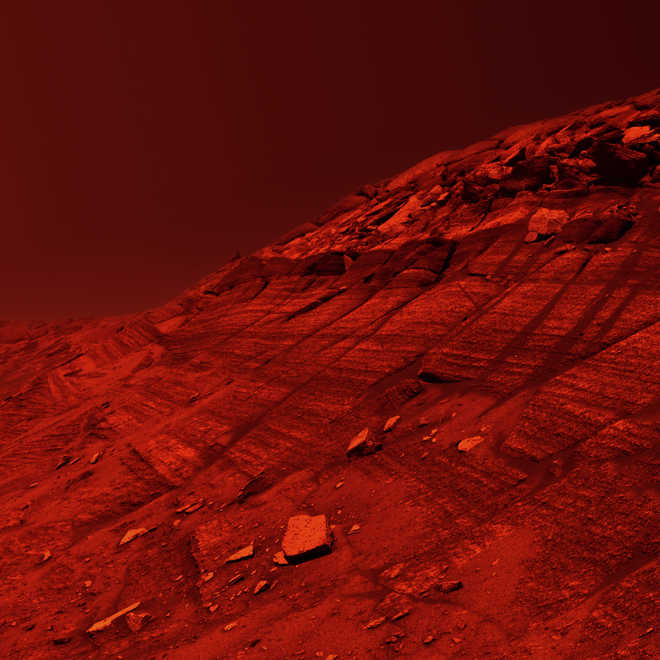
Mars appears red because its surface is coated with iron-rich dust and rock.
If you’ve ever seen an old garden tool, a rusty fence, or a piece of metal left outside in the rain, you’ve already seen the process responsible for Mars’ color.
When iron combines with oxygen, it forms iron oxide, more commonly known as rust.
Over billions of years, iron minerals on the Martian surface reacted with oxygen. This produced enormous amounts of iron oxide dust that now covers much of the planet.
When sunlight strikes Mars and reflects into space, that rusty dust gives the planet its distinctive reddish appearance.
Simply put, Mars appears red because of its iron oxide, or rust, coating.
Understanding how Mars became so rusty takes us back billions of years.
The story goes back billions of years.
Scientists believe that early Mars was very different from the cold, dry world we see today. Evidence suggests that liquid water once flowed across its surface.
Rivers carved valleys. Lakes filled impact basins. There may even have been vast oceans.
Water plays an important role in oxidation.
As iron-rich rocks interacted with water and oxygen over immense periods of time, the oxidation process gradually transformed the surface.
Over time, powerful Martian dust storms spread this rusty material across huge areas of the planet.
Some of these storms are so large that they can cover the entire planet for weeks or even months.
As a result, much of Mars became coated in the fine red dust we observe today.
So, is Mars actually bright red to the naked eye? Not exactly.
Photographs often make Mars appear much redder than it looks through the human eye.
NASA images are often enhanced to reveal surface details, which can give the impression that Mars is uniformly bright red.
To observers on Earth, Mars usually appears reddish-orange rather than bright red.
Its color can vary depending on:
- Atmospheric conditions
- Light pollution
- How high Mars is above the horizon
- Weather conditions on Earth
- The brightness of the surrounding sky
The important point is that Mars always shows a noticeable reddish tint, but how red it looks can change depending on all these conditions. From most perspectives, it often appears a subtle reddish-orange rather than a strong red.
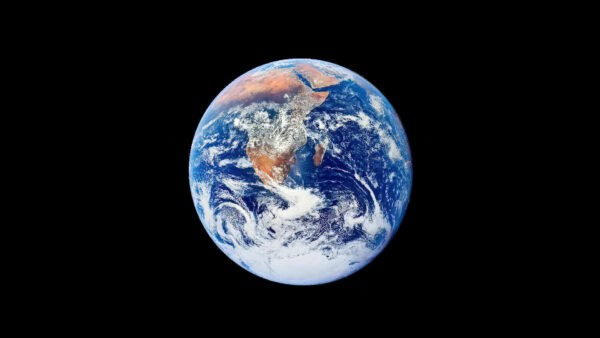
Why isn’t Earth red, too?
This is a fascinating question.
After all, Earth contains enormous amounts of iron as well.
So why isn’t our planet red?
The answer is that Earth has a very active geological and environmental system.
Wind, rain, oceans, vegetation, and plate tectonics constantly reshape Earth’s surface. Plants cover large areas of land. Water erodes rocks. New material is continually exposed.
Mars lacks most of these processes.
Without abundant liquid water, forests, oceans, and active plate tectonics, the rusty dust remains exposed on the surface.
As a result, Mars displays its iron oxide coating far more clearly than Earth does.
Why does Mars sometimes look brighter than at other times?
One thing beginners often notice is that Mars doesn’t always appear equally bright.
Sometimes it is one of the brightest objects in the night sky.
Other times it can be difficult to spot.
This happens because both Earth and Mars orbit the Sun at different distances and speeds.
As the two planets move around the Sun, the distance between them constantly changes.
When Earth and Mars are relatively close together, Mars appears brighter and larger.
Astronomers call one particularly favorable alignment an opposition. During opposition, Earth sits between Mars and the Sun, providing some of the best viewing opportunities.
These periods are excellent times for beginners to observe Mars.
With that in mind, can you see Mars without a telescope? Absolutely.
In fact, Mars is one of the easiest planets for beginners to identify with the naked eye.
When conditions are favorable, Mars appears as a bright reddish point of light.
Unlike many stars, which twinkle noticeably due to Earth’s atmosphere, Mars usually shines with a steadier light.
This combination of color and steady brightness helps distinguish it from nearby stars.
A telescope certainly reveals more detail, but you don’t need one to enjoy observing Mars.
If you use a telescope, what can you expect Mars to look like?
This is often one of the first questions new telescope owners ask.
Through a small beginner telescope, Mars appears as a tiny orange-red disc rather than a point of light.
During favorable viewing periods, experienced observers may notice:
- Dark surface markings
- Polar ice caps
- Variations in color across the surface
However, Mars is much smaller than many beginners expect.
The stunning close-up images seen online come from spacecraft orbiting the planet, not from backyard telescopes.
Even so, seeing the actual disc of another planet with your own eyes is an unforgettable experience.
A Fascinating Mars Fact
Mars is home to the largest volcano in the Solar System.
Known as Olympus Mons, it rises approximately 22 kilometers (13.6 miles) above the surrounding terrain.
That’s nearly three times the height of Mount Everest.
The volcano is so large that its base would cover an area roughly the size of Arizona.
Final Thoughts
Mars has fascinated humanity for thousands of years, and its distinctive color remains one of the reasons it continues to capture our attention today.
The next time you spot a reddish object shining in the night sky, you’ll know that you’re looking at a world covered in iron-rich dust that has slowly rusted over billions of years.
That rusty surface reflects sunlight back toward Earth, creating the color that earned Mars its famous nickname: the Red Planet.
For beginner astronomers, Mars offers something special. It isn’t just another point of light in the sky. It’s a neighboring world with a story written across its surface, waiting to be discovered every time you look up.

For more expert advice and information