Why does the Moon look bigger?
Why does the Moon look bigger near the horizon? Learn the science behind the Moon Illusion and why your eyes can be fooled.
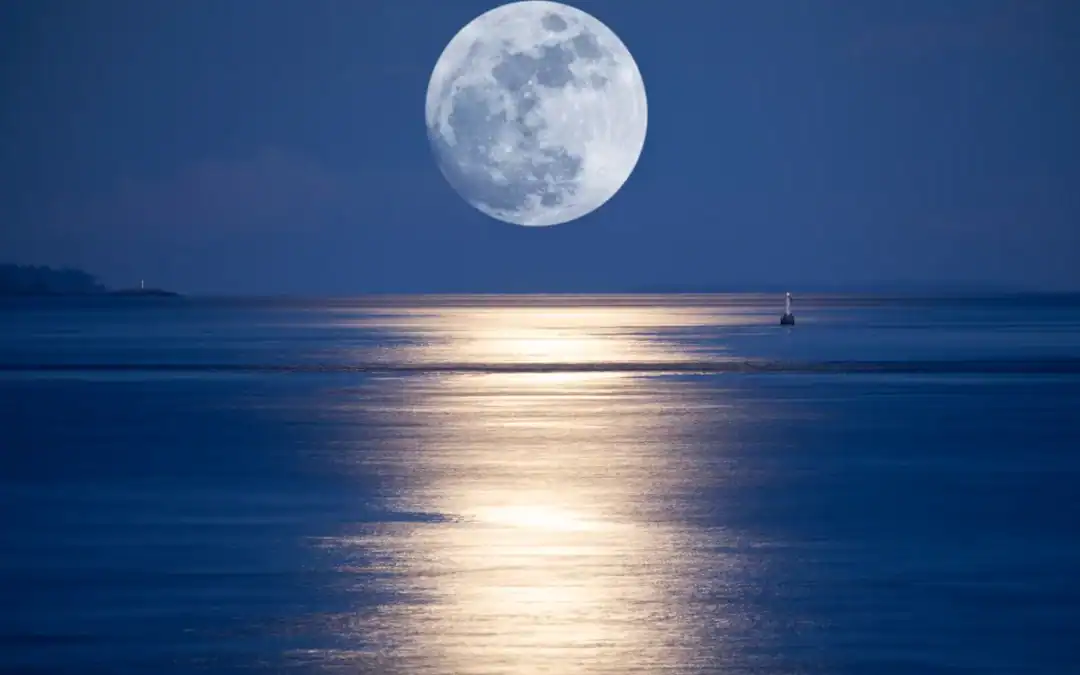
Have you ever stepped outside on a clear evening and noticed a huge Moon rising above the horizon?
Perhaps it appeared above distant trees, hills, or rooftops. It looked enormous. Almost unreal. Large enough to dominate the entire landscape.
Then, a few hours later, you glanced up again, and something strange had happened.
It now appears normal.
Smaller and less dramatic.
Less dramatic.
So what happened as the evening went on?
Did the Moon actually shrink?
Was it an illusion?
Or was something happening in the sky that most people never notice?
This is one of the oldest and most fascinating questions in astronomy. People have been asking it for thousands of years, and even today, it remains one of the most remarkable examples of how our brains interpret the world around us.
To understand, let’s start with a surprising fact.
The Moon is not actually bigger near the horizon.
The Moon Doesn’t Change Size During The Night
Most people assume that the Moon physically becomes larger when it rises.
It certainly looks that way.
However, careful measurements show that the Moon remains almost exactly the same apparent size throughout the night.
In fact, there’s an even stranger twist.
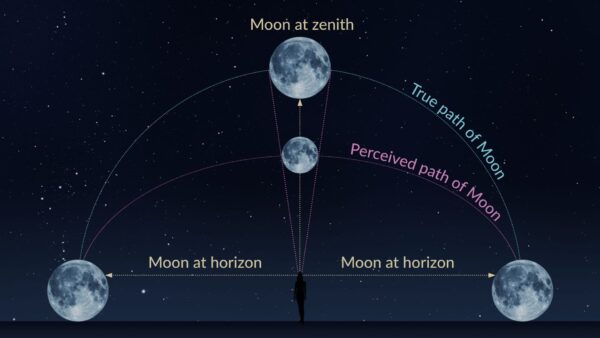
When the Moon is sitting on the horizon, it is actually slightly farther away from you than when it is directly overhead.
Think about it.
When the Moon is high above your head, you are standing on the side of Earth closest to it.
When the Moon is on the horizon, the distance is slightly greater because you are viewing it across the curve of Earth.
The difference is small, but it proves an important point.
The large Moon you see near the horizon is not a result of the Moon increasing in size.
The change is happening inside your mind.
To explain what’s happening, let’s introduce the concept behind this phenomenon.
Astronomers and psychologists have a name for this phenomenon.
It is called the Moon Illusion.
The Moon Illusion is when the Moon seems much larger near the horizon than when it is high up, but its size actually stays the same.
What makes this so fascinating is that virtually everyone experiences it.
It doesn’t matter where you live.
Whether you’re an astronomer or a newcomer, the illusion affects almost everyone.
The illusion affects almost everyone.
For centuries, people assumed the Moon was actually changing size.
Yet even knowing it’s an illusion, our brains experience it.
Yet even when we know the illusion exists, our brains still experience it.
That’s how powerful it is.
People Have Been Arguing About This For More Than 2,000 Years
The Moon Illusion is not a modern discovery.
More than 2,000 years ago, the ancient Greek philosopher Aristotle wrote about it.
He noticed the same thing you notice today.
A Moon near the horizon appeared larger than a Moon high overhead.
Over the centuries, countless scholars, astronomers, philosophers, and psychologists have tried to explain exactly why this happens.
What’s remarkable is that there is still no single explanation that satisfies everyone.
Scientists agree that the Moon isn’t actually changing size.
The main question is how the brain creates the illusion, not whether the Moon changes size.
That makes the Moon Illusion one of the oldest unsolved puzzles in visual perception.
Why Your Brain Thinks The Moon Is Larger
To understand the illusion, we need to understand how humans judge size.
Your brain rarely measures objects directly.
Instead, it compares them to other objects.
When the Moon is high overhead, it floats in an empty expanse of sky.
There are no nearby reference points.
Nothing helps your brain judge its size.
But when the Moon is close to the horizon, everything changes.
Suddenly, the Moon appears near:
- Trees
- Buildings
- Mountains
- Houses
- Roads
- Power poles
Your brain automatically compares the Moon to these familiar objects.
Because the Moon appears beyond them and much farther away, your brain concludes it must be enormous.
The result is a Moon that appears dramatically larger than it really is.
Why The Horizon Plays Tricks On Your Mind
Another important factor involves distance perception.
Humans instinctively perceive the horizon as extremely distant.
When the Moon sits on the horizon, your brain interprets it as occupying this distant region of space.
When the Moon appears farther away at the horizon but keeps the same visual size, your brain makes it seem larger.
Think of it like this.
If two objects appear identical in size, but one seems farther away, your brain assumes the distant object must actually be larger.
This mental shortcut works well in everyday life.
But with the Moon, it creates a powerful illusion.
The Upside-Down Moon Experiment
Here’s something fascinating you can try yourself.
The next time you see a huge Moon near the horizon, bend over and look at it upside down through your legs.
It sounds ridiculous.
But many people report that when they look at the Moon upside down, it suddenly appears much smaller and closer to its true size than it did before.r.
Why?
Because viewing the scene upside down disrupts the normal visual cues your brain uses to judge distance and size.
Without those cues, the illusion weakens.
The Moon itself hasn’t changed.
Only your perception has.
It’s one of the simplest and most surprising astronomy experiments you can perform.
Why Cameras Never Capture What You Saw
Have you ever tried photographing a giant Moon rising over the horizon?
Most people have.
And most people are disappointed by the result.
The Moon looked enormous to your eyes.
But in the photograph, it appears tiny.
This happens because cameras don’t experience the Moon Illusion.
A camera records the physical scene.
Your brain interprets the scene.
The dramatic size difference exists largely in your perception.
That’s why photographers often use long telephoto lenses when photographing moonrises. These lenses compress distance and recreate some of the visual impact our brains naturally experience.
Of course, you might wonder:
Can the Moon ever actually look bigger for a different reason?
Surprisingly, yes.
But not because it’s near the horizon.
The Moon follows an elliptical orbit around Earth.
That means its distance changes slightly throughout the month.
When the Moon is closest to Earth, it is called perigee.
When it is farthest from Earth, it is called the apogee.
A Full Moon occurring near perigee is often called a Supermoon.
During a Supermoon, the Moon can truly appear larger and brighter than usual.
However, this effect is completely separate from the Moon Illusion.
Many people confuse the two.
One is a real change in distance.
The other is a trick of perception.
Why The Moon Often Looks Orange Near The Horizon
Another reason the horizon Moon appears so dramatic is its color.
Near the horizon, moonlight must travel through much more of Earth’s atmosphere before reaching your eyes.
The atmosphere scatters shorter blue wavelengths more effectively.
The remaining light appears more orange, yellow, or reddish.
This is the same reason sunsets often appear red.
The combination of a large-looking Moon and a warm orange color creates one of the most beautiful sights in astronomy.
It’s no wonder people stop and stare.
What The Moon Illusion Teaches Beginner Astronomers
One of the most valuable lessons in astronomy is learning that things are not always what they seem.
The Moon Illusion reminds us that observation and understanding are two different things.
You noticed something unusual.
You became curious.
You asked a question.
That simple process is exactly how astronomy begins.
Every great discovery starts with someone looking up and wondering why.
The Moon Illusion is a perfect example.
Final Thoughts
The next time you see a giant Moon rising above the horizon, you’ll know you’re witnessing one of the most famous visual illusions in nature.
The Moon isn’t actually becoming larger.
Your brain is interpreting the scene, so it appears larger than it really is.
Far from making the experience less magical, understanding the Moon Illusion makes it even more fascinating.
It reminds us that astronomy is not only about planets, stars, and galaxies.
Sometimes the greatest mysteries begin with something as simple as looking up and asking:
“Why does that look different tonight?”

For more expert advice and information