Solar and Lunar Eclipses Explained
Never look directly at the Sun without proper solar eye protection, even during a partial solar eclipse. If you use a telescope, binoculars, or a camera to observe the Sun, a purpose-made solar filter must be securely fitted over the front of the optics before you point the equipment towards it.
An eclipse can be one of the most memorable sights in astronomy.
Sometimes the Sun appears to lose part of its familiar round shape. On other occasions, the Moon gradually darkens and turns a striking copper-red color.
Both events happen because the Sun, Earth, and Moon align in particular ways.
But there’s one important difference every beginner needs to understand.
A lunar eclipse is completely safe to watch with your naked eyes. A solar eclipse requires special precautions to protect your eyesight.
Let’s look at what happens during each event and how to enjoy them safely.
What is the difference between a solar eclipse and a lunar eclipse?
Although their names sound similar, solar and lunar eclipses are two different events.
Solar eclipse: The Moon moves in front of the Sun
A solar eclipse occurs when the Moon passes between Earth and the Sun.
From certain places on Earth, the Moon appears to cover part or all of the Sun’s bright surface.
There are three main types.
Partial solar eclipse: The Moon covers only part of the Sun, making it look as though a piece has been taken from its edge.
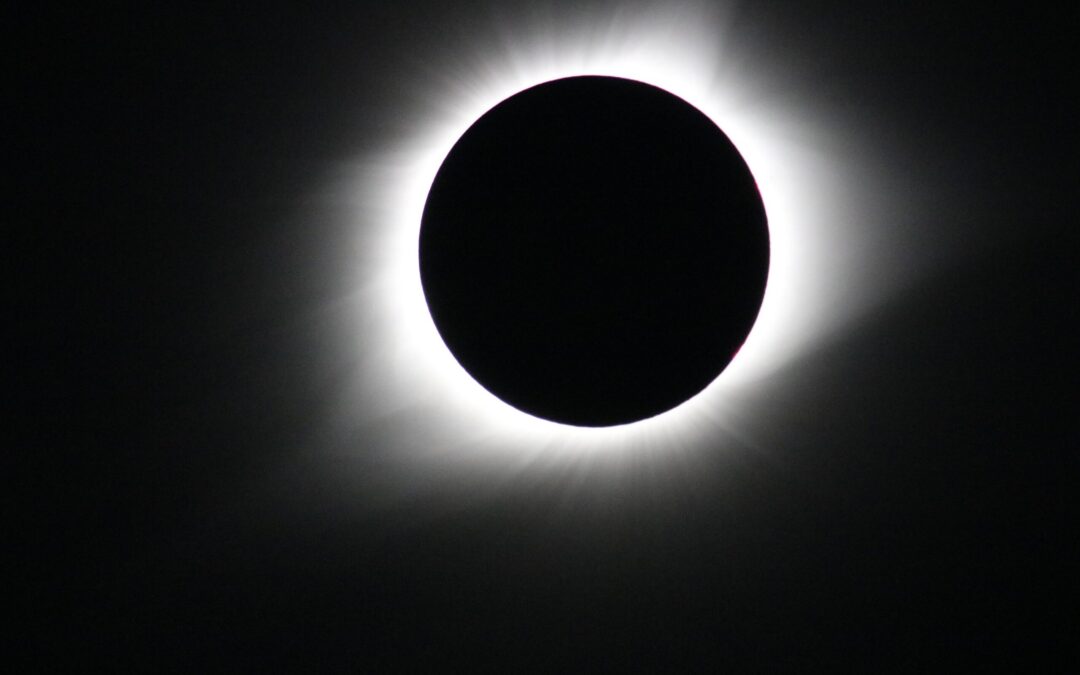
Total solar eclipse: The Moon completely covers the Sun’s bright face for a short period, allowing observers within a narrow path on Earth to experience totality.
Annular solar eclipse: The Moon passes directly in front of the Sun but appears slightly too small to cover it completely, leaving a bright ring around its edge.
During partial and annular eclipses, the Sun remains dangerous to look at directly without proper solar eye protection.
The same applies to the partial stages before and after totality.
Lunar eclipse: Earth casts its shadow on the Moon
A lunar eclipse happens when Earth moves between the Sun and the Moon.
Earth blocks some or all of the sunlight that would normally illuminate the Moon.
As the Moon passes into Earth’s shadow, it may gradually darken.
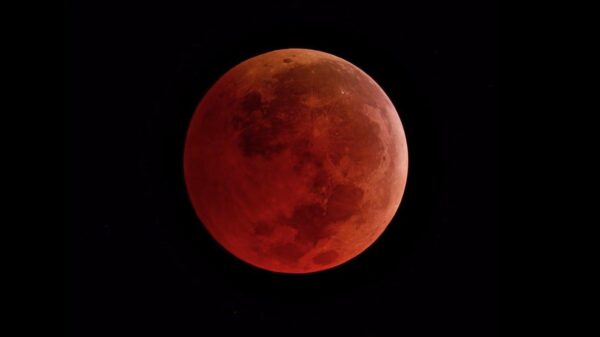
During a total lunar eclipse, the Moon can take on a reddish or copper color.
This happens because sunlight passing through Earth’s atmosphere is scattered and refracted, allowing some reddish light to reach the Moon.
It’s the same general reason that sunsets often appear red or orange.
You can watch every stage of a lunar eclipse safely with your naked eyes.
You can also use binoculars or a telescope without any special solar filter, because you’re observing the Moon at night rather than looking towards the Sun.
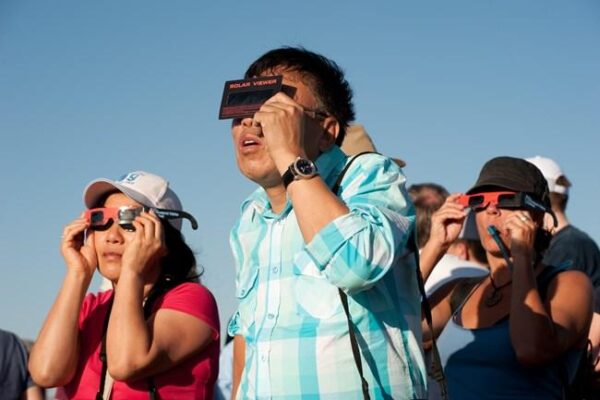
“How to watch a solar eclipse safely.”
How to watch a solar eclipse safely
The most important part of solar eclipse observing is choosing the correct protection.
Ordinary sunglasses are not suitable, regardless of how dark their lenses appear.
Neither are smoked glass, exposed photographic film, or homemade filters.
For direct viewing without magnifying equipment, use eclipse glasses or a handheld solar viewer that meets the ISO 12312-2 safety standard.
Buy them from a reputable supplier and follow the manufacturer’s instructions.
Before using them, inspect the material carefully.
If the filter is scratched, torn, punctured, or damaged, don’t use it.
Put your eclipse glasses on before looking towards the Sun. When you’ve finished, turn away from the Sun before removing them.
Children should always be supervised.
Never use eclipse glasses behind a telescope eyepiece.
This is especially important for anyone who already owns a telescope.
Eclipse glasses are designed for direct viewing with your eyes, not for looking through a telescope, binoculars, or camera lens.
These optical instruments concentrate sunlight.
The concentrated light can damage the material in eclipse glasses and cause severe, permanent eye injury.
A telescope or binoculars used for solar viewing must have a properly designed solar filter securely fitted over the front, where sunlight enters the instrument.
A camera lens also needs a suitable front-mounted solar filter.
The filter must be specifically designed for the instrument and securely attached so it cannot fall off during use.
Never rely on a small filter screwed into an eyepiece.
If you’re uncertain whether your equipment or filter is suitable, don’t point it at the Sun. Ask an experienced solar observer or qualified astronomy equipment specialist for guidance.
Red Moon
What about the total phase of a solar eclipse?
There is one narrow exception to the rule about looking directly at the Sun.
During the brief period of totality, when the Moon completely covers the Sun’s bright face, observers within the path of a total solar eclipse can look directly at the eclipsed Sun without solar viewing glasses.
This exception applies only to the fully total phase and only to direct viewing with your eyes.
As soon as even a small part of the bright Sun begins to reappear, you must use proper solar eye protection again.
This does not apply to partial or annular eclipses, and it does not mean you can use unfiltered telescopes, binoculars, or cameras.
For beginners, the safest approach is to follow official eclipse timing and viewing instructions for your exact location.
Can you watch a solar eclipse without eclipse glasses?
Yes, by using an indirect viewing method that doesn’t involve looking towards the Sun.
One of the simplest methods is a pinhole projector.
A small hole in a piece of cardboard allows sunlight to pass through and form an image of the Sun on another surface.
During a partial solar eclipse, that projected image shows the Sun’s changing shape.
You watch the projected image, not the Sun itself.
Keep your back to the Sun while setting up and using the projector.
Never look through the pinhole towards the Sun.
NASA provides instructions for safe indirect viewing on its Eclipse Viewing Safety page.
Another option is to watch a live broadcast from a recognized observatory or space agency.
You can enjoy the event without risking your eyesight.
Lunar eclipse
How to watch a lunar eclipse
Lunar eclipses are much simpler for beginners.
You don’t need special glasses, filters or expensive equipment.
Find a spot with a clear view of the Moon, check the predicted eclipse times for your location, and give yourself enough time to watch the changes.
Unlike a brief meteor, a lunar eclipse unfolds gradually.
You may notice Earth’s shadow beginning to move across the Moon’s surface.
During a total lunar eclipse, the Moon can become noticeably darker and change color.
Some eclipses produce a deep red Moon. Others appear copper, orange or brown.
The exact appearance varies depending on conditions in Earth’s atmosphere.
Do you need a telescope?
No.
A lunar eclipse is perfectly enjoyable with your naked eyes.
However, binoculars can make the changing shadows easier to appreciate.
A small beginner telescope can provide a closer view of the Moon’s surface as the eclipse progresses.
You don’t need a solar filter to observe a lunar eclipse because you’re looking at the Moon, not the Sun.
If you’re using a telescope for the first time, practice setting it up and finding the Moon before the eclipse begins.
That way, you can spend more time enjoying the event and less time adjusting equipment.
Why don’t eclipses happen every month?
The Moon orbits Earth about once every month.
So why don’t we experience a solar eclipse at every new Moon and a lunar eclipse at every full Moon?
The answer is that the Moon’s orbit is tilted by about five degrees relative to Earth’s orbit around the Sun.
Most months, the three bodies don’t line up closely enough to produce an eclipse.
A solar eclipse happens when the alignment is right around the new Moon.
A lunar eclipse happens when the alignment is right around full Moon.
These special alignments occur during periods known as eclipse seasons.
That’s why eclipses happen several times a year somewhere on Earth, rather than every month.
Where can you find upcoming eclipse dates?
Eclipse visibility depends on where you live.
A solar eclipse may be visible from one country but not another.
A lunar eclipse can be seen from a much larger part of Earth, as long as the Moon is above the horizon during the event.
Before making plans, check an authoritative eclipse calendar.
NASA provides information about upcoming solar and lunar eclipses, including maps and viewing guidance.
Check the dates and local viewing times before traveling or arranging an observing session.
And for solar eclipses, always review the official safety guidance rather than relying on general advice from social media.
Your next step into astronomy
An eclipse can be a wonderful introduction to the night sky.
Watching Earth’s shadow move across the Moon gives you a direct sense of how our planet, the Moon and the Sun move through space.
And once you’ve seen the Moon through binoculars or a telescope, there’s plenty more to explore.
If you’re preparing to use a telescope for the first time, our First Night With Your Telescope guide explains how to set it up, find your first objects and avoid common beginner frustrations.
Remember that ordinary night-time telescope observing and solar observing require very different safety precautions.
Enjoy lunar eclipses freely. Treat every solar eclipse with the respect your eyesight deserves.
A little knowledge makes both experiences more rewarding—and ensures the memories you take away are good ones.
Explore beginner telescopes,binoculars and best stargazing apps for beginners here: