Seeing Saturn Without A Telescope?
Learn what seeing Saturn without a telescope is really like, how to find it in the night sky, and what beginners should expect.
For many people, Saturn is the planet that first sparks an interest in astronomy.
Even those who know very little about the night sky can usually recognize Saturn’s distinctive appearance. The image of a pale golden planet surrounded by magnificent rings has appeared in books, magazines, documentaries, websites, and science classrooms for generations. It has become one of the most recognizable objects in our solar system and, for many people, one of the most fascinating.
At some point, curiosity naturally follows.
People begin to wonder whether Saturn is actually visible from Earth and whether they can see it for themselves. This often leads to a surprisingly common question.
Can you really see Saturn without a telescope?
The answer is yes.
Human beings have been observing Saturn with the naked eye for thousands of years. Long before telescopes were invented, ancient civilizations watched Saturn move slowly among the stars and recognized that it behaved differently from the fixed patterns surrounding it.
However, while Saturn can certainly be seen without a telescope, understanding what you are actually looking at is important. The view most people expect and the one they actually experience are often very different.
This difference between expectation and reality is one of the most important lessons beginner astronomers can learn.
Why Saturn Has Captured Human Attention For Thousands Of Years
Long before astronomy became a science, people were already studying the night sky.
Ancient observers noticed that most stars appeared fixed in familiar patterns. The constellations changed position throughout the seasons, but the stars within those constellations remained arranged in predictable ways.
A small number of bright objects behaved differently.
These objects wandered slowly through the sky over weeks, months, and years. Because they moved against the background stars, ancient astronomers eventually called them “wanderers.” The word planet itself comes from the Greek word planetes, meaning wanderer.
Saturn was one of these wandering objects.
Unlike modern observers, ancient civilizations had no understanding of planets orbiting the Sun. They could not know that Saturn was a giant gas world located nearly 1.5 billion kilometers from Earth. What they did know was that it moved differently from the stars around it.
This unusual behavior made Saturn significant in many cultures.
The Romans associated Saturn with their god of agriculture and time. Babylonian astronomers carefully tracked its movements. Ancient Chinese astronomers recorded its position in detailed sky records. Across different cultures and centuries, Saturn remained one of the most important objects visible in the heavens.
What makes this remarkable is that the same planet those ancient observers watched is still visible to us today.
When you locate Saturn in the night sky, you are participating in an observational tradition that stretches back thousands of years.
Can You See Saturn With The Naked Eye?
The simple answer is yes.
Under suitable conditions, Saturn can often be seen without any optical equipment at all.
However, this answer requires some explanation because many beginners imagine something very different from reality.
When people ask whether they can see Saturn, they are often picturing the famous photographs they have seen online. They imagine seeing a miniature version of those images hanging in the sky, complete with rings and obvious planetary detail.
That is not what happens.
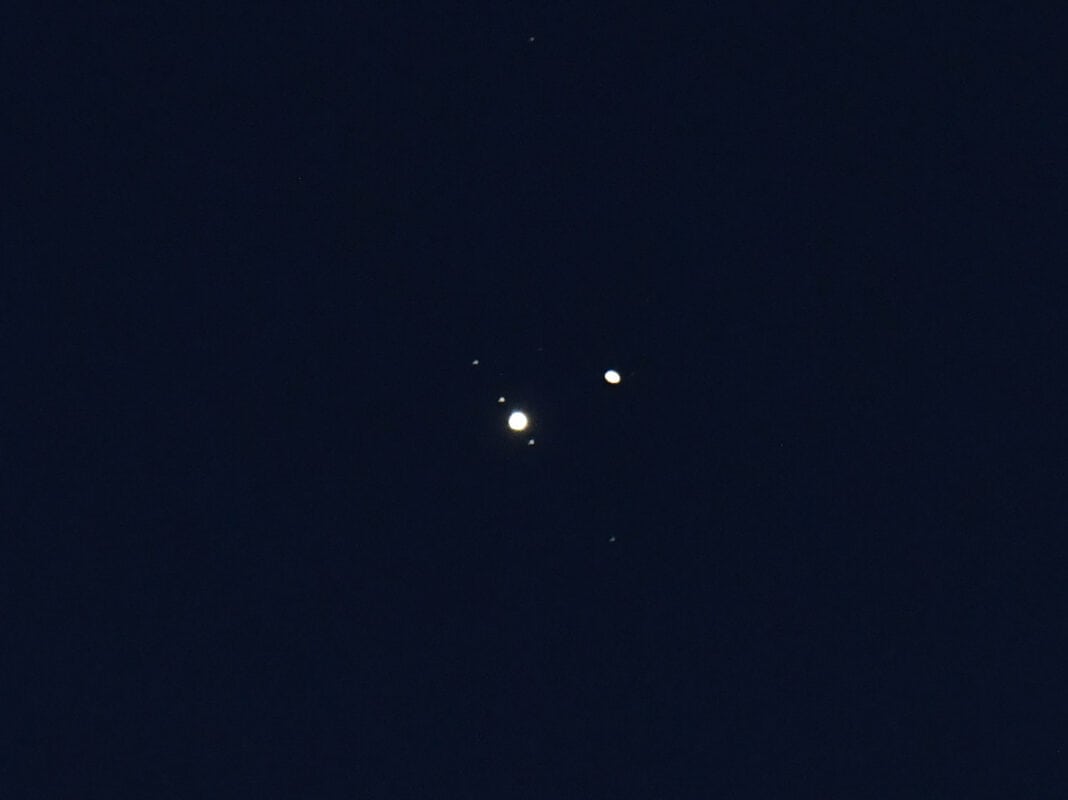
To the naked eye, Saturn appears as a bright point of light. It does not reveal its rings. It does not show cloud bands. It does not appear as a tiny disc suspended among the stars.
Instead, it looks surprisingly star-like.
This often disappoints beginners initially, but it shouldn’t.
The fact that you can see a planet located nearly one and a half billion kilometers away without any equipment is extraordinary in itself.
The challenge is learning to appreciate what you are actually observing rather than comparing the experience to highly processed astrophotography images.
Expectations Versus Reality
One of the biggest obstacles facing beginner astronomers is expectation.
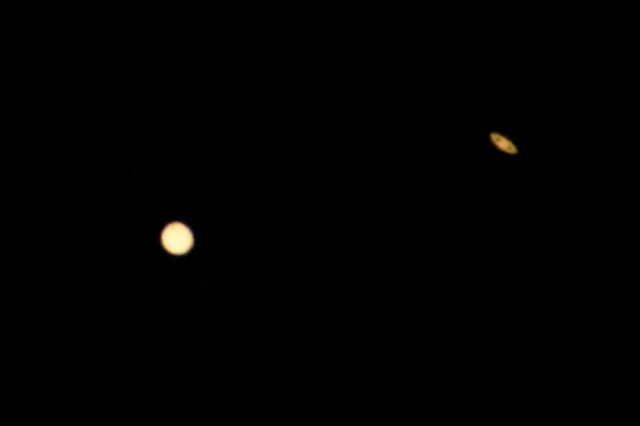
Modern astronomy photography is astonishing. Advanced cameras, computer processing, long-exposure techniques, and powerful telescopes produce images of Saturn that reveal details the human eye cannot see directly.
These photographs are beautiful, but they can unintentionally create unrealistic expectations.
A beginner may spend an evening searching for Saturn, expecting to see a spectacular ringed planet shining clearly in the sky. After finally locating it, they discover what appears to be little more than a bright point of light.
Some people assume they have found the wrong object.
Others conclude that astronomy is disappointing.
Neither conclusion is correct.
The reality is that observing and photography are two entirely different experiences.
Photography is designed to collect light over long periods of time and reveal details invisible to the human eye.
Observing is about experiencing the object directly.
Once beginners understand this distinction, astronomy becomes much more enjoyable. The goal is no longer to reproduce a photograph. The goal is to understand what you are looking at and appreciate the fact that you are observing a real world moving through our solar system.
In many ways, knowledge transforms the experience.
A bright point of light becomes far more interesting when you understand that it is a giant planet surrounded by rings, orbiting the Sun nearly ten times farther away than Earth.
Final Thoughts
So, can you really see Saturn without a telescope?
Yes, you can.
On a clear night, Saturn is often visible as a bright point of light moving slowly among the stars, just as it has appeared to observers for thousands of years.
But perhaps the more interesting discovery is that seeing Saturn is not really the point.
The real value lies in what happens when you begin looking for it.
At first, Saturn may appear no different from many of the other bright objects in the sky. Yet as you learn more about what you are observing, that small point of light begins to take on new meaning. You realize you are looking at a giant world nearly ten times farther from the Sun than Earth, surrounded by a vast ring system and accompanied by dozens of moons.
Knowledge transforms the experience.
What once looked like an ordinary star becomes a destination in the solar system.
This is one of the reasons astronomy remains such a rewarding hobby. The night sky has not changed. Saturn has always been there. What changes is our understanding of what we are seeing.
For many beginner astronomers, finding Saturn becomes an important milestone. It marks the moment when the night sky stops being a collection of random lights and starts becoming a place filled with recognizable objects, stories, and discoveries.
Some people will go on to view Saturn through binoculars.
Others will eventually observe it through a telescope and see the rings for the first time.
Many will remember that moment for the rest of their lives.
But every one of those experiences begins in the same way.
By stepping outside, looking up, and learning to recognize a bright world shining quietly among the stars.
🔭 White Star Outdoors
Helping beginner astronomers understand the night sky with confidence.

For more expert advice and information