Can Beginners see Saturn’s Rings and Jupiter’s Moons?
Imagine looking through a telescope for the first time and seeing Saturn’s rings surrounding a tiny golden planet.
Or finding Jupiter in the night sky and discovering several bright points of light lined up beside it — moons orbiting another world millions of miles away.
These are two of the most memorable experiences in beginner astronomy. And unlike the colorful photographs of distant galaxies that appear in telescope advertisements, they’re experiences you can genuinely enjoy with modest equipment.
Yes, beginners can see Saturn’s rings and Jupiter’s four largest moons. You don’t need an expensive observatory telescope.
But you do need realistic expectations, suitable equipment, and a little understanding of when and where to look.
Here’s what you can expect to see, how to find both planets, and how to make your first observing session worthwhile.
Can you really see Saturn’s rings through a beginner telescope?
Yes. Saturn’s rings are visible through many small telescopes when the planet is well positioned, and the atmosphere is reasonably steady.
With a suitable beginner telescope at approximately 50× magnification, you may be able to distinguish Saturn’s ring system from the planet itself, although the view will be small.
At around 100× to 150×, a good telescope under favorable conditions can give a clearer impression of the rings surrounding Saturn.
However, magnification isn’t everything.
Atmospheric steadiness, the telescope’s optical quality, and the angle of Saturn’s rings all influence what you see.
What does Saturn actually look like through an eyepiece?
Forget the enormous, brilliantly coloured images you’ve seen from spacecraft.
Through a beginner telescope, Saturn usually appears as a small, pale yellow or golden globe with a delicate ring system extending on either side.
You won’t see a planet filling the entire eyepiece.
You won’t see the intricate detail captured by NASA spacecraft.
But you may recognize those rings immediately.
And there’s something remarkable about knowing you’re looking at the real planet, not a photograph.
Why Saturn’s rings look different in 2026
Saturn’s rings don’t always appear equally open from Earth.
Because Saturn’s rotational axis is tilted, our viewing angle changes as the planet travels around the Sun.
During 2025, the rings appeared almost edge-on, making them particularly difficult to distinguish.
In late 2026, they’re becoming more visible again, but they still appear relatively narrow compared with years when the rings are widely open.
This means a beginner observing Saturn in 2026 should expect a thin, recognizable ring system rather than the broad oval seen in many photographs.
Over the coming years, the rings will gradually become more open from our perspective.
The rings haven’t changed size. Our viewing angle has changed.
Can you see Jupiter’s moons through a telescope?
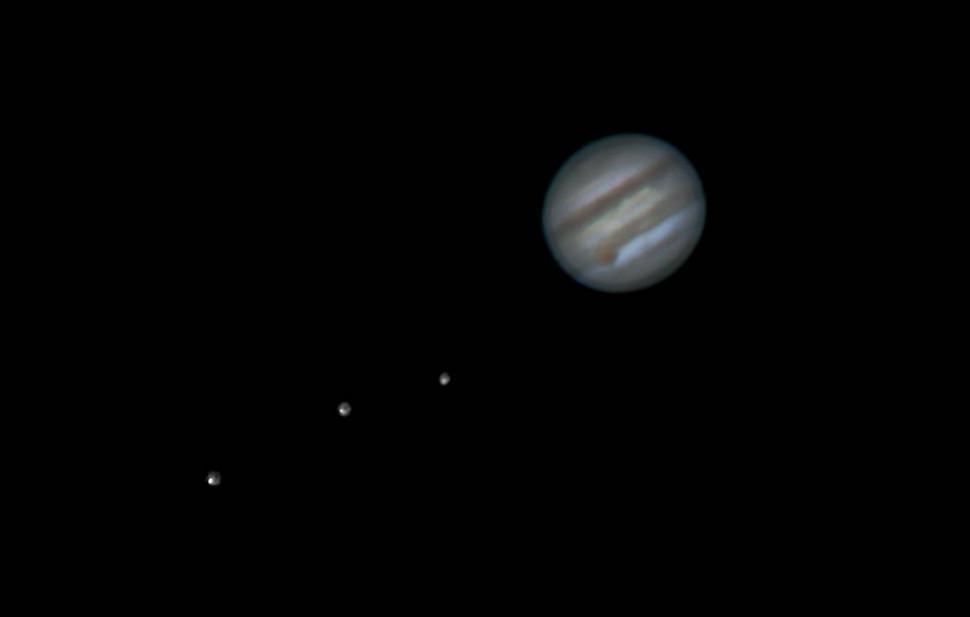
Absolutely. In fact, Jupiter’s moons can be easier to identify than some beginners expect.
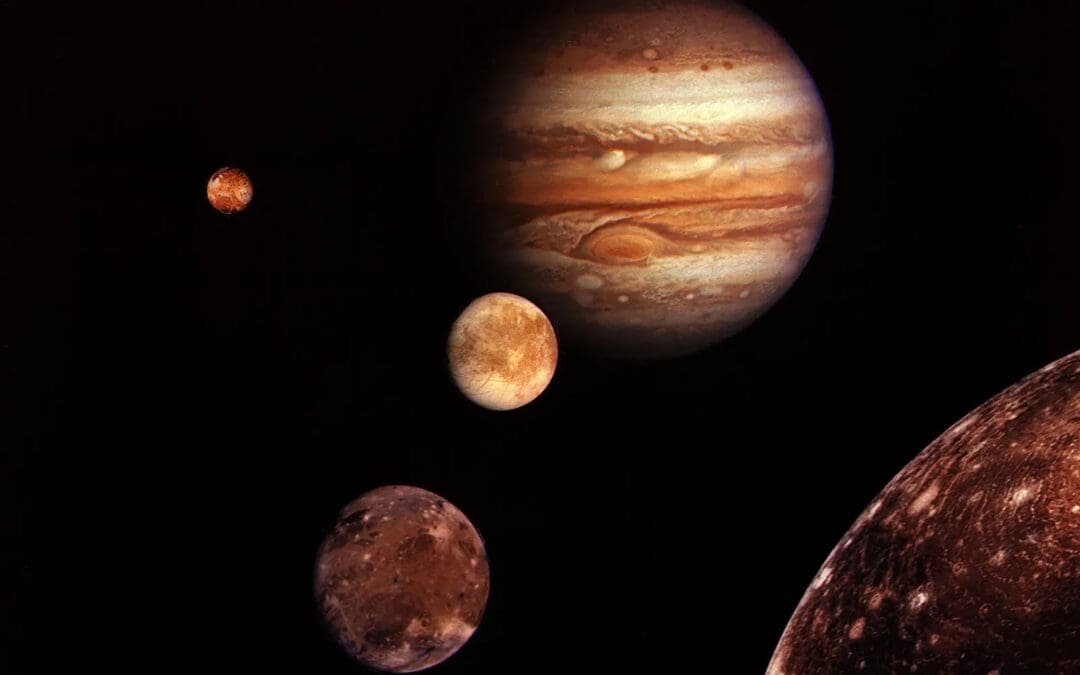
Jupiter has many moons, but four are particularly important for backyard astronomers:
- Io
- Europa
- Ganymede
- Callisto
These are known as the Galilean moons, named after Galileo Galilei, who observed them in 1610.
Through a small telescope, they appear as tiny points of light near Jupiter.
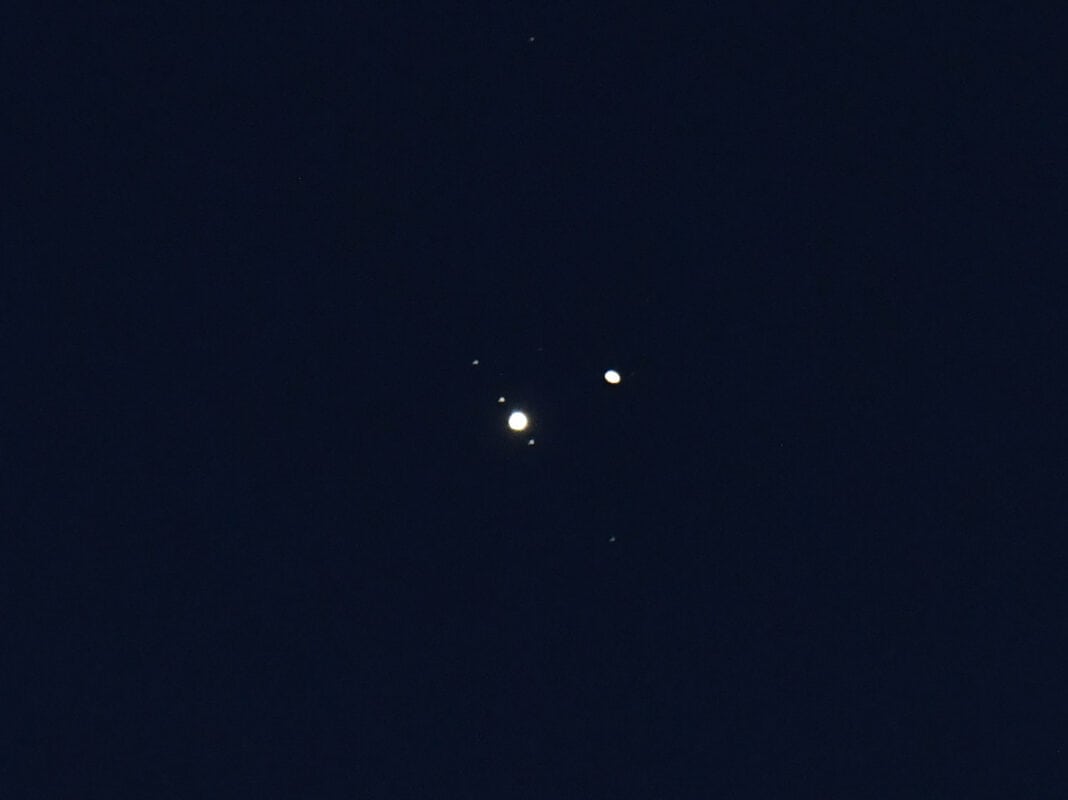
Sometimes you’ll see four. On other evenings, you may see only two or three because one or more moons are passing in front of Jupiter, behind it, or through its shadow.
Their positions change noticeably from night to night.
That’s part of what makes observing Jupiter so rewarding.
What does Jupiter look like through a beginner telescope?
Jupiter usually appears as a small, bright disc.
With a modest telescope and favorable conditions, you may distinguish two darker cloud belts stretching across its atmosphere.
The four large moons appear as tiny, star-like points arranged on either side of the planet.
They don’t look like miniature versions of our Moon. Even through substantial amateur telescopes, they generally appear as points rather than detailed worlds.
But knowing those tiny lights are actual moons orbiting Jupiter makes the view extraordinary.
Can binoculars show Jupiter’s moons or Saturn’s rings?
This is where the two planets differ.
A steady pair of 10×50 binoculars may reveal one or more of Jupiter’s Galilean moons when conditions are favorable.
A tripod or other stable support can make a significant difference.
Saturn’s rings, however, are generally beyond the resolving ability of ordinary 10×50 binoculars.
Saturn will appear as a bright point of light, while Jupiter’s nearby moons may be detectable as tiny dots.
If you’re beginning astronomy, binoculars are an excellent way to explore the sky before committing to a telescope.
What telescope do you need to see Saturn and Jupiter?
You don’t need the largest telescope in the shop.
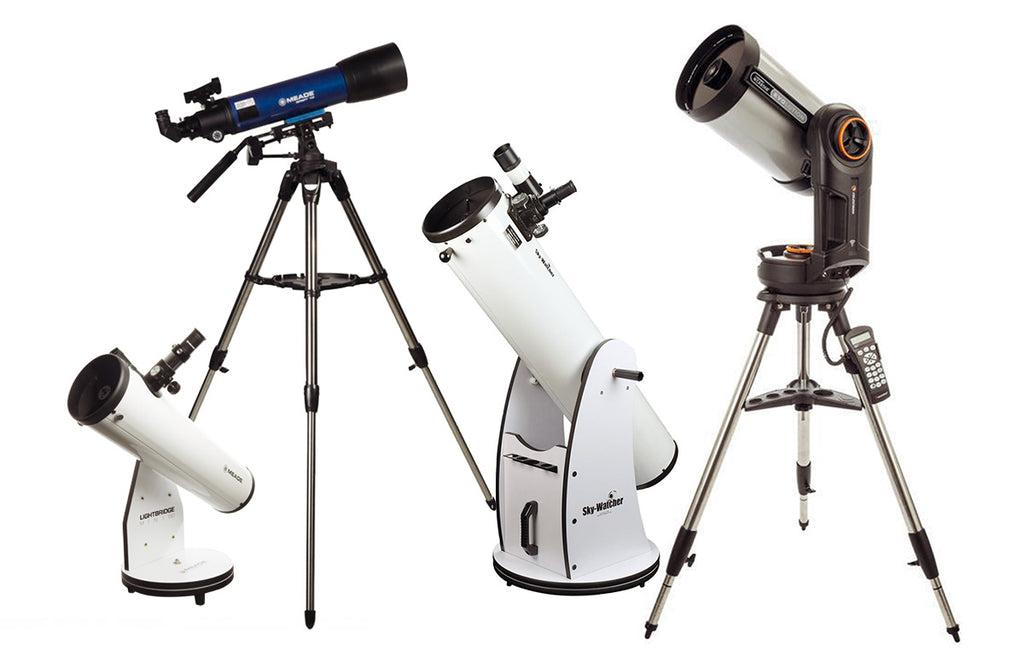
A well-made 70 mm refractor can reveal Saturn’s rings and Jupiter’s larger moons when conditions are favorable.
A 6-inch or 8-inch Dobsonian telescope can provide brighter views and greater potential for planetary detail.
Here’s how our three recommended beginner telescopes compare.
| Telescope | Saturn | Jupiter |
| Apertura AD6, 6-inch Dobsonian | Rings clearly recognizable under good conditions | Four large moons and major cloud belts |
| Apertura AD8, 8-inch Dobsonian | Greater potential for fine detail when conditions allow | More planetary detail possible in steady air |
| Celestron NexStar 5SE | Recognizable rings and useful planetary views | Moons and major cloud belts, with computerized object-finding |
Our overall beginner recommendation remains the Apertura AD8, provided you have the space and are comfortable moving and operating a manual telescope.
The AD6 is a capable alternative for a lower budget.
The NexStar 5SE is worth considering if computerized object-finding is particularly important to you.
But remember that a larger telescope doesn’t automatically produce a better view every night. Atmospheric conditions can limit even excellent equipment.
When is the best time to see Saturn and Jupiter?
Both planets change position in our sky throughout the year.
One of the best periods to observe an outer planet is around its opposition, when Earth lies approximately between that planet and the Sun.
Around opposition, the planet is generally brighter, appears larger, and remains visible for much of the night.
Saturn in late 2026
Saturn reached opposition on 4 October 2026.
During November and December, it remains a rewarding evening target, although it gradually moves towards the western sky as the season progresses.
For beginners, the best opportunity is generally when Saturn is reasonably high above the horizon, away from the atmospheric turbulence that can affect low-altitude views.
Jupiter in late 2026 and early 2027
Jupiter becomes increasingly convenient to observe during the closing months of 2026.
By November, it rises before midnight, and its visibility improves as we move towards early 2027.
Jupiter’s next opposition occurs on 11 February 2027.
That makes the months surrounding February particularly promising for observing its moons and atmospheric cloud belts.
Important: Exact rise times and observing directions depend on your location and date. Check a current sky map rather than relying on a fixed time throughout the year.
How to find Saturn and Jupiter in the night sky
You don’t need to memorize every constellation.
A free or inexpensive astronomy app can help you identify where the planets are tonight.
Stellarium Mobile and SkySafari are two useful options.
Enter your location, select the date, and search for Saturn or Jupiter.
The app will show where the planet should appear in your sky and when it rises and sets.
Finding Jupiter
Jupiter is often one of the brightest objects in the night sky.
Unlike many stars, its light usually appears relatively steady rather than strongly twinkling, although atmospheric conditions can sometimes make planets shimmer.
Once you’ve identified Jupiter with your app, look for it with the naked eye before using binoculars or a telescope.
Finding Saturn
Saturn is generally less brilliant than Jupiter and may be harder for a beginner to identify without a sky map.
Use your astronomy app to locate it, then identify nearby stars or constellations to help you aim your telescope.
Always confirm that the planet is above the horizon at your observing time.
Your first observing session: Six simple steps
1. Choose a clear evening
Look for reasonably clear skies and a night when the planet is well above the horizon.
A perfectly dark rural location isn’t essential for observing Jupiter and Saturn. Both are bright enough to be rewarding from many suburban backyards.
2. Set up your telescope before dark
Become familiar with the mount, eyepieces, and focusing controls while you can still see what you’re doing.
If you’re using a reflector, make sure its optical alignment is satisfactory.
3. Let your telescope adjust to the outdoor temperature
A telescope brought from a warm house into cool evening air may initially produce unsteady images.
Allowing the optics to approach the surrounding temperature can improve the view.
4. Start with your lowest-power eyepiece
A 25 mm eyepiece is a common starting point.
It usually provides a wider field of view than a shorter-focal-length eyepiece, making it easier to find and center a planet.
5. Increase magnification gradually
Once the planet is centered and focused, try a higher-power eyepiece.
If the image becomes soft, shaky, or difficult to focus, return to a lower magnification.
More magnification isn’t necessarily more detail.
6. Spend time looking
Don’t expect everything to appear in the first few seconds.
Atmospheric turbulence may briefly settle, revealing details that were previously difficult to distinguish.
Try observing for several minutes before changing eyepieces.
For more practical advice, follow our first-night stargazing guide.
Why do Saturn and Jupiter sometimes look blurry?
A blurry planet doesn’t necessarily mean you’ve purchased a poor telescope.
Several common factors can affect the view.
Atmospheric turbulence is one of the biggest. When layers of air move at different temperatures, they distort the light traveling from the planet to your telescope.
Observing over rooftops, roads, or buildings releasing heat can make the problem worse.
A planet low near the horizon is also viewed through more atmosphere than one high in the sky.
Other causes include an instrument that hasn’t adjusted to the outdoor temperature, imperfect focusing, excessive magnification, or misaligned optics.
The solution is often patience, careful focusing, and choosing a better observing time rather than buying another eyepiece.
Frequently asked questions
Can you see Saturn’s rings with a cheap telescope?
Some inexpensive telescopes can reveal Saturn’s rings, but optical quality and mount stability matter considerably. A well-made small telescope is generally preferable to a poorly constructed model advertising extreme magnification.
Can you see all four of Jupiter’s large moons at once?
Yes, when all four are positioned where they can be seen from Earth. At other times, one or more may be hidden behind Jupiter, crossing its disc or passing through its shadow.
Can you see Saturn’s rings at 50× magnification?
Under suitable conditions, a good telescope may reveal the ring system at approximately 50×. Higher magnification can improve the view when the atmosphere and optics support it.
Can you see Jupiter’s Great Red Spot?
It’s possible with suitable equipment and favorable atmospheric conditions, but it is considerably more challenging than seeing Jupiter’s moons or major cloud belts. The Great Red Spot must also be facing Earth during your observing session.
Do you need dark skies to see Jupiter and Saturn?
No. These bright planets can often be observed successfully from suburban locations. Atmospheric steadiness and the planets’ altitude are usually more important than escaping every streetlight.
The real reward of your first telescope
There’s a difference between seeing a photograph of Saturn and finding the planet yourself.
One is an image someone else captured.
The other is light that has traveled across the Solar System and entered your own telescope.
The same applies to Jupiter’s moons.
Those tiny points of light are worlds orbiting a distant planet, just as our Moon orbits Earth.
You don’t need expensive equipment to begin appreciating that.
You need a telescope you understand, realistic expectations, and the patience to look carefully.
Start with Jupiter’s moons. Find Saturn’s rings. Then let your curiosity lead you further.
If you’re still choosing equipment, our beginner’s telescope buying guide explains what matters before you spend your money.
If you’re preparing for your first evening under the stars, visit Start Your Stargazing Journey for beginner resources and a free guide.
Explore beginner telescopes, binoculars, and the best stargazing apps for beginners here: