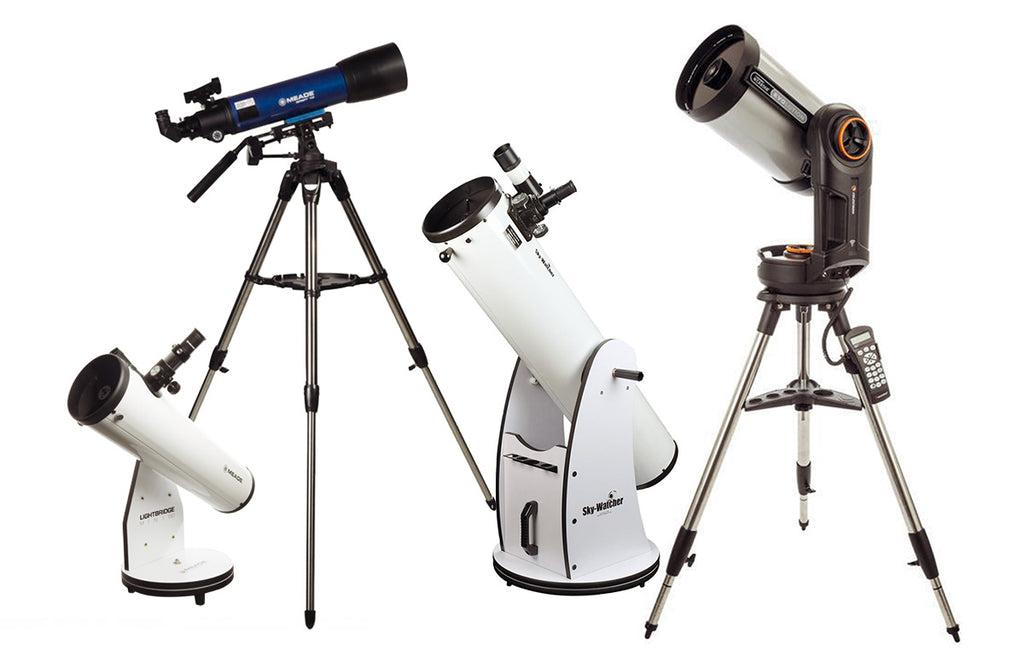
Refractor vs reflector vs Dobsonian: discover which telescope is best for beginners, how they compare, and what to avoid before buying.
For most people buying their first telescope, a Dobsonian wins—six or eight inches, hand-moved, sitting on its own sturdy base.
It wins for one reason. A Dobsonian gives you plenty of light-gathering power for your money on a mount that doesn’t shake every time you touch it. Together, those two things help decide whether a telescope gets used or lives in the garage.
Two situations change the answer. If you want something small, quick to set up, and easy to maintain, a good refractor is worth a look. If you would rather have a telescope that finds objects for you, a computerized model may suit you better.
One thing first, because it trips up nearly everyone. A Dobsonian is a reflector. Comparing a reflector with a Dobsonian is rather like comparing a car with a hatchback. The difference is what holds the telescope up.
What the three names actually mean
Every telescope does the same basic job: it collects light and brings it into focus so your eye can see detail it couldn’t see on its own.
Two things matter when comparing telescope designs. The first is how it collects light: the optics. The second is how the telescope is supported and moved: the mount.
The optics determine how the image is formed. The mount determines how easily you can point the telescope, focus it, and keep the view steady. Beginners spend a great deal of time reading about the first and often overlook the second. That is backward.
Refractor: A glass lens at the front of the tube gathers and focuses the light. No secondary mirror obstructs the center of the light path. This is the basic design Galileo used to observe Jupiter’s moons.
Reflector: A large curved mirror at the bottom of the tube gathers the light and reflects it towards a smaller mirror near the top. That second mirror directs the light sideways to the eyepiece. This is the Newtonian reflector, the design most beginners encounter.
Dobsonian: The same Newtonian reflector tube rests in a low, sturdy rocker-box mount. You move it up and down or swing it from side to side. The base is commonly made from engineered wood, although other materials are used.
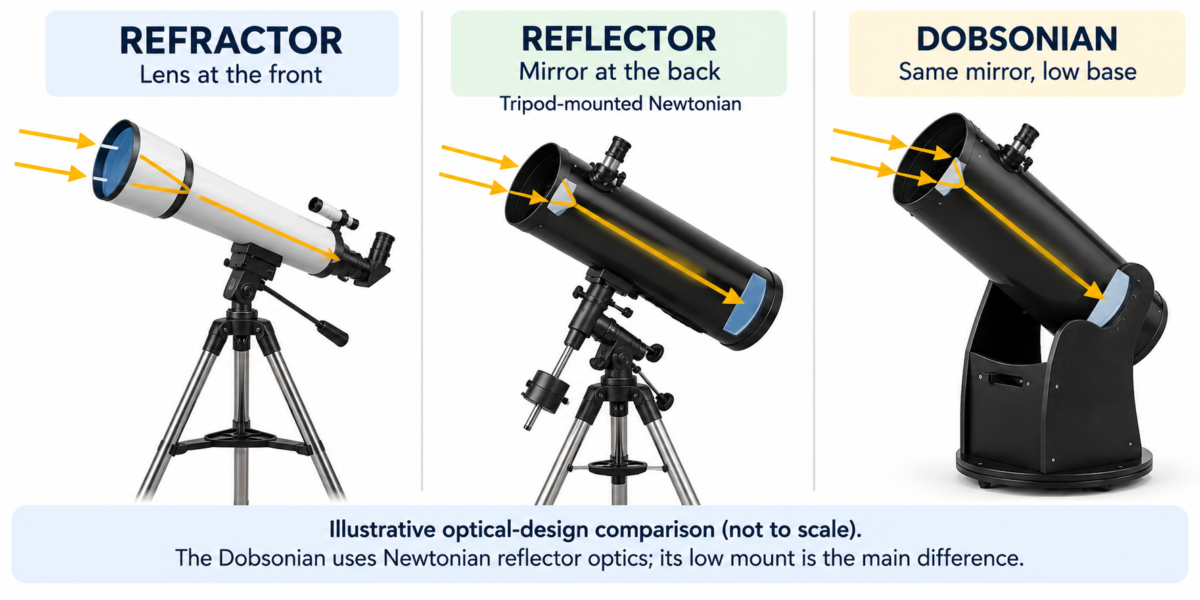
The refractor bends light with a lens. The reflector redirects it with mirrors. The Dobsonian is a reflector supported by a different kind of mount. Look at the third illustration and the confusion disappears: the optics are the same; the thing underneath changes.
Before you compare the three, forget magnification
Nearly every disappointing first telescope is sold on a number, and that number is magnification. A box advertising 525× or 600× sounds impressive. But magnification is not a measure of how much detail a telescope can actually reveal.
Aperture — the diameter of the main lens or mirror — is a much more useful starting point. Aperture determines how much light the telescope collects and influences the finest detail its optics can resolve. Magnification enlarges the image the telescope forms.
Manufacturers sometimes quote very different maximum useful magnifications for telescopes with similar apertures. Those figures reflect their own specifications and assumptions; they are not promises about what you will see on an ordinary night. The practical limit also depends on optical quality, atmospheric steadiness, the object you are observing, and how well you adjust the telescope.
If you increase magnification beyond what the conditions support, the image gets larger without revealing more detail. It becomes dimmer, softer, and harder to focus. On an unstable mount, it also shakes every time you touch the telescope.
Buy the quality of the view, not the biggest number on the packaging.
 1. The Refractor: The one everybody pictures
 1. The Refractor: The one everybody pictures
A long tube, a lens at the front, an eyepiece at the back, and relatively little routine adjustment. That is the traditional refractor.
What it does well
Refractors are known for crisp, high-contrast views, and for good reason. Unlike a Newtonian reflector, a refractor has no central obstruction in its light path. That helps preserve image contrast, particularly when the optics are well made.
A good refractor can produce remarkably sharp views for its aperture, although the final result still depends on optical quality, telescope size and atmospheric conditions.
The Moon rewards one more than almost any other target. Even a modest refractor reveals craters, mountain ranges and long shadows near the boundary between lunar daylight and darkness, known as the terminator. Around first and last quarter, those shadows make surface features particularly striking.
Jupiter’s four largest moons are visible through small refractors, and its main cloud belts become accessible with suitable aperture and steady conditions. Saturn’s rings are another realistic target, although their appearance changes with the planet’s orientation and the observing conditions.
Practical advantages matter too. The optical tube is relatively enclosed, so internal surfaces are protected from much of the dust and handling associated with an open Newtonian reflector. Most refractors rarely need routine optical alignment.
Small models are convenient. Take the telescope outside, spend half an hour looking at the Moon, and bring it back indoors. For someone who wants short, uncomplicated observing sessions, that simplicity matters.
What it does badly
You pay more for every inch of aperture. Manufacturing a large, accurately figured lens is generally more expensive than producing a comparable Newtonian mirror. As refractors become larger, the cost rises quickly.
Long refractors also need sturdy mounts. A lightweight tube on a weak tripod is not a good observing setup, regardless of how impressive the telescope looks in a photograph.
Cheaper refractors can show coloured fringes around bright objects. The Moon or Jupiter may develop a purple or yellow edge because different wavelengths of light don’t all come into focus at the same position. This is called chromatic aberration. More sophisticated lens designs reduce the problem, but they cost more.
And remember, a light telescope tube doesn’t necessarily mean a light complete setup. A long refractor may need a heavier tripod than you expect.
Who it suits
Someone with limited storage, a preference for short observing sessions, an interest in the Moon and planets, or a need to transport their telescope regularly. A small refractor isn’t limited to bright objects. Still, if your main ambition is to explore faint galaxies, you will usually get more light-gathering power for the same money from a larger reflector.
 2. The Reflector: More aperture for the money
 2. The Reflector: More aperture for the money
A curved mirror at the bottom of the tube, a smaller flat mirror near the top, and an eyepiece at the side. That is the Newtonian reflector. It uses mirrors rather than a large objective lens, so it avoids the chromatic aberration produced by a simple refractor’s front lens.
What it does well
Light for your money. That is the central argument. An 8-inch telescope collects about 78% more light than a 6-inch telescope, based on the area of their circular apertures before accounting for central obstructions and other optical losses.
Under suitable skies, that extra light helps reveal fainter objects and can make some details easier to detect. An 8-inch reflector can show the brighter regions of the Orion Nebula, resolve numerous stars in open clusters, and begin separating individual stars in some globular clusters.
It also performs well on planets. The idea that reflectors are exclusively for deep-sky observing while refractors are for planets is misleading. A well-collimated reflector with good optics can provide excellent planetary views. Its larger aperture can resolve finer detail when atmospheric conditions cooperate.
What it does badly
It needs collimation. That means aligning the mirrors so light follows the intended optical path. It sounds worse than it is. Once you have learned the procedure, checking and adjusting the alignment becomes a manageable part of telescope ownership. The time required depends on the telescope and how much adjustment is needed.
An open Newtonian tube also allows dust to accumulate over time, although you should not clean the mirrors unnecessarily.
Temperature matters too. A telescope brought from a warm house into cold outdoor air needs time to approach the surrounding temperature. Until then, air currents inside the tube can soften the image. A small temperature difference may cause little trouble. A larger one can require considerably more patience.
And then there is the real problem: the mount. Some inexpensive Newtonian reflectors are sold on lightweight equatorial tripods that struggle to support the tube. Touch the focuser and the image shakes. Try to center Jupiter, and it bounces around the field of view.
When that happens, the larger mirror stops being an advantage you can fully enjoy. You cannot appreciate fine detail when the image will not stay still.
Who it suits
Someone who wants a generous aperture for their budget, is willing to learn collimation, and understands that the mount matters as much as the optical tube, which brings us to the design that solves much of the mounting problem.
 3. The Dobsonian: The same mirror, a better home
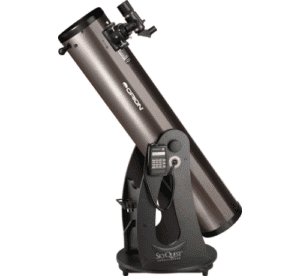 3. The Dobsonian: The same mirror, a better home
Optically, it is the Newtonian reflector described above. The difference is that the tube rests low in a sturdy rocker-box mount rather than being balanced high on a tripod. A broad base close to the ground supports its weight.
That one change explains why Dobsonians feature so prominently in beginner telescope recommendations. A substantial optical tube on a low, well-designed base can be remarkably stable.
And that base is generally less expensive than the heavy-duty equatorial mount needed to support a similarly sized Newtonian. You spend more of your money on the mirror instead of the mounting machinery.
What it does well
Aperture and stability together at an attractive price. A 6-inch or 8-inch Dobsonian can deliver rewarding views of the Moon and planets, while collecting enough light to explore open clusters, nebulae, and brighter galaxies.
Moving the telescope is intuitive. Push it upwards, swing it around, then nudge it gently to follow an object as Earth rotates. You don’t need to learn celestial coordinates or complete an electronic alignment routine before starting a session with a conventional manual model.
Learning to find objects yourself becomes part of the pleasure. And because the mount is simple, a Dobsonian avoids many of the complications that can make an inexpensive tripod-mounted telescope frustrating.
What it does badly
Bulk, plain and simple. The Apertura AD8, an 8-inch Dobsonian, weighs about 52 lb (24 kg) total, split between its optical tube and base. That doesn’t mean you have to lift all 52 pounds at once. You can move the two main pieces separately.
But the tube is long, and the base takes up space. Doorways, stairs, narrow storage areas, and small cars all deserve consideration before you buy.
A telescope that becomes difficult to carry may eventually spend more time in storage than under the stars.
The eyepiece height also changes as you point the telescope around the sky. An adjustable observing chair can make longer sessions more comfortable.
With a manual Dobsonian, no motor follows the target. As Earth rotates, the object drifts across the field of view, and you gently move the telescope to keep it centered. That is straightforward at lower magnifications and more demanding when observing a planet at high power.
It still needs occasional collimation, and its mirror still benefits from reaching outdoor temperature.
Who it suits
Someone with enough storage space, a practical route to their observing area and an interest in exploring a wide variety of celestial objects. If you are happy to find targets by hand and primarily want to look through the eyepiece rather than pursue long-exposure astrophotography, a Dobsonian is difficult to beat. For many beginners, it is the strongest all-round choice.
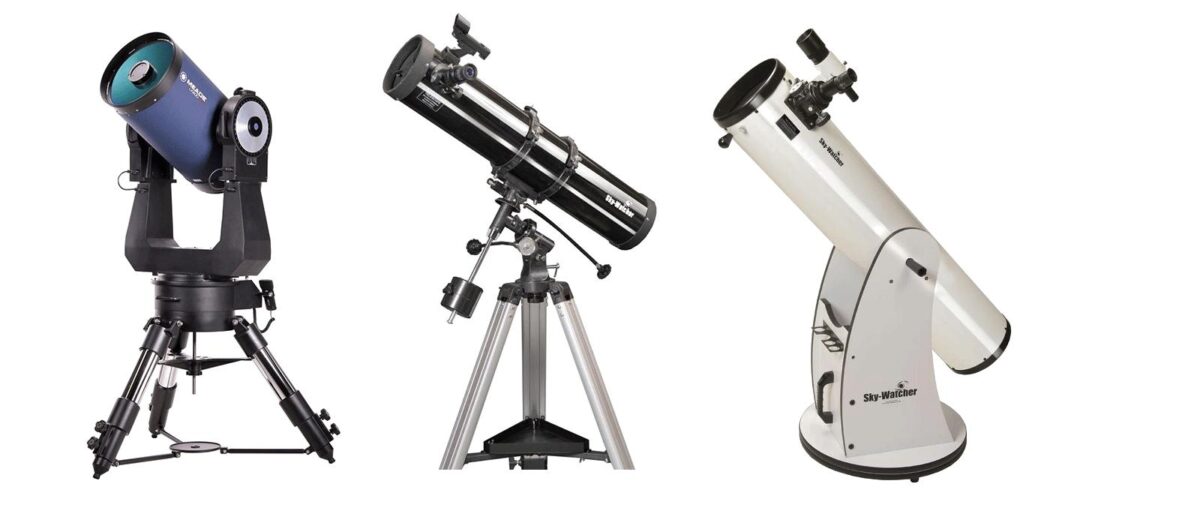
Refractor, Newtonian reflector and Dobsonian telescopes compared side by side.
Refractor, Reflector and Dobsonian side by side
The easiest way to compare them is to consider what each design gives you and what it asks of you in return.
Refractor
Light for the money. You pay for the lens, and the mount on top of it.
Best at: The Moon and planets, double stars, quick sessions and travel.
Each night, carry it out and look—little or no routine adjustment.
What goes wrong: Color fringing on bright objects in cheaper models. A long tube on a weak tripod.
Following an object: Depends entirely on the mount.
Reflector on a tripod
Light for the money: Good. Mirrors are cheaper to make than lenses.
Best at: A bit of everything, if the mount holds it.
Each night. Carry it out, let it reach outdoor temperature, and check collimation when needed.
What goes wrong: The mount. A budget equatorial tripod can shake at your touch and spoil the advantage of the larger mirror.
Following an object: Manual, or motorized if equipped.
Dobsonian
Light for the money. Excellent. More of the money goes into the mirror, not an elaborate mount.
Best atDeep-sky objects as well as planets, thanks to the aperture available for the price.
Each night: Move the tube and base outside, let it reach outdoor temperature, and check collimation when needed.
What goes wrong: Its size. The AD8 weighs about 52 lb in two pieces, with a long tube to move.
Following an object: Push and nudge by hand—no motor on a manual model.
The pattern is the point. The refractor is the easiest to live with and the hardest to afford as aperture increases. The Dobsonian is the opposite. The reflector on a tripod can be either, depending on a part the advertisement rarely gives enough attention to: the mount.
Which is best for the Moon and planets?
For lunar and planetary observing on a modest budget, a good refractor or a 6-inch Dobsonian can both provide rewarding views.
The refractor has no central obstruction and requires little routine adjustment. Its convenience makes it appealing for short sessions, especially when you do not want to carry substantial equipment outside.
The Dobsonian offers greater aperture for the money. On a steady night, with properly adjusted optics and a telescope that has reached outdoor temperature, that extra aperture can reveal finer planetary detail.
Jupiter’s cloud belts, Saturn’s rings and the changing shadows across the Moon all reward careful observation. An 8-inch telescope has considerable potential, but it cannot guarantee a sharp view every night. Atmospheric turbulence often limits how much detail you can see, and a telescope still adjusting to outdoor temperatures may deliver a softer image than its optics can produce.
The best planetary telescope is not necessarily the one with the largest advertised magnification. It is the one that provides a steady, sharp image under the conditions you are observing in.
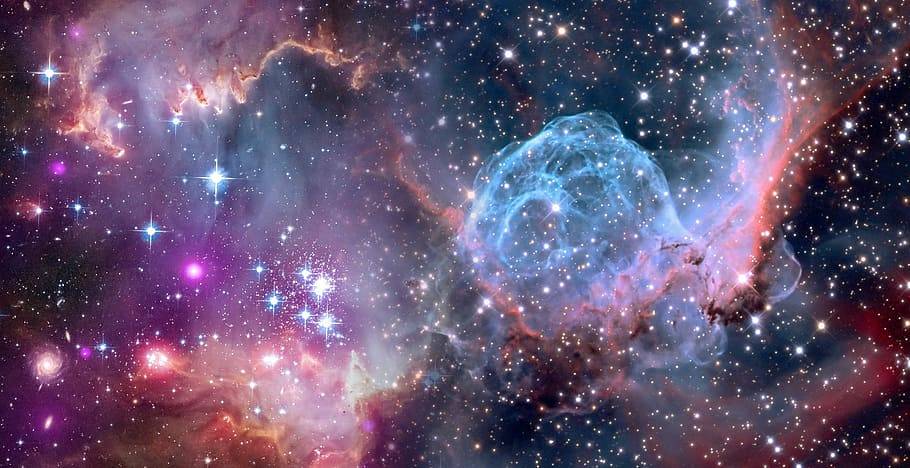
Which is Best for Galaxies and Nebulae?
Aperture matters, and so does how dark your observing location is. That second point surprises many beginners.
An 8-inch telescope under heavily light-polluted skies can struggle with faint galaxies that a smaller telescope reveals more readily from a dark location. The additional aperture helps, but it cannot remove the bright background sky created by artificial lighting.
If faint deep-sky objects are the main reason you want a telescope, include access to darker skies in your buying decision.
There is another distinction worth understanding. Detecting an object and seeing detail within it are two different achievements. Many galaxies appear as small grey glows through an eyepiece. You shouldn’t expect the vivid spiral arms and colors shown in long-exposure photographs.
That does not mean the telescope has failed. Your eyes are observing extremely faint light in real time, while astrophotography gathers and processes light over much longer periods. Knowing what to expect makes your first observing sessions far more rewarding.
For example, read What You Will Actually See Through Your First Telescope.
What not to buy, whichever design you choose
Astronomy enthusiasts have a name for the telescope that ends someone’s interest before it properly begins. They call it a hobby killer.
These telescopes are often marketed to beginners, photographed attractively, and promoted with specifications that sound impressive but say little about real-world performance. Three warning signs are worth recognizing.
1. The box leads with enormous magnification
A large 525× or 600× claim should make you cautious. The seller is drawing attention to a number that does not tell you whether the telescope can produce a sharp, useful image. Look for the aperture, optical design, focal length, and mount specifications instead.
2. The tripod looks too light for the telescope
A long optical tube supported by thin, unstable tripod legs is a warning sign. If the mount vibrates every time you adjust the focuser, observing becomes unnecessarily difficult. A smaller telescope on a stable mount is often a better purchase than a larger telescope on a poor one.
3. The listing hides important specifications
A general marketplace is not automatically a bad place to buy a telescope. Reputable manufacturers sell through many channels. The warning sign is a listing that advertises magnification and impressive photographs while omitting practical information.
A trustworthy product listing should clearly identify the aperture, focal length, mount type, included accessories, weight, and manufacturer. Dedicated astronomy retailers often make these details easier to compare.
A seller who tells you the weight is a seller who expects you to carry it.
Before buying, make sure you understand the equipment you will actually have to move and store.
The three telescopes I would point you to
Two manual Dobsonians and one computerized design, because the comparison above points to those options for different kinds of beginners. Prices checked October 2026; check the current price before buying.
 Top pick for beginners — Apertura AD8, 8-inch Dobsonian
 Top pick for beginners — Apertura AD8, 8-inch Dobsonian
My pick for most people, and the one I use as the yardstick. Enough aperture for the Moon, the planets, and a long list of deep-sky objects, on a sturdy base that keeps the view steady while you focus.
$699.95 at High Point Scientific (October 2026). About 52 lb in two pieces.
See the AD8 at High Point Scientific
Lighter and cheaper — Apertura AD6, 6-inch Dobsonian
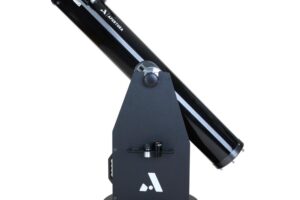 Lighter and cheaper — Apertura AD6, 6-inch Dobsonian
The same idea, two inches smaller and easier to carry and store. If an 8-inch would be a struggle to get out the door, this is the honest choice. It can still reveal Saturn’s rings and Jupiter’s moons under suitable conditions.
$499.95 at High Point Scientific (October 2026). A sensible first Dobsonian for someone with stairs or a small car.
Finds things for you — Celestron NexStar 5SE.
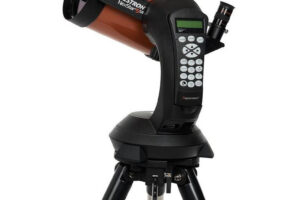 Finds things for you — Celestron NexStar 5SE.
For someone who would rather the telescope did the searching. After setup and alignment, it locates and tracks objects for you. It gives you five inches of aperture for more money than eight, but the electronic assistance can be worthwhile if you dread finding objects.
$1,029.00 at High Point Scientific (October 2026). Not the choice for maximum light-gathering ability per dollar.
See the NexStar 5SE at High Point Scientific
Affiliate disclosure: White Star Outdoors may earn a commission if you buy through qualifying retailer links, at no extra cost to you.
Frequently asked questions
Is a Dobsonian the same as a reflector?
A Dobsonian is normally a Newtonian reflector mounted on a simple, low alt-azimuth base. Most Dobsonians are reflectors, but not every reflector is a Dobsonian.
Is a 6-inch or 8-inch Dobsonian better for beginners?
An 8-inch gathers approximately 78% more light than a 6-inch before accounting for optical losses. That makes it attractive for observing fainter objects. But a 6-inch is easier to accommodate and often costs less. Choose the 8-inch if you can manage it comfortably; otherwise, the 6-inch remains an excellent first telescope.
Can a Dobsonian be used for astrophotography?
Yes, particularly for basic lunar and planetary imaging. However, a conventional manual Dobsonian isn’t designed for the accurate tracking required for long-exposure deep-sky photography. That type of imaging generally needs a suitable tracking mount and additional equipment.
So which one?
A Dobsonian, for most beginners interested in visual astronomy. Choose six inches if you have limited storage, stairs to negotiate, or a small vehicle. Choose eight inches if you have the room, can comfortably handle the equipment, and want the additional aperture.
Choose a refractor if you prefer something compact, quick, and straightforward, particularly when the Moon and planets are your main interests. If finding objects yourself worries you, consider a computerized telescope. There is no prize for doing it the hard way.
What matters is not winning an argument about telescope designs. It is choosing something you will enjoy taking outside.
If you are still weighing up the practical details, our guide to How to Choose a Telescope explains the buying considerations in greater depth. When you are ready to compare specific models, Start Your Stargazing Journey is the next place to go.
And if you haven’t started exploring the night sky yet, you don’t need to wait to buy a telescope. You can discover plenty with your eyes alone.
Explore beginner telescopes, binoculars, and the best stargazing apps for beginners here: