Observing the Moon with a Telescope
Discover the wonders of observing the Moon with a telescope.
Find out which lunar features to see, tips for beginners, and the best times for observation.
Unlock the secrets of the Moon’s craters, mountains, and maria with this comprehensive guide.
For many amateur astronomers, observing the Moon with a telescope is often their very first experience.
Its familiar glow draws attention and fuels curiosity about observing the Moon with a telescope.
Its brightness, ease of location, and wealth of detail make the Moon an ideal target, even with basic equipment.
Unlike deep-sky objects, which are often faint and challenging to find, the Moon’s landscape is clear and changes throughout the lunar cycle. Even with a modest telescope, the Moon’s bright disk transforms into a vivid world of craters, rugged mountains, and ancient volcanic plains.
For those just starting out with stargazing, the Moon is one of the most rewarding objects to explore,
and the perfect starting point before venturing on to other celestial sights.
What You Can See With Your Eyes
Some features on the Moon are visible even without any optical aid.
Large dark regions, known as “maria,” spread across the lunar surface.
Early astronomers mistook these for oceans and named them after the Latin word for seas.
Today, we know these are vast plains of ancient lava, created by volcanic activity billions of years ago.
The brighter areas surrounding the maria are known as the lunar highlands.
These regions, heavily cratered and mountainous, stand in stark contrast to the smooth, dark plains.
Even without magnification, these contrasting patterns make the Moon one of the most fascinating objects in the night sky.
What Binoculars Can Reveal
Binoculars are often an excellent intermediate step before progressing to a telescope.
With binoculars, much more lunar structure becomes visible.
Prominent craters catch the eye, and it becomes much easier to distinguish the boundaries between the darker maria and the brighter highlands.
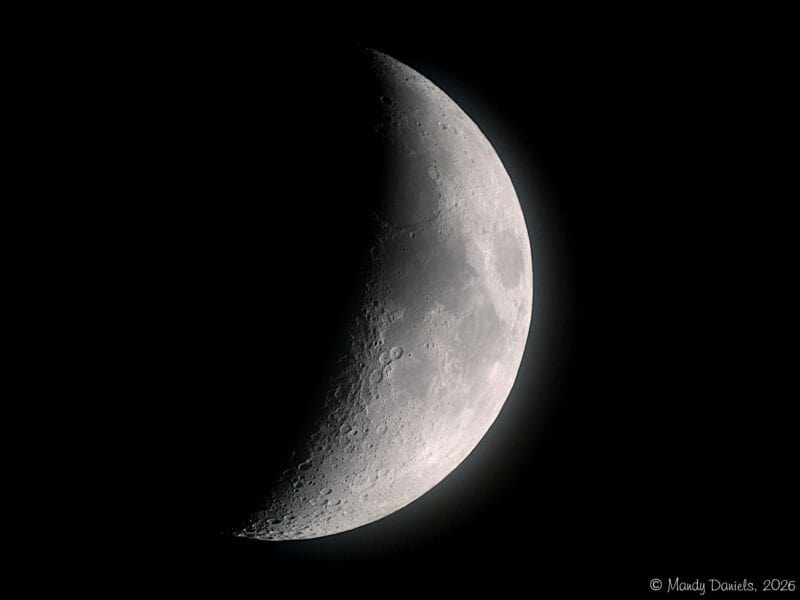
You may also notice the curved line dividing the illuminated and shadowed portions of the Moon.
This divide, called the terminator, is an excellent place to observe lunar detail,
as shadows here highlight the shapes of craters and mountains.
What a Telescope Reveals
Observing the Moon with a telescope reveals intricate surface details, providing new observers with a sense of discovery while sharpening their observational skills.
Even a small beginner telescope reveals hundreds of craters, with sharp rims and central peaks.
The rugged surface also includes mountains, valleys, and overlapping impact features.
Because the Moon lacks an atmosphere to obscure its features, its features remain sharply defined through a telescope.
Many beginners, during their first close-up observations, are amazed by the wealth of visible detail.
Five Lunar Features Beginners Can Easily See
Several famous lunar features are visible even through modest telescopes.
Learning to recognize these landmarks makes observing the Moon with a telescope far more rewarding.
Tycho Crater
Tycho is one of the most striking craters on the Moon, easily visible even through small telescopes.
It measures about 85 kilometers (53 miles) across and is estimated to be about 108 million years old.
Tycho’s most distinctive feature is its network of bright rays—streams of material ejected during the impact that formed the crater, radiating outward for hundreds of kilometers.
These rays are especially prominent during the full Moon, making Tycho a favorite target for beginners.
The crater’s well-defined central peak is also visible under good conditions, giving observers a sense of the powerful forces that shaped the lunar surface.
Tycho is one of the most famous craters on the Moon.
It appears as a bright circular crater with long streaks called ejecta rays spreading outward across the surface.
During the full Moon, these rays become especially noticeable.
Copernicus Crater
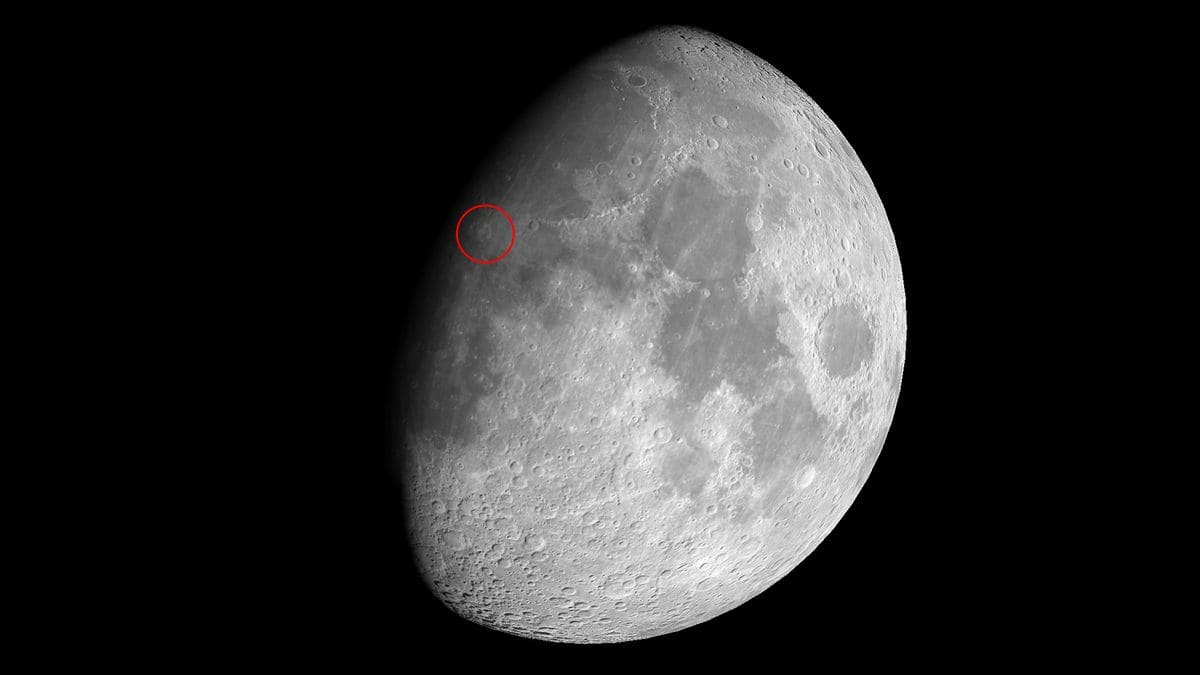
Copernicus is another prominent lunar crater, approximately 93 kilometers (58 miles) wide.
Its terraced walls and central mountain peaks make it a textbook example of a complex crater formed by a massive impact. Through a telescope, observers can admire the crater’s layered inner walls and the cluster of peaks rising from its center. Which result from the lunar surface rebounding immediately after the impact.
Copernicus is located in the eastern part of Mare Imbrium, making it easy to find and a rewarding feature to study as shadows shift throughout the lunar phases.
Copernicus is a large crater with impressive raised walls and central peaks.
Sunlight striking at an angle casts shadows, making its depth and structure easy for beginners to study and understand.
Many beginners find this to be one of the easiest craters to identify.
Mare Imbrium
Mare Imbrium, or the “Sea of Rains,” is one of the largest impact basins on the Moon, spanning over 1,100 kilometers (683 miles) in diameter.
Formed by a colossal asteroid impact about 3.8 billion years ago, it was later flooded by basaltic lava, giving it a dark, smooth appearance.
Mare Imbrium is bordered by several mountain ranges, including the Apennines, the Caucasus, and the Alps.
With a telescope, you can trace the edges of these ranges and see smaller craters and rilles scattered across the mare’s surface, highlighting the Moon’s dynamic geological history.
Mare Imbrium is one of the Moon’s largest dark regions, providing an obvious target for beginners to identify and compare with surrounding features.
Formed by ancient lava flows, this massive volcanic plain appears smoother and darker than the surrounding terrain.
The Lunar Terminator
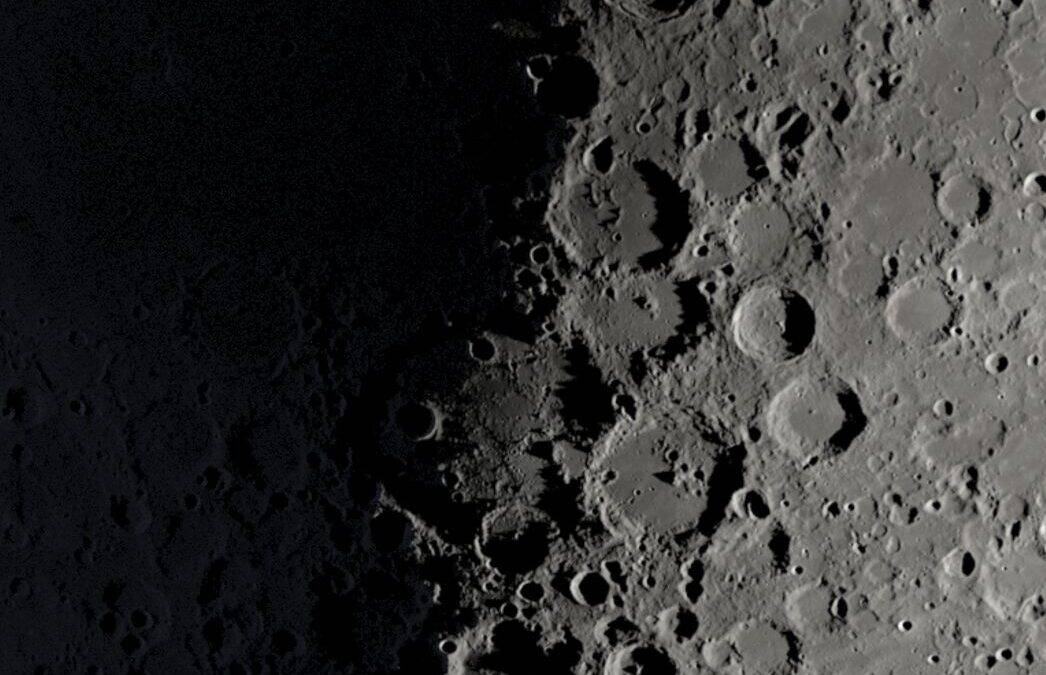
The lunar terminator is the dividing line between the Moon’s illuminated and shadowed hemispheres.
As the Moon progresses through its phases, the terminator slowly moves, revealing new features each night.
This region offers the greatest visual contrast and brings out fine surface details such as crater walls,
mountain peaks, and valleys, thanks to the long shadows cast by the low Sun angle.
Beginners will find that observing along the terminator, especially during the waxing and waning phases,
makes lunar features appear sharper and more three-dimensional.
The terminator is the boundary between the Moon’s illuminated and dark sides, giving beginners a dynamic region to observe as shadows change.
This area is especially interesting to observe because sunlight hits at a low angle, casting long shadows.
Partial illumination along the terminator reveals more surface detail, making each session unique.
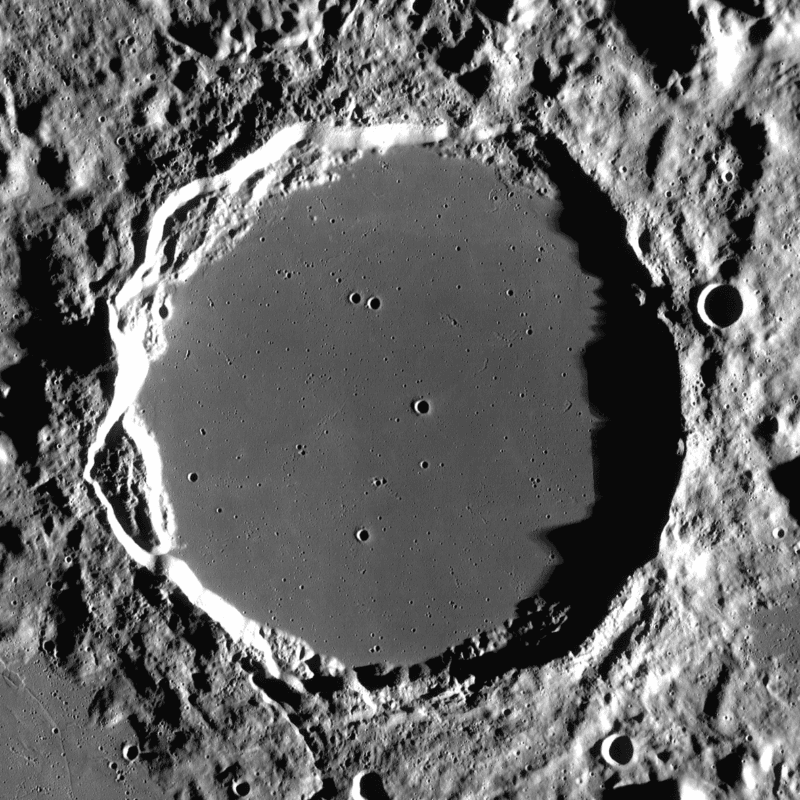
Plato Crater
Plato is a large, dark-floored crater located just north of Mare Imbrium, measuring about 101 kilometers (63 miles) in diameter.
Its floor is unusually smooth and dark because it was filled with lava after the crater formed.
The crater’s rim is sharply defined, rising above the surrounding terrain, while the flat interior makes it stand out against the more rugged lunar landscape.
Under steady viewing conditions, telescopes may reveal several tiny craterlets within Plato, providing an extra challenge for keen-eyed observers.
Plato is a large, dark-floored crater in the Moon’s northern region.
Its smooth, dark interior stands out clearly, making it an excellent landmark for beginners learning to recognize features.
Under steady viewing conditions, beginners can sometimes spot small craterlets inside Plato.
The Best Time to Observe the Moon
While many beginners assume the full Moon is the best time to observe, this isn’t always the case.
The most dramatic opportunities to observe the Moon with a telescope occur between the first and last quarters.
Shadows along the terminator during these phases reveal much more surface detail.
As the Moon moves through its phases, sunlight constantly alters the appearance of craters and mountains.
For this reason, the Moon may look slightly different each night.
Why the Moon Is Perfect for Beginner Stargazers
Unlike faint galaxies or distant nebulae, the Moon is frequently visible and requires no specialized equipment to observe. It helps beginners learn to focus, track objects, and recognize features.
For many astronomers, observing the Moon with a telescope marks the beginning of a lifelong interest in the night sky.
Looking Deeper Into the Night Sky
Once you have become familiar with the Moon, the night sky begins to feel less mysterious.
You may start to notice bright planets, constellations, and other objects that become visible as your observing skills improve. Just beginning your journey?
Learning how to start stargazing and understanding the best times can help you get even more from your nights under the stars.
Final Thoughts
More than just a bright light in the sky, the Moon offers far more to explore.
Through observing the Moon with a telescope, it becomes a fascinating world shaped by billions of years of impacts and volcanic activity.
Craters, mountains, and vast plains slowly reveal themselves as sunlight moves across the lunar surface.
For beginner stargazers, exploring the Moon is often the first step toward understanding the wider universe.
Each time you engage in observing the Moon with a telescope, you may notice something new.

Explore beginner telescopes, binoculars, and the best stargazing apps for beginners here