Moon Phases Explained Simply
Discover why the Moon changes shape, when to see each phase, and how to start observing from either hemisphere.
You recognize the Moon as soon as you see it. But why does a thin crescent grow into a bright, round disc?
It is easy to imagine Earth’s shadow gradually covering and uncovering it. But Earth’s shadow does not cause the monthly Moon phases. It causes a lunar eclipse.
Once you understand what creates the phases, the Moon’s shape becomes a useful clue to when and where you can see it.
You do not need a telescope or a background in science.
A few clear evenings and somewhere to look up are enough to begin.
Why Does the Moon Change Shape?
The Moon reflects sunlight. The Sun normally illuminates half of it, but as the Moon travels around Earth, we see different amounts of that sunlit half.
That changing view creates the phases.
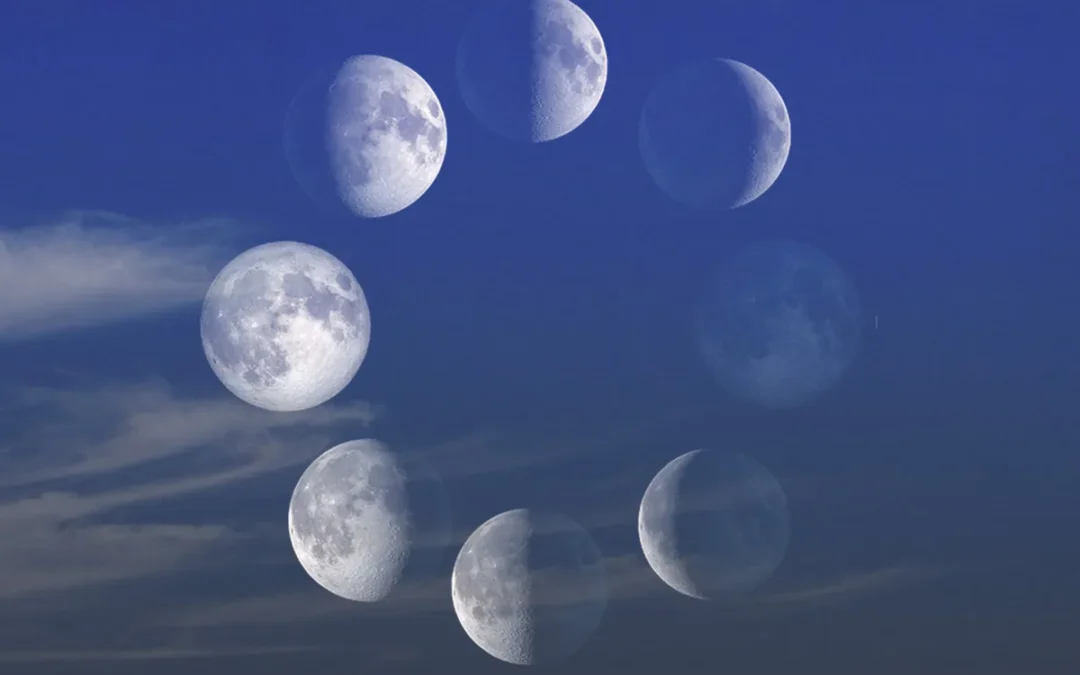
At new Moon, the illuminated half faces mostly away from us. At full Moon, it faces towards us. Between those positions, we see crescents, half-lit Moons, and shapes that are more than half illuminated.
The Moon itself stays round throughout. What changes is how much of its sunlit surface we can see.
A complete cycle, from one new Moon to the next, takes approximately 29.5 days. NASA’s guide to Moon phases illustrates how the positions of the Sun, Earth, and Moon produce this changing view.
Follow the Moon’s Phases in Order
My suggestion is to learn two words first: waxing and waning.
Waxing means the visible illuminated portion is growing. Waning means it is shrinking.
The complete sequence is:
- New Moon
- Waxing Crescent
- First Quarter
- Waxing Gibbous
- Full Moon
- Waning Gibbous
- Last Quarter
- Waning Crescent
The cycle then begins again. These names describe stages in a continuous change, rather than eight separate shapes that appear suddenly.
New Moon
At new Moon, the Moon lies in roughly the same direction as the Sun in our sky. Its sunlit half faces mostly away from Earth, and it is normally hidden in the Sun’s glare.
That is why a new Moon doesn’t look like a dark circle hanging in the night sky. Usually, you cannot see it at all.
The darker nights around new Moon can be useful for seeing faint stars and the Milky Way, provided weather and light pollution allow. Our guide to seeing the Milky Way tonight explains what else affects your view.
 Waxing Crescent
 Waxing Crescent
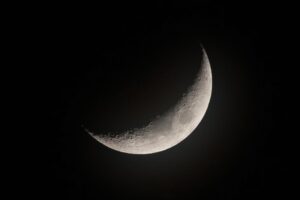
A few days after new Moon, a thin illuminated crescent becomes easier to see towards the west after sunset.
If you are unsure which way west is, begin with the part of the horizon where the Sun went down. The exact sunset point shifts with the seasons, but it gives you a useful starting direction.
From one evening to the next, the crescent grows and generally remains visible later.
I would choose this part of the cycle for an easy introduction to Moon watching. You can follow the changes during the evening without staying up late.
First Quarter
 First Quarter
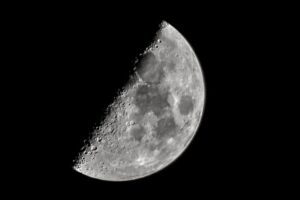
At first quarter, half of the face we see appears illuminated.
The Moon rises around noon, reaches its highest point around sunset, and sets around midnight. These times are approximate, but they make first quarter a convenient phase for evening observing.
“Highest” does not necessarily mean directly overhead. Its height depends on your location and the Moon’s position in its orbit.
Waxing Gibbous
 Waxing Gibbous
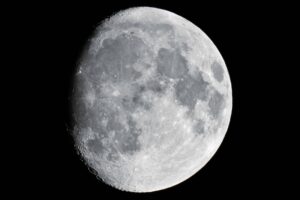
After first quarter, more than half of the visible face is illuminated.
This is the waxing gibbous phase. “Gibbous” means the Moon looks more than half lit but is not full.
It becomes increasingly prominent during the evening as the full Moon approaches.
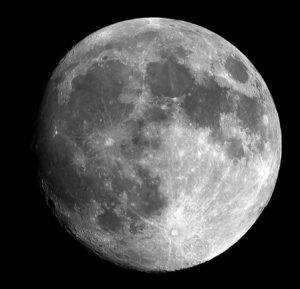
Full Moon
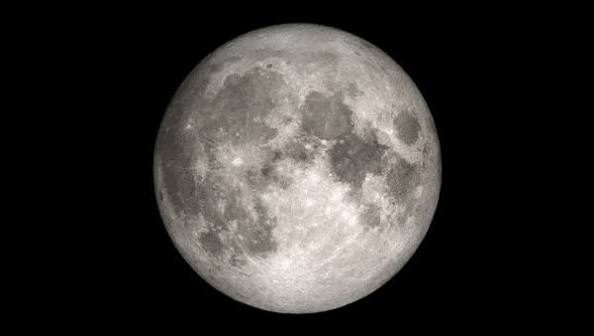
At full Moon, the sunlit face points towards Earth, making the Moon appear round and bright.
It lies approximately opposite the Sun in our sky. Consequently, it rises around sunset, remains above the horizon through the night and sets around sunrise.
If you want to watch a full Moon rise, choose a spot with a clear view of the eastern horizon.
For an explanation of why some full Moons seem especially striking, read Why Is the Moon So Bright Tonight?.
Waning Gibbous
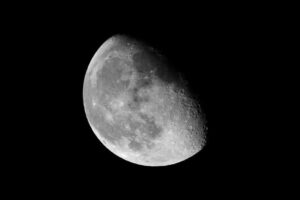 Waning Gibbous
After the full Moon, the illuminated portion begins to decrease.
The Moon rises progressively later after sunset and remains visible into the morning. This is the waning gibbous phase.
You might notice it on your way out in the morning, even if you missed it the previous evening.
Last Quarter
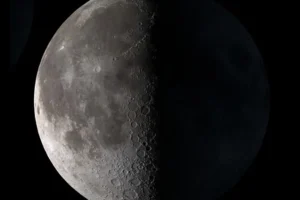 Last Quarter
At last quarter, also called third quarter, half of the visible face is illuminated again.
The Moon rises around midnight, reaches its highest point around sunrise, and sets around noon. It is therefore a morning observing opportunity rather than an early-evening one.
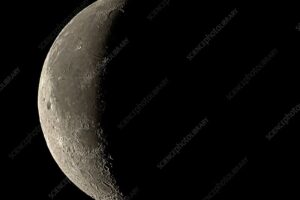
Waning Crescent
During the final part of the cycle, a thinning crescent appears towards the east before sunrise.
It draws closer to the Sun in our sky and eventually becomes difficult to see. The next new Moon begins the cycle again.
Why the Moon Rises About 50 Minutes Later Each Day
The Moon rises about 50 minutes later each day on average.
As it orbits Earth, it moves roughly 13 degrees eastward against the background stars each day. Earth must rotate a little farther before your location turns towards the Moon again.
That changing position explains why an evening crescent follows the Sun toward the western horizon, while a full Moon rises on the opposite side of the sky around sunset.
It also explains why the Moon is sometimes visible at breakfast rather than during your evening walk.
The 50-minute difference is an average, not a timetable. Your location and the angle of the Moon’s path to the horizon can make the daily gap considerably shorter or longer.
NASA explains this daily shift in its skywatching FAQs.
The Harvest Moon Exception
Around the full Moon nearest the autumn equinox—the Harvest Moon—the gap between successive moonrises can be much shorter.
At some mid-northern latitudes, it can be around 20–30 minutes for several evenings. This provides several nights with moonlight arriving soon after sunset, which traditionally helped people continue gathering their harvest.
The amount varies with latitude and year. It is not a worldwide 20-minute rule, and the corresponding autumn season falls at a different time of year in Australia.
The US Naval Observatory’s explanation of the Harvest Moon shows how strongly the effect changes with location.
When and Where to Look for Each Phase
You do not need to memorize every phase immediately. Use this table to connect the shape you see with a likely viewing time.
| New Moon | Near the Sun in the sky and normally hidden in its glare |
| Waxing crescent | Towards the west after sunset |
| First quarter | Highest around sunset; sets around midnight |
| Waxing gibbous | Visible during the afternoon and evening; sets before dawn |
| Full Moon | Rises around sunset; sets around sunrise |
| Waning gibbous | Rises progressively later after sunset; remains visible into the morning |
| Last quarter | Rises around midnight; highest around sunrise |
| Waning crescent | Towards the east before sunrise |
These are approximate patterns. Exact rise and set times vary by date and location.
The important point is that the Moon is not in the same part of the sky every evening. If you always look west after sunset, you may enjoy a waxing crescent but miss a rising full Moon behind you.
For current observing suggestions, visit the Look Up This Month section on our homepage.
Why a Quarter Moon Looks Half Lit
“Quarter Moon” is an understandably confusing name.
At first quarter, half of the Moon’s visible face appears bright. Why call it a quarter?
The name refers to its progress through the phase cycle. At first quarter, the Moon is approximately a quarter of the way from one new Moon to the next.
At last quarter, it is approximately three-quarters of the way through that cycle.
It does not mean that only a quarter of the visible disc is illuminated.
If you see a half-lit Moon in the evening, consider first quarter. If you see one in the morning, last quarter is the more likely answer.
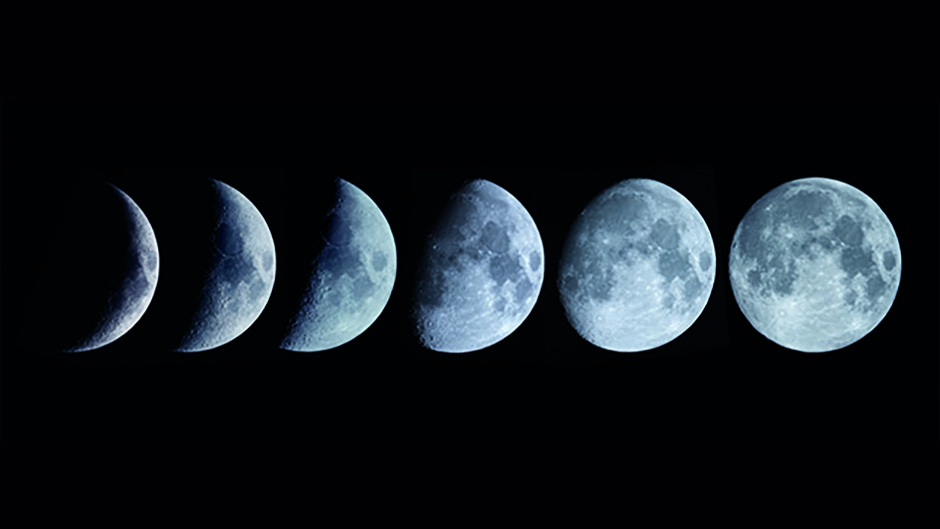
Why the Moon Looks Different in Australia and the USA
An American Moon guide may show a waxing Moon illuminated on the right, while an Australian observer sees the illuminated portion on the left.
Both views can show the same phase.
Observers in the Northern and Southern Hemispheres view the Moon from different orientations. The phase is effectively the same worldwide at a given moment, although local visibility differs.
In a common Northern Hemisphere view, the waxing Moon grows from the right. In a typical Southern Hemisphere view, it grows from the left.
However, the Moon’s apparent tilt also changes with your location and its position in the sky. A crescent may look upright, slanted, or bowl-shaped.
I would remember this more dependable principle: the illuminated side faces towards the Sun.
You can also use the time of day as a clue. An evening crescent is waxing; a pre-dawn crescent is waning.
Why You Can See the Moon During the Day
Spotting the Moon in a blue sky is nothing unusual.
The Moon spends plenty of time above the horizon during daylight. When its position, brightness, and the sky conditions are suitable, you can see it without waiting for darkness.
Around first quarter, look during the afternoon. Around last quarter, look during the morning.
Daytime sightings help connect the Moon’s position with the Sun’s position. The Moon follows the same orbit whether the sky behind it looks blue or black.
Never point binoculars or a telescope towards the Sun while searching for the Moon. Begin with an easy naked-eye sighting well away from the Sun.
Is Full Moon the Best Time to Observe?
That depends on what you want to see.
A full Moon rising above the horizon is a rewarding sight. Its darker plains and bright ray systems can also stand out well.
But for crater relief through binoculars or a telescope, I would usually suggest looking during a partial phase.
Focus near the terminator, the boundary between lunar daylight and darkness. Here, sunlight strikes the landscape at a low angle, casting shadows across crater walls and mountains.
Those shadows help reveal the ground’s shape. As the phase changes, the terminator moves and different features become prominent.
Our guide to what you can see on the Moon with a telescope introduces features to explore more closely.
A bright Moon can also wash out faint stars and reduce the visibility of the Milky Way. If those are your targets, choose a time when the Moon is below the horizon or plan around the new Moon.
No single phase is best for everything. You can choose your observing target to suit the Moon, rather than treating moonlight as a reason to stay indoors.
Why There Is Not an Eclipse Every Month
At new Moon, the Moon passes roughly between Earth and the Sun. At full Moon, Earth lies roughly between the Sun and Moon.
So why do we not see an eclipse every month?
The Moon’s orbit is tilted by about five degrees relative to Earth’s orbital plane around the Sun. Most months, the Moon passes above or below the precise alignment needed for an eclipse.
A lunar eclipse occurs when the full Moon enters Earth’s shadow. A solar eclipse occurs when the Moon passes in front of the Sun from a particular viewing location.
The ordinary phases continue every month because our view of the sunlit Moon changes, even if an eclipse doesn’t occur.
NASA’s guide to lunar eclipses explains the difference in more detail.
One Orbit and One Phase Cycle Take Different Times
Here is a detail that initially sounds contradictory.
The Moon completes an orbit relative to the distant stars in approximately 27.3 days. But returning to the same phase takes approximately 29.5 days.
While the Moon is orbiting Earth, Earth is also moving around the Sun.
After completing its circuit relative to the stars, the Moon must travel farther to restore the same Sun–Earth–Moon arrangement.
That extra travel accounts for the difference.
You do not need to remember both numbers to start observing. But they explain why the time between two full Moons is longer than the Moon’s orbital period measured against the stars.
Try a Simple Moon-Watching Exercise
I would start a few evenings after new Moon, when a waxing crescent becomes easier to find.
Choose a safe viewing spot with an open outlook towards the evening Moon. Take a phone photograph at approximately the same time each evening, keeping a distant roofline, tree, or another landmark in the frame.
Use the same spot, direction and zoom setting where possible. Include enough sky so the Moon’s changing position remains in your pictures.
You do not need a detailed photograph of its craters. The aim is to record where the Moon appears. Note its phase separately if the phone turns it into a bright white patch.
After several evenings, compare the pictures side by side. You should see the Moon generally shifting eastward at the same evening time, while its illuminated portion grows.
Clouds may leave gaps in your sequence. That is fine—a few clear evenings can still reveal the pattern.
If you need help checking its position or phase, our guide to the best stargazing apps for beginners offers useful options.
Frequently Asked Questions About Moon Phases
Does Earth’s shadow cause the Moon’s phases?
No. The phases result from our changing view of the Moon’s sunlit half. Earth’s shadow causes a lunar eclipse.
How long does a complete Moon-phase cycle take?
Approximately 29.5 days, measured from one new Moon to the next.
Does the Moon rise exactly 50 minutes later every day?
No. Fifty minutes is an average. The daily difference varies with your location and the Moon’s changing path relative to the horizon.
Are Moon phases different in the Northern and Southern Hemispheres?
The phase is effectively the same worldwide at a given moment. Its apparent orientation differs, and whether it is above your horizon depends on your location and local time.
Why can I sometimes see the dark part beside a crescent?
That faint glow is called earthshine. Sunlight reflects from Earth onto the Moon’s night side, then reflects towards us.
The dim portion has not begun producing its own light. You are seeing sunlight that has reflected off both Earth and the Moon.
Can I follow the phases without a telescope?
Yes. Your eyes are enough to recognize the changing shape and position. Binoculars or a telescope add surface detail, but they are optional.
See What the Moon Is Doing Tonight
Start with the Moon you can see from your location. Notice its shape, the time and where it appears, then return when the weather allows.
You do not have to memorize every phase. Recognizing an evening crescent or understanding why a full Moon rises around sunset is already useful progress.
Check our Look Up This Month section for current skywatching highlights.
For help preparing your first evening outside, get the free Your First Night Out guide through our Start Your Stargazing Journey page. It covers what to look for, simple preparation, and a practical first-night checklist.

Explore beginner telescopes, binoculars, and the best stargazing apps for beginners here: