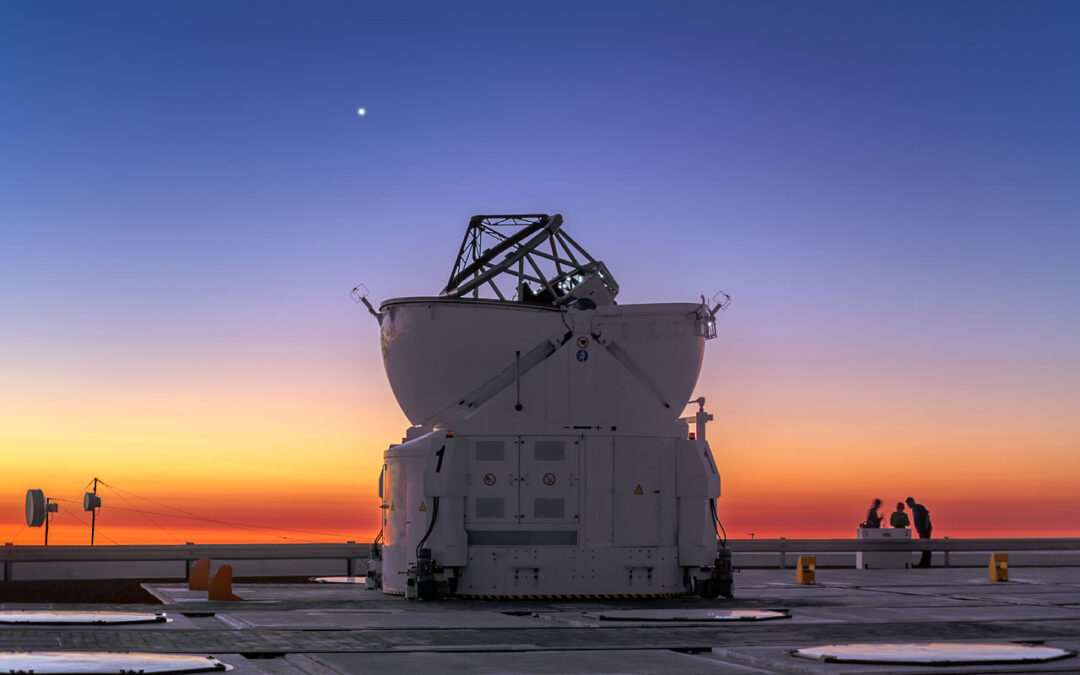
How to Identify Stars
Learn how to identify stars, distinguish them from planets, and recognize satellites—simple clues for beginners, with no telescope needed. One bright light is often enough to make you stop and look up. Perhaps it appears above a neighbor’s roof after sunset, or catches your attention as you walk home. It looks brighter than everything around it, and you want to know its name.
I suggest starting with that single object.
You do not need to identify a whole constellation or memorize a chart before enjoying the night sky. Learning one familiar light gives you a starting point and something to recognize next time.
The first question is whether you are looking at a star. Planets, satellites, and aircraft can also appear as points of light. A few observations will help you narrow the possibilities.
What Is That Bright Star in the Sky Tonight?
A brilliant light could be Venus, Jupiter, or a bright star such as Sirius. If it crosses the sky noticeably within a few minutes, it could be a satellite or aircraft.
No single answer applies everywhere. Your location, the date, the local time, and the direction you are facing all matter.
| A brilliant light towards the west after sunset | Venus is a possibility |
| A brilliant light towards the east before sunrise | Venus is a possibility |
| A bright object high overhead around midnight | You can rule Venus out |
| Strong twinkling or flashes of color | Often a star, although low planets can twinkle too |
| A steady light crossing the sky in minutes | A satellite, possibly the International Space Station |
| Flashing lights moving across the sky | Often an aircraft |
These clues help you decide what to check. For confirmation, match the object with a sky map set to your location and time.
Start with One Object, Not the Whole Sky
A crowded star chart can make astronomy feel like a memory test. Start with one object you can find comfortably from your own viewing spot.
Choose a bright light above a roofline, tree, or open horizon. Spend a little time noticing it before reaching for an app.
Which direction are you facing?
Is it close to the horizon, halfway up the sky, or almost overhead?
Does it look white, yellowish, or orange?
Do nearby stars form a recognizable pattern?
You do not need precise measurements. You are gathering enough information to compare your view with a reliable map.
“A brilliant light above the western rooftops at eight o’clock” is much more useful than “a bright star outside”.
If directions are unfamiliar, begin with the part of the horizon where the Sun went down. That gives you a rough western reference, although the exact sunset point changes through the year.
Use Your Fist to Describe Its Position
Astronomers measure distances across the sky in degrees, but you can estimate them without special equipment.
A closed fist held at arm’s length covers roughly 10 degrees of sky. It varies from person to person, so treat it as an approximate guide.
An object three fist-widths above the horizon is roughly 30 degrees high.
This measures an angle across your view, rather than the object’s distance from Earth. Two objects can appear close together while being enormously far apart in space.
For beginners, it provides a practical way to describe a position and find it again.
Venus: Brilliant, but Never Far from the Sun
Venus is one of the most striking objects you can identify without a telescope.
At its brightest, it reaches approximately magnitude −4.9. On the astronomical magnitude scale, smaller and more negative numbers mean brighter objects.
That makes peak-brightness Venus roughly 20–25 times brighter than Sirius, the brightest star in the night sky. Its advantage over Jupiter varies because both planets change brightness.
Venus can become visible while the twilight sky is still blue, before most stars appear. In that setting, a brilliant point is worth checking for Venus, although bright stars and other planets can also appear during twilight.
When Venus is visible in the evening, look towards the west after sunset. During its morning appearances, look towards the east before sunrise.
The famous morning star and evening star are the same planet. At other times, Venus is too close to the Sun in our sky to observe easily.
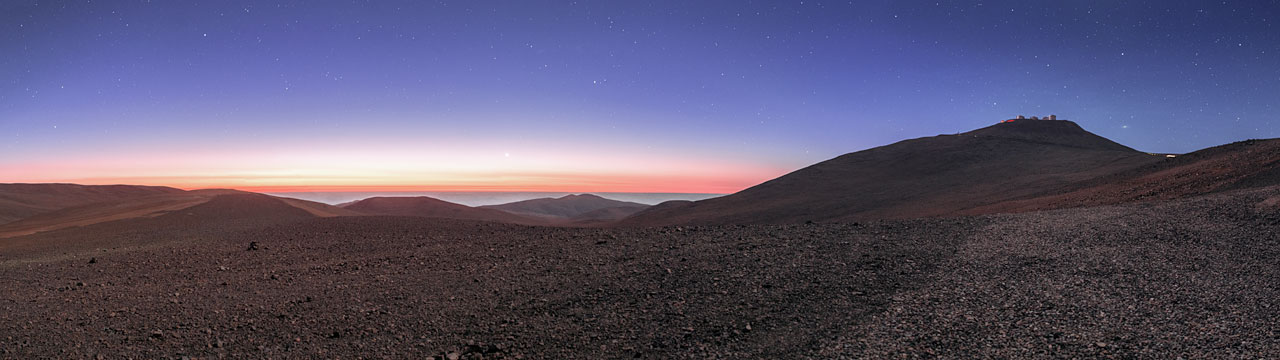
Venus stands out near the centre of this twilight panorama above Chile’s Atacama Desert. Credit: P. Horálek/ESO.
The 47-degree clue
Venus never appears more than about 47 degrees from the Sun in our sky. That is roughly five fist-widths held at arm’s length.
Because Venus orbits inside Earth’s orbit, it stays associated with the evening or morning sky.
A brilliant object high overhead at midnight? You can rule Venus out.
That doesn’t automatically mean you have found Jupiter. But eliminating one possibility moves you closer to an answer.
Venus can stand well above the horizon during favorable appearances. Think “evening or morning sky”, rather than assuming it must always sit just above the rooftops.
Read how to identify Venus for more practical clues. NASA also explains its changing appearances in Viewing Venus from the Space Station.
Jupiter: Look for the Tiny Worlds Beside It
Jupiter is another bright planet that frequently attracts attention.
Unlike Venus, it can appear far from the Sun in our sky. When suitably positioned, it may remain visible through much of the night.
To your unaided eyes, it looks like a bright point. Binoculars can make the experience considerably more interesting.
Once you have identified a likely Jupiter, steady your binoculars by supporting your elbows on a fence or another firm surface. Focus carefully and look for tiny points close beside the planet.
You may see one or more of its four large Galilean moons: Io, Europa, Ganymede and Callisto. Galileo famously observed these moons in 1610.
They usually appear roughly in line with Jupiter. You may find moons on both sides or several on the same side.
Their visibility depends on the binoculars, their distance from Jupiter’s glare, and the observing conditions. A moon can also be hidden behind the planet or pass in front of it, so don’t expect four separate dots every time.
Return another evening and compare their positions. These are orbiting worlds, and their changing arrangement provides a rewarding reason to look again.
NASA’s guide to observing Jupiter explains what binoculars and small telescopes can reveal. You can check the arrangement using Sky & Telescope’s Jupiter’s Moons tool.
Why Stars Twinkle and Planets Sometimes Do Too
“Stars twinkle and planets don’t” is a useful starting point, but it is not a dependable rule on its own.
Stars are so distant that they appear as extremely small points of light. Moving air in Earth’s atmosphere bends their light, making them appear to flicker.
Planets appear as tiny discs, even though your unaided eyes generally cannot resolve their shape. Atmospheric disturbances tend to average out across those discs, making their light steadier.
Near the horizon, however, light passes through more atmosphere before reaching you.
A low planet can twinkle too.
Venus can flicker when low down, while a bright star such as Sirius may flash through noticeable colors. These effects come from the atmosphere, rather than the object changing color rapidly in space.
Low Venus is sometimes reported as a UFO. Its brilliance and unfamiliar appearance can confuse someone who does not expect a planet to look that bright. NASA discusses this in its guide to identifying UFOs and UAPs.
I would use twinkling alongside position, time, and nearby stars, rather than treating it as a final test.
Sometimes the Bright Light Really Is a Star
Several genuine stars stand out even from suburban locations. You do not need to learn them all immediately. Find the one closest to you and start there.
Sirius
Sirius is the brightest star in the night sky, excluding our Sun. It belongs to the constellation Canis Major and can twinkle strongly when it’s low.
It is particularly familiar during Northern Hemisphere winter evenings. Australian observers see it prominently during their warmer months.
Its visibility still depends on your latitude and the time you look.
Arcturus
Arcturus belongs to the constellation Boötes and often has a noticeable orange tint.
Its color can help distinguish it from blue-white stars, but its position still matters. A warm-looking point of light is not automatically Arcturus.
Vega
Vega is a prominent blue-white star in Lyra, particularly familiar during Northern Hemisphere summer evenings.
It is visible from some Southern Hemisphere locations too, although it appears lower in the northern sky and is not equally accessible everywhere.
Our guide to the best constellations for beginners helps connect individual stars with larger patterns.
Why Most Stars Look White
If you look up and see mostly white stars, you are not doing anything wrong.
The cone cells responsible for color vision need enough light to work effectively. Many stars do not deliver enough light to your eyes for an obvious color impression, especially compared with their appearance in photographs.
Brighter stars are better candidates for noticing a tint.
Binoculars or a telescope can make subtle colors easier to distinguish by gathering more light from individual stars. However, they do not guarantee vivid colors in every object.
I would look for a gentle difference between white, blue-white and orange, rather than expecting intensely coloured lights.
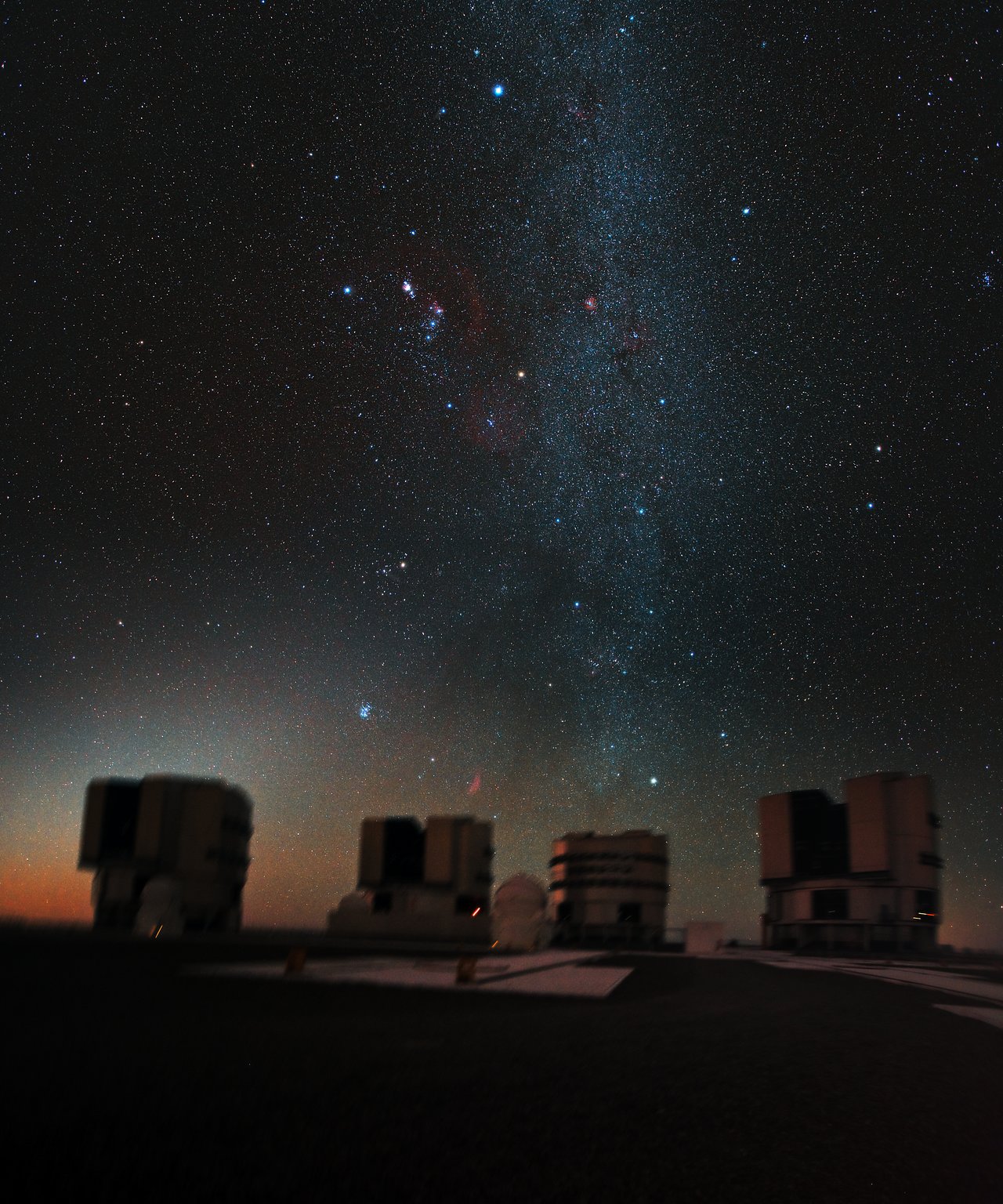
The great hunter Orion hangs above ESO’s Very Large Telescope (VLT)
Orion provides a useful comparison when it is visible.
Find its distinctive belt of three stars. Then compare Betelgeuse, the orange-red shoulder star, with Rigel, the blue-white star towards the opposite corner of the main pattern.
Their contrasting colors reflect different surface temperatures. Rigel is much hotter than Betelgeuse.
The contrast may be subtle, but viewing both in the same region of the sky makes the comparison easier. Let your eyes settle on each star rather than expecting the colors to stand out immediately.
NASA’s introduction to Orion explains these two stars and their surroundings.
A Light Crossing the Sky: Satellite, Aircraft or Meteor?
Watch your object for a minute or two.
Stars and planets appear to move slowly as Earth rotates. They do not normally sweep across a large section of sky within a few minutes.
A satellite can.
Satellites and the International Space Station
A satellite may look like a steady point, traveling without flashing navigation lights.
The International Space Station can be especially bright during favorable passes. It may also disappear before reaching the horizon because it enters Earth’s shadow and stops reflecting sunlight towards you.
That sudden disappearance can be puzzling until you know the explanation.
Other satellites can look similar. Check predicted passes using NASA’s Spot the Station before deciding that you have seen the ISS.
Aircraft
Aircraft often show flashing lights, and their sound can sometimes help identify them.
A distant aircraft traveling towards you may initially appear almost stationary. Give yourself time to watch before deciding it is a star or planet.
Meteors
A meteor generally appears as a brief streak rather than a point traveling steadily across the sky.
If your object has been moving for several minutes, it’s more likely a satellite or aircraft.
Return Another Night and Watch What Changes
Looking again becomes more rewarding when you know what change to watch for.
Over ordinary observing timescales, stars keep their patterns relative to one another. Planets gradually change position against that background.
Compare a suspected planet with neighboring stars over several nights or weeks. A note, sketch, or suitable photograph can reveal a change that is hard to remember.
Do not expect every planet to move an obvious amount overnight. Planets can also appear almost stationary against the stars for a while.
Another detail is worth knowing: stars do not return to the same position at the same clock time each evening. They rise approximately four minutes earlier each day.
Compare your planet with neighboring stars, not just the garden fence.
OpenStax’s explanation of astronomical timekeeping describes why the stars’ daily schedule shifts.
Use an App to Check Your Identification
I would use an app to support your observations while still looking at the real sky.
Check the location, date, and local time. Find your object on the map, then compare the neighboring stars with what you can see.
If the phone’s pointing display is slightly off, use those surrounding patterns to match the view. The label nearest the object is not always the correct identification if the phone’s sensors are misaligned.
Our guide to the best stargazing apps for beginners compares suitable options.
Keep the screen dim where possible. A bright display makes faint stars harder to see afterward.
The Moon Can Help You Notice Other Objects
A bright star or planet beside the Moon can make an attractive pairing.
Their apparent closeness does not mean they are physically near each other. They happen to lie along similar directions from your viewpoint.
The Moon moves eastward against the stars, so its position beside the other object can change noticeably by the following night.
That gives you another simple observing exercise: identify the neighboring object, then return to see where the Moon has moved.
Our Moon phases explained guide describes its changing shape, daily movement, and the best times to look for each phase.
A Simple Plan for Your Next Clear Evening
Choose a safe viewing spot and one bright object you can see comfortably.
Record the time, the direction, and its approximate height above the horizon. Watch for a few minutes to see whether it moves noticeably.
Then use a reliable map or app to identify it. Match the surrounding stars and the object itself.
If it is Jupiter and you have binoculars, try looking for its moons. If it is a star, notice its color and position within the surrounding pattern.
Return when the weather allows and see whether you can recognize it without starting again.
You have turned a passing glance into a small observing project, using whatever equipment you already have.
Frequently Asked Questions
What is the brightest star in the sky tonight?
Sirius is the brightest true night-time star, but it may not be above your horizon. Venus and Jupiter can outshine it, although they are planets.
Identify your particular object using your location, time, direction, and an up-to-date sky map.
Is a brilliant western light always Venus?
No. Venus is a possibility during its evening appearances, but other planets and stars can occupy the western sky.
Can planets twinkle?
Yes. Although planets usually appear steadier than stars, they can twinkle when atmospheric conditions disturb their light, particularly near the horizon.
Can I see Jupiter’s moons with ordinary binoculars?
Yes, suitable binoculars can reveal some of its four large moons. Steady support helps, and you may not see all four.
Why does a star flash red, blue, or green?
Earth’s turbulent atmosphere can make a bright star appear to flash different colors. The effect is often strongest when the star is low in the sky.
Why do most stars look white?
Their light may be too faint for your eyes to distinguish color clearly. Try comparing bright stars with contrasting colors, such as Betelgeuse and Rigel.
How can I tell whether I saw the International Space Station?
Compare the time and path of the moving light with a predicted ISS pass for your location. Many other satellites are visible, so movement alone is not enough.
Do I need a telescope to identify stars and planets?
No. Your eyes, a reliable sky map, and a little patience are enough to begin. Magnification becomes useful when you want to explore detail rather than identify an object.
Give One Familiar Light a Name
For your next clear evening, choose one bright object. Notice where it is, watch how it behaves, and check its identity.
Once you have a name, look for it again.
Recognizing one object deliberately is a worthwhile success. You now have a familiar point in the sky and a reason to return.
If the Moon has caught your attention too, these two guides provide useful next steps:
- Moon Phases Explained: understand its changing shape and know when to look.
- What Can You See on the Moon With a Telescope?: discover the craters, plains, and shadows that magnification reveals.
For help planning an observing session, get the free Your First Night Out guide through the sign-up section on the White Star Outdoors homepage.

Explore beginner telescopes, binoculars, and best stargazing apps for beginners here: