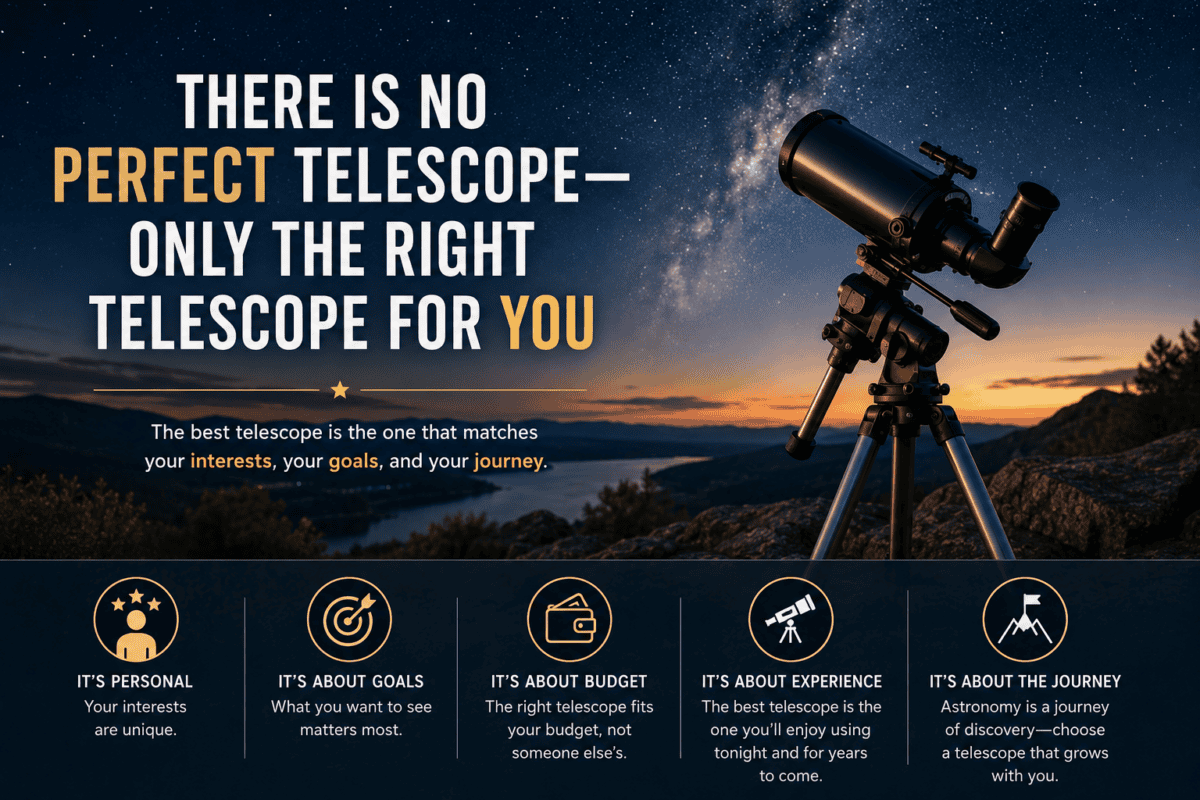
There Is No Perfect Telescope—Only The Right Telescope For You

Learn how to choose a telescope with confidence. Compare telescope types, avoid common mistakes, and find the right telescope for your budget.
Buying your first telescope should be exciting.
For many people, however, it quickly becomes overwhelming.
What begins as curiosity about the night sky often leads to hours of research, countless reviews, conflicting opinions, and a growing sense that choosing a telescope is far more complicated than expected.
Refractor or reflector?
How much magnification do you need?
What can you see through a telescope?
How much should you spend?
How do you know it’s the right choice?
These are sensible questions.
After all, a telescope is rarely an impulse purchase. For most people, it represents a meaningful investment of both money and expectation. In a time when many households are carefully considering discretionary spending, it’s natural to want reassurance that the telescope you choose will provide genuine enjoyment rather than become another unused item gathering dust in a spare room or garage.
The good news is that choosing your first telescope does not need to be complicated.
The challenge is not that there are too few options.
The real challenge is the abundance of choices.
Many beginners begin by comparing specifications. They focus on magnification, aperture, optical designs, and product reviews before fully considering what they actually hope to experience under the night sky.
Experienced amateur astronomers often approach the decision differently.
Rather than starting with the telescope, they start with the observer.
They ask questions such as:
What excites you about astronomy?
What would you most like to see?
How much time do you realistically have available?
Will you be observing from a backyard, a balcony, or dark country skies?
What kind of experience are you hoping to create?
Those questions may seem simple, but they often lead to far better telescope decisions than any specification sheet ever will.
This guide was created to help you make a confident, informed decision.
Whether you’re purchasing your very first telescope, buying a gift for a child or grandchild, returning to a hobby you once enjoyed, or considering an upgrade from an older instrument, the goal remains the same.
Not to find the perfect telescope.
But to find the telescope that is right for you.
Because astronomy is not really about equipment.
It is about discovery.
It is about stepping outside on a clear evening and seeing Saturn’s rings with your own eyes for the first time.
It is about watching Jupiter’s moons line up beside the giant planet.
It is about exploring star clusters, nebulae, and distant galaxies whose light has traveled through space for thousands, millions, and sometimes billions of years before reaching your telescope.
The telescope is simply the tool that makes those experiences possible.
By the end of this guide, you will have a clearer understanding of the different types of telescopes available, what you can realistically expect to see through them, the common mistakes many beginners make, and how to choose a telescope that matches both your interests and your budget.
Most importantly, you will have the confidence to move forward knowing that your decision is based on understanding rather than uncertainty.
Who Is This Guide For?
One reason choosing your first telescope can feel so confusing is that, as a beginner, you might not share the same starting point as others in astronomy.
Some people have spent months exploring the night sky with their naked eyes and are now ready to take the next step.
Others may have watched a YouTube video, seen Saturn through a telescope for the first time, or discovered a growing curiosity about astronomy and space exploration.
Many visitors arrive here with very different questions, yet all are trying to solve the same problem.
They want to make a good decision.
You may be considering your first telescope and wondering where to begin.
You may be asking questions such as:
“What can I realistically see through a telescope?”
“How much should I spend?”
“Do I need an expensive telescope to enjoy astronomy?”
These are sensible questions and ones that almost every beginner asks at some point.
You might also be a parent or grandparent searching for a meaningful gift. If so, your needs and intentions are unique compared to those buying for themselves.
You are not simply selecting a telescope; you are selecting an experience.
You may encourage curiosity, learning, and discovery. At the same time, you want confidence that the telescope will be enjoyable to use rather than becoming another forgotten gadget after a few weeks.
Or you once owned a telescope yourself and are now thinking about reengaging with the hobby. Your experience will shape what matters most to you.
Many amateur astronomers can relate to this experience. Life becomes busy. Careers develop. Families grow. Priorities change.
A telescope that once saw regular use may now be sitting quietly in a cupboard, garage, or spare room.
Yet the fascination with the night sky often never completely disappears.
Sometimes all it takes is seeing a bright planet, a meteor shower, or a photograph of Saturn to rekindle that interest.
You may not be choosing your first telescope at all.
You may choose your next telescope.
Some observers already have a telescope and are deciding whether to upgrade. This group’s questions will differ from those of first-time buyers or returning hobbyists.
They have gained experience.
They have learned what interests them most.
Now they are wondering whether an upgrade would allow them to enjoy astronomy even more.
While the details may differ, all of these people share a common goal.
They want to make an informed decision.
They hope to avoid mistakes.
They seek realistic expectations.
And they want lasting enjoyment from their telescope.
If that sounds familiar, then this guide was written for you.
The goal is not to convince you to buy a telescope.
The goal is to help you understand how experienced observers approach the decision so that when you do choose a telescope, you do so with confidence.
Why Choosing Your First Telescope Feels So Confusing
If you’ve spent any time researching telescopes online, you’ve probably noticed something surprising.
The more information you read, the harder the decision can become.
What initially seemed like a simple purchase quickly turns into a maze of technical terms, competing opinions, product reviews, and endless recommendations.
One website recommends a refractor.
Another insists that a reflector offers better value.
A YouTube video argues that every beginner should buy a Dobsonian.
Meanwhile, online forums contain discussions about aperture, focal length, collimation, optical quality, computerized mounts, eyepieces, filters, and dozens of other topics that may be completely unfamiliar to someone new to astronomy.
It is hardly surprising that many beginners feel overwhelmed.
The problem is not a lack of information.
The problem is an abundance of information without context.
Most telescope advice focuses on equipment.
Experienced observers often focus on outcomes.
They ask a different question.
Not:
“What telescope should I buy?”
But:
“What experience am I trying to create?”
This distinction is important because telescopes are not an end in themselves.
They are tools designed to help you explore the night sky.
The best telescope for one person may be completely wrong for another.
For example, someone who dreams of observing distant galaxies from dark rural skies may require a very different telescope from someone who wants quick views of the Moon from a suburban backyard.
Similarly, a parent buying a telescope for a curious child may value simplicity and ease of use over maximum performance.
This is why experienced astronomers often smile when beginners ask:
“What is the best telescope?”
The honest answer is that there is no single best telescope.
There is only one telescope that is best for your interests, circumstances, budget, and expectations.
Unfortunately, much of the telescope marketing industry encourages the opposite view.
Many advertisements focus on magnification figures, impressive specifications, and dramatic photographs captured using equipment far more advanced than the telescope being advertised.
This can create unrealistic expectations.
A beginner may assume that a telescope capable of 400x magnification must be better than one capable of 200x magnification.
In reality, astronomy rarely works that way.
Likewise, many people see breathtaking images from the Hubble Space Telescope or the James Webb Space Telescope and assume they will observe something similar through a backyard telescope.
The reality is different, though no less rewarding.
Understanding what a telescope can realistically show you is one of the most important parts of choosing your first telescope.
In many ways, the decision becomes much easier when you stop searching for the perfect telescope and start thinking about the type of observer you want to become.
Would you like quick, convenient sessions?
Are you fascinated by nebulae and galaxies?
Want something that grows with you?
The answers to those questions provide far more useful guidance than any product specification sheet.
This is why choosing your first telescope should never begin with a telescope catalog.
It should begin with understanding your interests, your expectations, and the experiences you hope to enjoy under the night sky.
Once those become clear, the telescope itself often becomes much easier to choose.
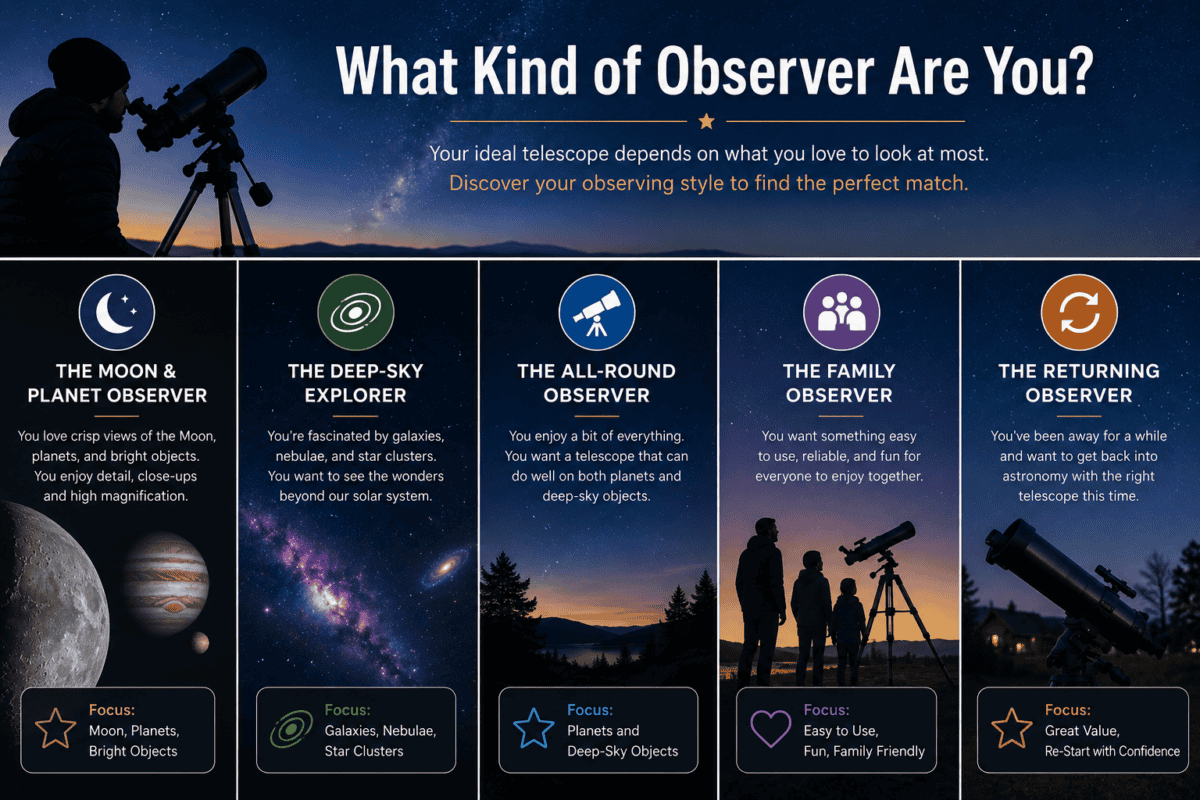
What Kind of Observer Are You?
One of the most effective ways to simplify the process of choosing your first telescope is to stop thinking about telescopes altogether for a moment.
Instead, could you think about the night sky?
Think about the moments that sparked your interest in astronomy.
Was it seeing the Moon rising above the horizon?
A bright planet shining in the evening sky?
A photograph of Saturn’s rings?
A documentary showing distant galaxies and nebulae?
The answer matters because different telescopes excel at different types of observing.
Before choosing your first telescope, it helps to understand what excites you most about astronomy.
The Moon and Planet Observer
For many people, the journey begins with the objects that are easiest to find.
The Moon is often the first target viewed through a telescope, and for good reason.
Even a modest telescope can reveal astonishing detail. Craters, mountain ranges, shadows, and lava plains become visible in a way that photographs rarely capture. The Moon is constantly changing throughout its phases, meaning there is always something new to observe.
Then there are the planets.
Jupiter reveals cloud bands and its four largest moons.
Saturn displays its magnificent ring system.
Mars occasionally shows surface features and polar caps.
Venus progresses through phases similar to the Moon.
Many beginners discover that these familiar objects provide years of enjoyment.
If this type of observing appeals to you, simplicity, sharp optics, and ease of use may be more important than owning the largest telescope possible.
The Deep-Sky Explorer
Other observers are drawn toward the deeper universe.
They want to explore ancient star clusters, distant galaxies, and the dense star clouds of the Milky Way.
These objects often require a different approach.
Unlike relatively bright planets, many deep-sky objects are faint. The ability to gather light becomes increasingly important.
This is where larger apertures begin to play a significant role.
For deep-sky enthusiasts, the telescope becomes less about magnification and more about collecting enough light to reveal details that would otherwise remain invisible.
Many experienced observers eventually discover that the quiet challenge of finding and observing deep-sky objects becomes one of the most rewarding aspects of astronomy.
The All-Round Observer
You may find both of these worlds equally fascinating.
You want to see Saturn’s rings, but you also want to explore galaxies.
You enjoy the Moon, but you’re curious about nebulae and star clusters.
In reality, this describes many beginners.
They are not yet sure where their interests will eventually lead.
For these observers, versatility becomes important.
Rather than specializing immediately, they benefit from a telescope that performs reasonably well across a wide range of targets.
One of the most common pieces of advice experienced astronomers give beginners is this:
Allow yourself time to discover what you enjoy most.
Your first telescope is not a declaration of lifelong commitment to a particular style of observing.
It is an opportunity to learn.
The Family Observer
Some people are choosing a telescope not only for themselves but for their family.
Perhaps you want to share your love of astronomy with your children or grandchildren.
Perhaps you are searching for a gift that encourages curiosity and exploration.
In these situations, ease of use often becomes more important than technical specifications.
A telescope that can be set up quickly and used comfortably by several people will often provide more enjoyment than a technically superior instrument that is difficult to transport or operate.
The best family telescope is often the one that gets used regularly.
The Returning Observer
Not everyone choosing a telescope is a beginner.
Many people arrive at astronomy more than once.
They may have owned a telescope years ago.
Life became busy.
The telescope was packed away.
Yet the fascination with the night sky never completely disappeared.
Returning observers often have an advantage.
They already understand the excitement of seeing celestial objects through a telescope.
They have experienced both the rewards and frustrations of the hobby.
As a result, they are often looking for something that removes the obstacles that caused them to stop observing in the first place.
Sometimes that means a simpler telescope.
Sometimes it means a larger one.
Either way, experience tends to clarify priorities.
The important thing to remember is that there is no right or wrong type of observer.
Astronomy is a remarkably personal hobby.
The telescope that is ideal for one person may be completely unsuitable for another.
This is why choosing your first telescope becomes much easier once you understand what you hope to experience under the night sky.
Before we look at specific telescope designs, it helps to understand one more important reality.
The telescope that provides the most enjoyment is not always the telescope with the most impressive specifications.

What Most Beginners Get Wrong About Telescopes
One of the biggest challenges when choosing your first telescope is separating useful information from marketing.
Many beginners naturally focus on the wrong specifications because those are the numbers most heavily promoted in advertisements.
The most common example is magnification.
It is easy to understand why. A telescope advertised as offering 400x magnification sounds more impressive than one offering 150x magnification.
Unfortunately, astronomy does not work that way.
Under real observing conditions, factors such as atmospheric stability, optical quality, and aperture often have a far greater impact on what you see than magnification alone.
Experienced observers rarely discuss magnification first.
Instead, they talk about light-gathering ability, optical quality, stability, and ease of use.
Another common misconception is that bigger is always better.
While larger telescopes can reveal more detail and fainter objects, they also become heavier, bulkier, and more demanding to transport.
A slightly smaller telescope that is used regularly will almost always provide more enjoyment than a larger one that remains indoors because it is inconvenient to set up.
Perhaps the most damaging misconception is the belief that your first telescope must be perfect.
It doesn’t.
Most amateur astronomers learn more about their observing preferences during their first year than they do during months of online research.
Your first telescope is not a final decision.
It is the beginning of a journey of discovery.
The goal is not perfection.
The goal is confidence.
What Can You Actually See Through a Telescope?
This is one of the most important questions any beginner can ask.
It is also one of the most misunderstood.
Many people begin astronomy after seeing spectacular images captured by the Hubble Space Telescope, the James Webb Space Telescope, or advanced astrophotographers using sophisticated equipment and extensive image processing.
The reality of visual observing is different.
Fortunately, it is also more personal.
It is about seeing the universe directly with your own eyes.
The Moon becomes a landscape filled with mountains, valleys, and impact craters.
Jupiter reveals cloud bands and a changing arrangement of moons.
Saturn’s rings become visible as a real structure rather than an image in a book.
Bright star clusters sparkle against a dark background.
Nebulae appear as delicate clouds of light suspended in space.
Galaxies reveal themselves as faint islands of stars millions of light-years away.
Will they look identical to magazine photographs?
No.
Will they leave a lasting impression?
Very often, yes.
Many experienced observers can still remember the first time they saw Saturn through a telescope.
That experience alone has inspired countless people to continue exploring astronomy for years.
Understanding the Main Telescope Types
Choosing your first telescope becomes much easier when you understand why different telescope designs exist.
Refractors use lenses to gather and focus light.
They are known for their sharp images, low maintenance requirements, and simplicity. They are particularly popular for observing the Moon and planets.
Reflectors use mirrors rather than lenses.
This design allows larger apertures at lower cost, making them especially attractive for deep-sky observing.
Dobsonian telescopes are a variation of the reflector design.
Their simple mounting system makes them one of the most popular choices among beginner and intermediate astronomers. They offer excellent value and significant light-gathering ability without unnecessary complexity.
Computerized telescopes add technology to the observing experience.
They can automatically locate and track celestial objects, making them appealing to those who prefer guidance when navigating the night sky.
Each design offers advantages.
None is universally superior.
The best choice depends entirely on your goals, expectations, observing location, and budget.
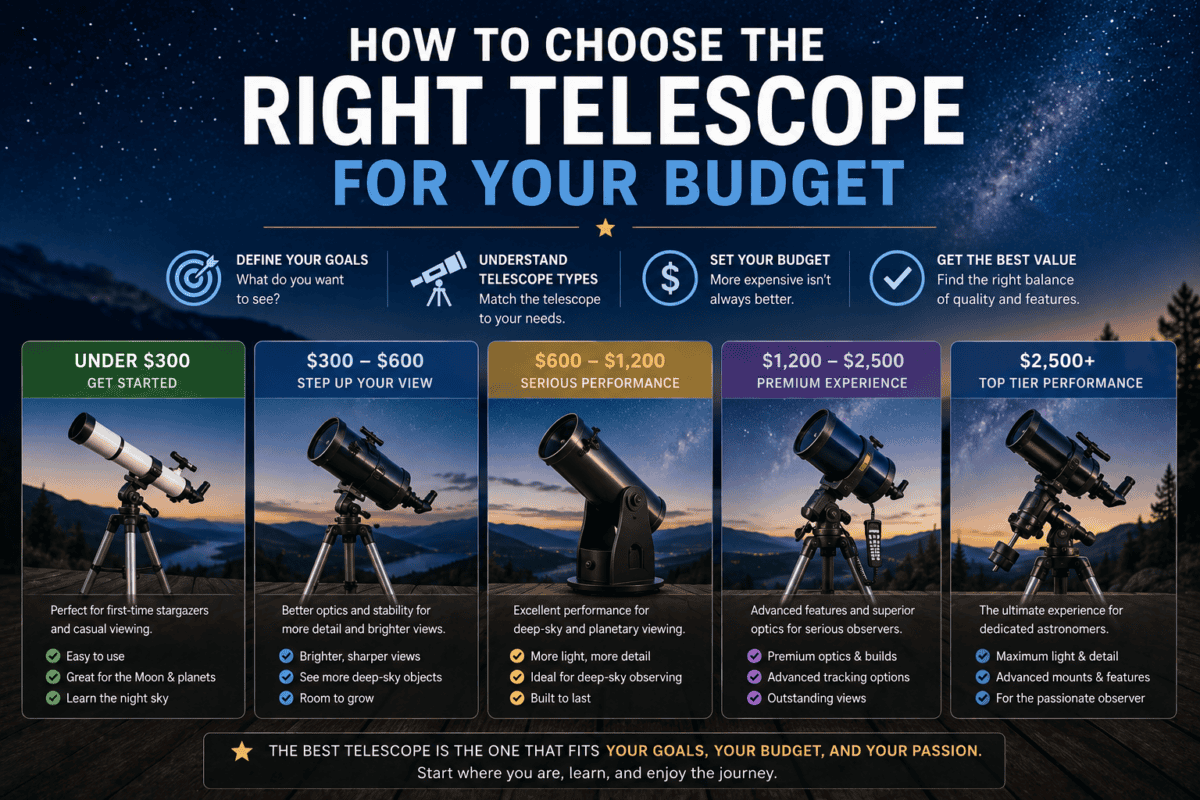
How to Choose the Right Telescope for Your Budget
One of the most common concerns when choosing your first telescope is cost.
This is understandable.
A telescope is often a carefully considered purchase rather than an impulse buy.
The encouraging news is that astronomy can be enjoyed at many different budget levels.
You do not need to spend thousands of dollars to begin exploring the night sky.
In fact, many experienced observers would recommend starting with a sensible, well-built telescope rather than immediately investing in the largest model you can afford.
A modest telescope can reveal an extraordinary amount.
More importantly, it allows you to develop observing skills and discover what aspects of astronomy you enjoy most.
As your experience grows, your understanding of equipment naturally deepens.
Many astronomers eventually upgrade.
That is not a sign that their first telescope was a mistake.
It is simply part of the learning process.
Choosing your first telescope is not about making a perfect lifetime purchase.
It is about making a sensible first step.
Our Recommended Beginner Telescope Pathways
Choosing your first telescope doesn’t have to be overwhelming.
By now, you’ve learned that there is no single “best” telescope for every beginner. The right telescope depends on your interests, your observing goals, your budget, and the type of experience you want from the hobby.
Some people dream of exploring the Moon’s craters and the rings of Saturn. Others are fascinated by distant galaxies, nebulae, and star clusters. Many beginners want a telescope that allows them to explore a little of everything.
The recommendations below are designed to help you match your interests with a telescope that can provide years of enjoyment without unnecessary complexity or expense.
Remember, the goal is not to find the perfect telescope. The goal is to choose a telescope that helps you get outside, look up, and enjoy the night sky with confidence.
Best Telescope for Moon and Planet Observers
If your primary interest is viewing the Moon, Jupiter, Saturn, Venus, and the brighter planets of our solar system, you don’t necessarily need the biggest telescope available.
Many beginners are surprised to discover that some of the most enjoyable astronomical sights can be observed with relatively modest equipment. The Moon alone contains enough detail to keep many observers fascinated for years, while Jupiter’s cloud bands and Saturn’s rings can provide unforgettable viewing experiences.
For this style of observing, sharpness and contrast are often more important than extreme light-gathering power. A quality refractor or compact reflector can provide excellent views while remaining easy to set up and use.
Moon and planetary observing are particularly well-suited to suburban backyards because these bright objects remain visible even in areas affected by moderate light pollution.
Why This Type of Telescope Works Well
• Excellent views of the Moon’s craters and surface detail
• Sharp views of Jupiter, Saturn, Venus, and Mars
• Easy to set up and maintain
• Suitable for suburban locations
• Beginner-friendly learning curve
Our Recommendation
Apertura AD8 Dobsonian 8″ Telescope with Accessories
This telescope offers an excellent balance of performance, simplicity, and value for beginners who want to focus primarily on lunar and planetary observing. It provides enough capability to reveal impressive detail while remaining straightforward to use and enjoy.
Best Telescope for Deep-Sky Observers
Some people look up at the night sky and immediately become fascinated by what lies beyond our solar system.
They want to explore star clusters, glowing nebulae, distant galaxies, and the countless objects scattered throughout the Milky Way. For these observers, astronomy becomes a journey into the deeper universe.
If this sounds like you, one of the most important considerations when choosing your first telescope is light-gathering ability. Unlike the Moon and planets, many deep-sky objects are faint. The more light a telescope can collect, the more detail becomes visible.
This is why Dobsonian telescopes are often recommended to beginners interested in deep-sky observing. They provide a larger aperture for the money than many other telescope designs and can reveal an astonishing variety of celestial objects.
It’s important to keep expectations realistic. Even with a good telescope, galaxies and nebulae will not appear exactly as they do in magazine photographs or online images. Those pictures are often created using long-exposure photography and advanced image processing.
What a telescope can provide is something arguably more valuable: the experience of seeing these objects with your own eyes. There is something remarkable about looking at a distant galaxy and knowing the light entering your telescope began its journey millions of years ago.
Why This Type of Telescope Works Well
• Excellent light-gathering ability
• Ideal for galaxies, nebulae, and star clusters
• Outstanding value for money
• Simple and reliable design
• Plenty of room to grow as your experience develops
Our Recommendation
Sky-Watcher Classic 200P Dobsonian (8-inch)
The Sky-Watcher Classic 200P is often regarded as one of the best-value deep-sky telescopes available to beginners. Its larger aperture gathers significantly more light than a smaller telescope, allowing you to explore a wider range of celestial objects while remaining straightforward to use. For many amateur astronomers, an 8-inch Dobsonian becomes a telescope they continue enjoying for many years.
Best All-Round Beginner Telescope
Not everyone knows exactly what they want to observe when they first begin exploring astronomy.
Some people are fascinated by the Moon and planets. Others are drawn to galaxies and nebulae. Many beginners want a telescope that allows them to experience a little of everything while they discover what interests them most.
For these observers, versatility becomes more important than specialization.
An all-round beginner telescope should provide enjoyable views of the Moon, planets, star clusters, and brighter deep-sky objects without becoming overly complicated or expensive. It should be capable enough to keep you interested as your knowledge grows, while remaining simple enough to encourage regular use.
This is often the safest choice for first-time buyers because it allows you to explore different areas of astronomy before deciding where your long-term interests lie.
Rather than purchasing a telescope designed for a single purpose, many beginners benefit from choosing equipment that performs well across a wide range of observing conditions.
Why This Type of Telescope Works Well
• Excellent balance between planetary and deep-sky observing
• Beginner-friendly setup and operation
• Versatile enough for many different targets
• Strong value for money
• Suitable for long-term enjoyment and learning
Our Recommendation
Sky-Watcher Classic 150P Dobsonian (6-inch)
The Sky-Watcher Classic 150P Dobsonian is one of the most balanced beginner telescopes available. It provides enough aperture to reveal impressive views of the Moon, planets, star clusters, and many deep-sky objects while remaining affordable and easy to use. For beginners who are unsure where their astronomy journey will lead, it offers an excellent combination of capability, simplicity, and value.
For many observers, a 6-inch Dobsonian becomes the telescope that teaches them the night sky, develops their observing skills, and provides years of memorable experiences under the stars.
Best Telescope for Families
Many people don’t buy their first telescope for themselves.
They buy one for a son or daughter who has become interested in space. Others buy a telescope for a grandchild, a partner, or as a family activity that everyone can enjoy together.
In these situations, simplicity becomes incredibly important.
The best family telescope is often not the telescope with the most features. It is the telescope that gets used regularly. Complicated equipment can create frustration, while a simple telescope that is quick to set up often encourages curiosity, learning, and shared experiences under the night sky.
A family telescope should provide rewarding views without requiring extensive technical knowledge. The goal is to spend more time observing and less time assembling equipment or navigating complicated instructions.
Many lifelong astronomers can trace their interest back to a simple telescope and a memorable evening spent looking at the Moon with family members. Sometimes that first experience is all it takes to spark a lifelong fascination with the universe.
Why This Type of Telescope Works Well
• Easy for children and adults to use
• Quick setup and minimal maintenance
• Excellent Moon and planetary views
• Encourages family participation
• Affordable and beginner-friendly
Our Recommendation
Sky-Watcher Heritage 130P Tabletop Dobsonian
The Sky-Watcher Heritage 130P is one of the most beginner-friendly telescopes available. It provides impressive views for its size, requires minimal setup, and is easy to transport and store. For families looking for a telescope that offers genuine capability without unnecessary complexity, it represents an excellent starting point.
Your First Telescope Is Not Your Last Telescope
This may be the most reassuring idea in this entire guide.
Many beginners approach telescope buying as though they are making a permanent decision.
Experienced astronomers rarely think that way.
Interests evolve.
Skills improve.
Goals change.
Someone who initially enjoys lunar observing may later develop an interest in deep-sky objects.
A family telescope may eventually become a personal observing instrument.
A larger Dobsonian may later complement a compact telescope.
This is completely normal.
The first telescope is not about reaching the final destination.
It is about beginning the journey.
A good first telescope teaches you what kind of observer you are.
That knowledge becomes invaluable when future decisions arise.
Final Thoughts: Choose With Confidence
Choosing your first telescope does not need to be intimidating.
There is no perfect telescope. There is only the telescope that best matches your interests, expectations, and budget at this stage of your astronomy journey.
The most important step is not finding the largest, most expensive, or most feature-rich telescope. The most important step is choosing a telescope that encourages you to step outside, look up, and begin exploring the night sky for yourself.
Whether your interests lie with the Moon, the planets, distant galaxies, or simply sharing the experience with family and friends, there has never been a better time to begin.
Remember that your first telescope is exactly that—your first telescope. As your knowledge grows, your interests may evolve, and your equipment may change. That is a normal part of the journey experienced by almost every astronomer.
Start where you are.
Learn at your own pace.
Enjoy the process.
The night sky has been inspiring people for thousands of years, and your journey is only just beginning.

For more expert advice and information