Learn how to spot a hobby killer telescope before you buy. Discover three warning signs, why 600x magnification misleads, and what to choose instead. Imagine buying your first telescope, carrying it into the backyard and pointing it towards the Moon. The box promises 600x magnification, and the photographs suggest that Saturn’s rings and Jupiter’s cloud belts will look spectacular.
But when you try to focus, the image shakes. The Moon looks blurry, and every adjustment sends it bouncing across the eyepiece. Finding another object is even harder. After several frustrating attempts, the telescope ends up in a cupboard.
Astronomy enthusiasts sometimes call this a hobby-killer telescope: equipment that makes getting started so frustrating that beginners give up before discovering how enjoyable stargazing can be.
The problem isn’t necessarily that the buyer chose a cheap telescope. Some affordable telescopes are excellent. The real problem is buying equipment that looks impressive in its advertising but performs poorly in everyday use.
Fortunately, three warning signs can help you spot a potential hobby killer before you spend your money.
What Is a Hobby Killer Telescope?
A hobby killer telescope is a telescope that creates more frustration than enjoyment for the person using it.
It may have perfectly serviceable optics but an unstable mount. It might be difficult to aim, awkward to focus, or supplied with accessories that make observing unnecessarily complicated.
Sometimes the equipment itself is adequate, but the advertising creates expectations no beginner telescope can meet.
The result is often the same. Instead of learning to recognize lunar craters, follow Jupiter’s moons or locate bright star clusters, the beginner spends the evening struggling with the telescope.
That is particularly unfortunate because astronomy doesn’t have to be difficult to enjoy. The Moon alone offers an extraordinary variety of features, and even modest equipment can reveal sights invisible to the unaided eye.
The important thing is choosing a telescope that makes those first discoveries possible.
Warning Sign 1:
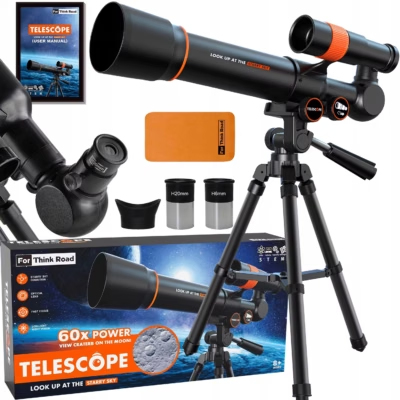
The Box Promises 600x Magnification.
One of the clearest warning signs is a telescope advertised primarily by an enormous magnification figure.
You might see claims like 400x, 500x, or 600x printed prominently on the packaging, while the aperture and mount get much less attention.
These numbers are designed to impress, but they tell you very little about the quality of the view.
Why Magnification Doesn’t Equal Detail
A telescope’s main lens or mirror collects light and forms an image. The eyepiece magnifies that image so you can examine it.
But magnification cannot reveal detail the telescope didn’t capture in the first place.
Imagine enlarging a slightly blurry photograph on your computer. The image gets bigger, but the missing detail doesn’t suddenly appear. Eventually, you have a larger blurry photograph.
Something similar happens when you push a telescope beyond its useful magnification.
The image becomes dimmer, atmospheric turbulence becomes more noticeable, and focusing becomes increasingly difficult.
Aperture, the diameter of the main lens or mirror, matters far more because it affects both light-gathering ability and the detail the telescope can resolve.
How Much Magnification Is Actually Useful?
A commonly used upper-limit guideline is approximately 50 times the telescope’s aperture in inches, or twice its aperture in millimeters.
For example:
| Telescope aperture | Approximate theoretical upper limit |
| 60 mm | 120x |
| 70 mm | 140x |
| 100 mm | 200x |
| 150 mm (6 inches) | 300x |
| 203 mm (8 inches) | 400x |
These figures are approximate theoretical limits, not magnifications you should expect to use every night. A telescope’s practical magnification is often much lower because atmospheric turbulence, optical quality, and observing conditions limit how much detail remains visible.
For example, an 8-inch telescope may have a theoretical limit around 400x, but many of its most rewarding views are obtained at substantially lower powers. The Apertura AD8, which we discuss later, illustrates why aperture, image clarity, and stability matter more than the largest magnification number printed on a box.
The manufacturer’s recommended magnification and the telescope’s optical specifications are worth consulting, but neither guarantees a sharp view at a particular power. The atmosphere ultimately affects what you can see.
That is why a well-made telescope that produces a sharp image at 100x can be far more satisfying than a poorly mounted instrument struggling at 500x.
What to look for instead: Check the aperture, optical design, mount quality, and supplied eyepieces. Treat extreme magnification claims as a reason to investigate further, not as proof of a better telescope.
Warning Sign 2:
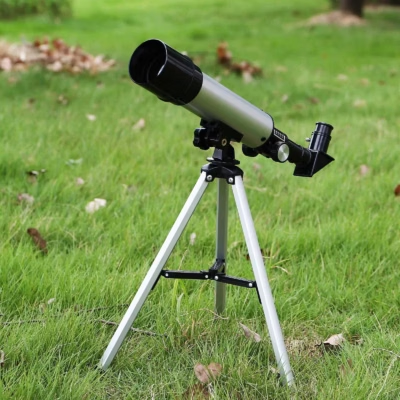
The Mount Shakes Every Time You Touch It
A telescope’s mount rarely gets the attention it deserves.
Buyers naturally focus on the optical tube because that is the part that looks like a telescope. Yet the mount determines whether you can aim the instrument accurately, focus comfortably, and keep an object in view.
Even excellent optics cannot compensate for a mount that constantly vibrates.
Why a Shaky Mount Ruins the Experience
Suppose you have located Jupiter and want to examine its cloud belts.
You touch the focusing knob, but the telescope shakes.
You wait for the image to settle, make another adjustment, and the shaking starts again.
By the time you find a reasonably sharp image, Jupiter has drifted towards the edge of the field of view because Earth is rotating.
You try to move the telescope slightly, but the mount sticks and then jumps too far.
Instead of concentrating on Jupiter, you spend the evening fighting the equipment.
This is why mount stability matters just as much as the telescope’s optical specifications.
How to Recognize a Poor Mount
If you can examine a telescope in person, gently move it and see how smoothly it responds. Check whether the optical tube settles quickly after you touch it and whether the focusing controls operate without excessive vibration.
Be particularly cautious with tall, lightweight tripods supporting relatively long telescope tubes.
A tripod that looks adequate in a product photograph may be much less stable when the telescope is pointed towards the sky.
Also consider the controls. A beginner should be able to make small, deliberate movements without the telescope sticking, slipping, or suddenly changing direction.
Why Dobsonian Mounts Are Popular
A Dobsonian telescope uses a simple base that supports the optical tube close to the ground.
The telescope moves up and down and rotates from side to side. There are no complicated alignment procedures for a standard manual Dobsonian.
Because the base provides a broad, stable support, this design can offer excellent stability without an expensive mounting system.
That doesn’t mean every beginner should buy a Dobsonian. A well-mounted refractor can also be an excellent choice, especially when portability is important.
The principle is the same: choose a telescope with a mount that’s stable, smooth, and easy to control.
Warning Sign 3:
The Accessories Look Impressive but Make Observing Harder
A telescope package can appear generous because it includes several eyepieces, a high-powered Barlow lens, a finder, and assorted accessories.
But the number of items in the box says little about their quality.
Some inexpensive packages include accessories primarily to support impressive advertising claims rather than to make observing easier.
The 3x Barlow Magnification Trap
A Barlow lens increases an eyepiece’s effective magnification. A 2x Barlow doubles it, while a 3x Barlow triples it.
A good Barlow can be a useful accessory, but it cannot create detail the telescope’s optics haven’t resolved.
Suppose a telescope produces 150x magnification with a particular eyepiece. Adding a 3x Barlow increases that figure to 450x.
The resulting image may be much larger, but if the telescope and atmospheric conditions cannot support that magnification, it will also be dimmer and blurrier.
This is why a package that promotes extreme magnification through combinations of short-focal-length eyepieces and inexpensive Barlow lenses deserves careful examination.
The question isn’t whether a Barlow is included. It’s whether the combination produces a useful image.
Outdated Eyepiece Sizes
Another detail worth checking is the eyepiece barrel diameter.
Most modern beginner telescopes accept standard 1.25-inch eyepieces, while some also accommodate larger 2-inch eyepieces.
Older or particularly inexpensive telescopes sometimes use 0.965-inch eyepieces.
That smaller format is not automatically evidence of poor optics, but it can limit your choice of replacement eyepieces and accessories.
For a new beginner telescope, compatibility with modern, readily available eyepieces is a practical advantage.
A Finder That Makes Targets Harder to Locate
A finder helps you aim the main telescope at an object before looking through the eyepiece.
Common designs include optical finders and red-dot finders. Both can work well when properly made and aligned.
Problems arise when a finder is difficult to adjust, poorly mounted, or too awkward to use accurately.
Some basic sighting tubes can help with rough aiming, but a poorly designed finder may make locating even bright objects unnecessarily frustrating.
Before buying, check what type of finder is included and whether you can align it reliably.
What to look for instead: A telescope with a stable mount, a practical finder, and one or two useful eyepieces is often a better purchase than a package containing numerous low-quality accessories.
What Does a Hobby Killer Telescope Really Cost?
Imagine spending US$150 on a telescope that promises impressive views but proves difficult to use.
You spend an evening assembling it, another trying to find the Moon, and several more struggling to focus or keep an object in view.
Eventually, you stop using it.
The financial loss is disappointing, but the higher cost may be the price of an opportunity to enjoy a hobby you never properly experienced.
That doesn’t mean a beginner must spend US$500 or more to enjoy astronomy. Affordable binoculars, a well-made small refractor, or a carefully chosen second-hand telescope can all provide rewarding experiences.
Nor does every inexpensive telescope deserve the hobby killer label. Some modestly priced instruments perform very well within their limitations.
The lesson is to consider value rather than simply the lowest purchase price.
A telescope that works reliably and gets used regularly can be a much better investment than a cheaper instrument that makes observing unnecessarily difficult.
What Should You Buy Instead of a Hobby Killer?
Avoiding a poor telescope doesn’t mean spending a fortune. It means choosing equipment with sound optics, a stable mount, and realistic specifications.
It also helps to buy from a retailer who understands astronomy equipment.
A specialist telescope retailer should be able to explain the instrument’s aperture, optical design, mount, included accessories, and practical limitations. More importantly, they should help you decide whether the telescope suits what you want to observe.
Before buying, consider asking:
-
- What can I realistically see through this telescope?
- Is the mount stable enough for planetary observing?
- How much does the complete telescope weigh?
- Does it require collimation, batteries, or computer alignment?
- What eyepieces and finder are included?
- What support is available if I need replacement parts or assistance?
A general retailer can sell good telescopes, but detailed specifications and knowledgeable after-sales support matter, especially for a first-time buyer.
Two examples worth comparing are the Apertura AD6 and AD8 Dobsonian telescopes, available through specialist astronomy retailer High Point Scientific.
They are not the only suitable beginner telescopes, and neither will suit every home or budget. But they illustrate what a thoughtfully designed visual telescope can offer.
The prices below are in US dollars and were checked against High Point Scientific in October 2026. Prices, availability, and additional charges may change.
Apertura AD6: A Sensible 6-Inch Starting Point
Listed price: US$499.95 — checked October 2026
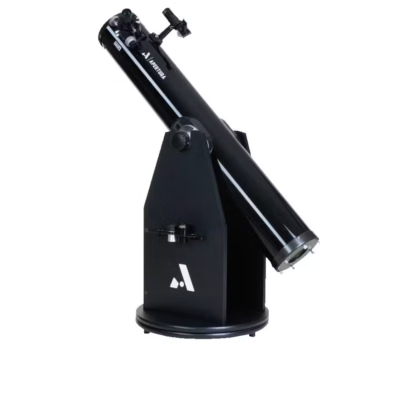
The Apertura AD6 is a 152 mm (6-inch) Newtonian reflector on a manual Dobsonian mount.
Its mirror collects enough light for rewarding views of the Moon, planets, many star clusters, and brighter nebulae, particularly when observing conditions are favorable.
It also provides a stable base and a straightforward observing experience without requiring batteries or computerized alignment.
The AD6 comes with a dual-speed focuser, two eyepieces, and an optical finder, giving beginners the equipment they need to get started.
It is a good option for someone who wants a capable telescope for visual astronomy but doesn’t need the extra aperture of an 8-inch model.
However, it is still a substantial instrument. The complete telescope weighs approximately 19.5 kg, with the tube and base moved separately.
That is worth considering if you need to carry it up stairs or transport it frequently.
Who it suits: Beginners with some storage space who want a capable all-round visual telescope and prefer simple manual operation.
Apertura AD8: More Light, More Possibilities
Listed price: US$699.95 — checked October 2026
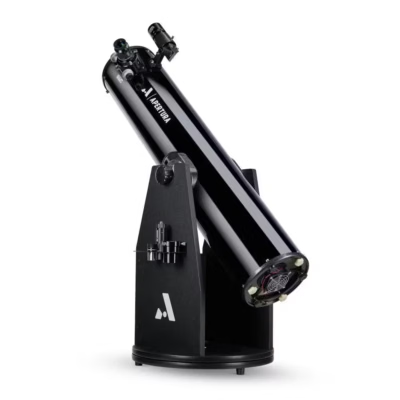
The Apertura AD8 uses a 203 mm (8-inch) primary mirror.
Compared with a 6-inch telescope, it gathers approximately 78% more light before accounting for differences in optical design and transmission.
That additional light can make faint objects easier to detect and can reveal more detail when the atmosphere and optical quality allow.
For someone interested in exploring star clusters, nebulae and galaxies over many years, the extra aperture is appealing.
The AD8 also uses a manual Dobsonian mount, so its basic operation remains straightforward.
It includes useful observing accessories, including two eyepieces, an optical finder and a collimation tool.
But there is an important trade-off: the complete telescope weighs approximately 23.7 kg, and the tube is bulky.
If moving that equipment outside feels like a chore, the extra aperture may not be worth it.
Who it suits: Beginners with suitable storage space who can comfortably move the equipment and want greater light-gathering capability for visual observing.
AD6 or AD8: Which Is the Better Choice?
| Consideration | Apertura AD6 | Apertura AD8 |
| Aperture | 152 mm (6 inches) | 203 mm (8 inches) |
| Light gathering | Good | Approximately 78% more |
| Mount | Manual Dobsonian | Manual Dobsonian |
| Total weight | Approximately 19.5 kg | Approximately 23.7 kg |
| Listed price, October 2026 | US$499.95 | US$699.95 |
| Portability | Easier of the two to handle | Larger and bulkier |
| Best reason to choose | Balance of capability and practicality | Greater potential for faint-object observing |
If you can comfortably handle either telescope and have suitable storage space, the AD8 offers more light-gathering power.
But if you would willingly carry the AD6 outside several evenings a week, that is a very good reason to choose it.
A telescope doesn’t reveal anything while it is sitting in storage.
We’ll explore the differences in greater detail in our forthcoming 6-Inch vs 8-Inch Telescope comparison.
A Good First Telescope Doesn’t Have to Be Large
It is important not to turn advice about hobby killers into a claim that everyone needs a 6-inch or 8-inch Dobsonian.
A well-made 70 to 90 mm refractor on a stable mount can provide excellent views of the Moon, Jupiter’s moons, Saturn’s rings when favorably tilted, and bright star clusters.
A compact tabletop reflector may also suit someone with limited storage space, provided it has a suitable stable surface.
And for people who aren’t ready to buy a telescope, binoculars can be a rewarding way to start exploring the night sky.
What matters is that the equipment works well for its intended purpose.
A small, reliable telescope that is easy to use is not a hobby killer. A much larger telescope that is too awkward to set up can be frustrating for an entirely different reason.
Your First Telescope Should Encourage You to Keep Looking
Think about what a successful first evening of astronomy might involve.
You set up your telescope without difficulty, point it towards the Moon and bring the image into focus.
The view is steady enough to examine the shadows inside a crater. You move across the lunar surface, discovering features invisible to the unaided eye.
On another evening, you find Jupiter and notice tiny points of light beside it. When you return a few nights later, those points have moved because they orbit the planet.
These experiences don’t require enormous magnification or expensive computerized equipment.
They require a telescope that is comfortable to operate, provides a clear image, and lets you focus on the sky rather than the machinery.
For a realistic guide to the sights available through beginner equipment, read What Can You See With a Telescope?.
The Three Checks That Can Save Your First Telescope Purchase
Before you buy, ask these three questions.
1. Is the telescope being sold on genuine optical performance or exaggerated magnification? Look for clear aperture specifications and realistic observing claims.
2. Is the mount stable and easy to operate? A steady image and smooth movement are essential to an enjoyable observing experience.
3. Are the supplied accessories genuinely useful? Check the eyepiece size, finder quality, and whether the advertised magnification combinations make sense.
These checks won’t guarantee that every telescope is perfect for you, but they can help you avoid many of the problems that discourage beginners.
If you are still deciding which design and aperture best suit your needs, our guide to choosing your first telescope takes you through the buying decision step by step.
If you are ready to compare equipment, High Point Scientific offers a range of beginner telescopes and accessories.
The goal isn’t simply to buy a telescope. It’s to choose one that makes you want to go outside and use it again.
Explore beginner telescopes,binoculars and best stargazing apps for beginners here:
Affiliate disclosure: White Star Outdoors may earn a commission if you purchase through certain retailer links, at no additional cost to you. Product recommendations are based on suitability and stated specifications, not commission rates.