Dobsonian vs GoTo vs Smart Telescope:
Imagine your first clear evening with a new telescope.
You’ve been looking forward to it for weeks. Jupiter is shining brightly, Saturn is somewhere above the horizon, and you’re finally ready to discover what the night sky looks like through your own equipment.
But you need to decide before you spend a dollar.
Do you want to find celestial objects yourself, have a telescope find them for you, or watch the universe appear on a screen?
These are three different experiences, and choosing the wrong one can be disappointing even when you’ve purchased excellent equipment.
For most beginners who want to look directly through an eyepiece, a manual Dobsonian is our first choice. It offers useful aperture, a stable mount, and straightforward operation without relying on motors or complicated electronics.
A computerized GoTo telescope is worth considering if you want help locating and tracking objects. A smart telescope makes more sense if your main interest is photographing galaxies, nebulae, and star clusters.
None is automatically better than the others.
A telescope should suit how you want to observe, not how someone else thinks you should enjoy astronomy.
Let’s work out which experience is right for you.
1. Three Telescopes, Three Different Experiences
Before comparing specifications or prices, understand what you’re actually buying.
Manual Dobsonian: You explore the sky
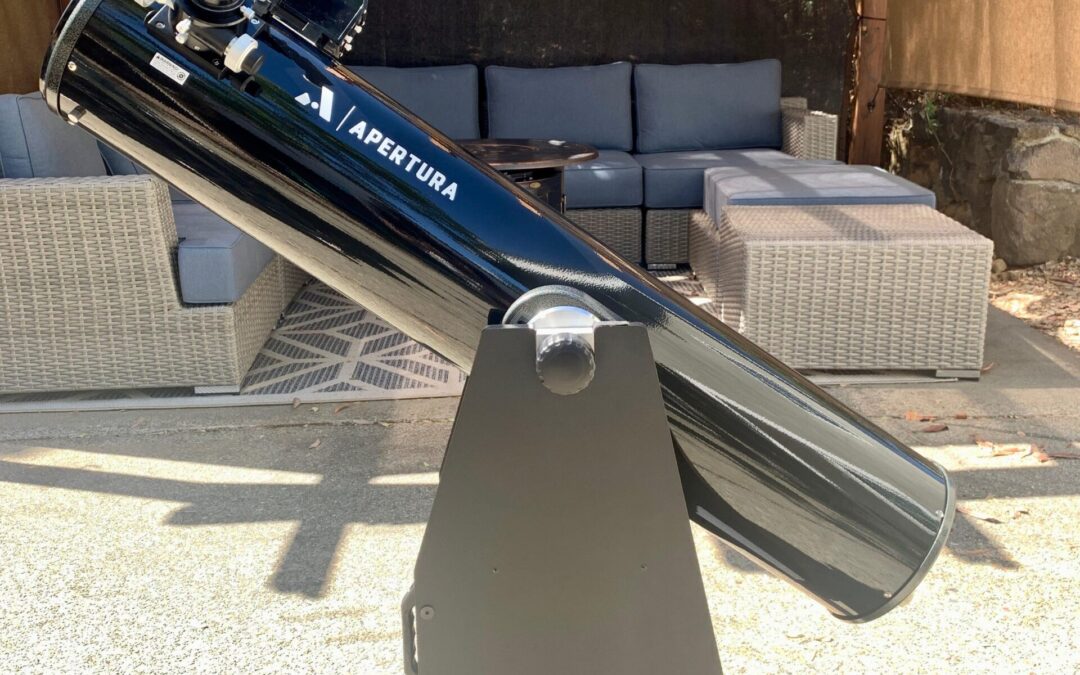
A traditional Dobsonian uses a reflecting telescope mounted on a simple, stable base.
You point it towards an object, move it by hand, and look through an eyepiece.
Finding objects is part of the experience. You might start with the Moon, locate Jupiter, and then use an astronomy app to find the Orion Nebula.
There’s satisfaction in recognizing a constellation, following its stars and discovering something you couldn’t see with your unaided eyes.
Computerized GoTo: The telescope helps you find objects
A GoTo telescope uses motors and a computerized control system to locate selected celestial objects.
After setup and alignment, you choose an object, and the telescope moves toward it.
Most GoTo systems also track objects as Earth rotates, helping keep them within the eyepiece.
You’re still observing directly through the telescope. The computer helps with navigation and tracking.
Smart telescope: You capture the sky digitally
A smart telescope combines optics, a camera, automated pointing, and image-processing software.
Instead of looking through a conventional eyepiece, you generally view the result on a smartphone or tablet.
The telescope can collect multiple exposures and combine them to reveal faint details and colors that may be difficult to see visually.
You might select the Orion Nebula and watch its image develop on your screen.
That’s an exciting experience, but it isn’t the same as seeing the nebula directly through an eyepiece.
The most important difference isn’t the technology. It’s how you experience the night sky.
2. Which Telescope Matches Your Interests?
| Telescope type | What you’re choosing |
Manual Dobsonian | Direct eyepiece observing, hands-on exploration, and useful aperture for your money |
Computerized GoTo | Direct eyepiece observing with automated object finding and tracking |
Smart telescope | Automated digital imaging, usually viewed and saved through an app |
There’s another important distinction.
A Dobsonian describes a type of mount, not necessarily a lack of electronics. Motorized GoTo Dobsonians exist, and some manual telescopes offer smartphone-assisted navigation.
For this comparison, we’re considering the three common beginner approaches.
3. Why a Manual Dobsonian Is Our First Choice
A manual Dobsonian remains one of the strongest options for beginners interested in traditional visual astronomy.
Its straightforward design lets you put more of the purchase price toward optics and a stable mount rather than motors and electronics.
That matters because aperture, the diameter of the main mirror or lens, determines how much light a telescope can collect and influences the fine detail it can resolve.
A larger aperture makes faint objects easier to detect and reveals more detail on the Moon and planets.
What makes a Dobsonian rewarding?
Imagine finding Saturn yourself.
You locate the correct part of the sky, move the telescope carefully, and look through the eyepiece.
At first, you see a bright object.
Then you adjust the focus, and those unmistakable rings become visible.
It’s a small image, nothing like a spacecraft photograph, but you’re seeing the real planet with your own eyes.
And you’ve found it yourself.
For someone who enjoys learning by doing, that’s part of the appeal.
Two practical Dobsonian examples
Its 203 mm mirror offers generous light-gathering ability for exploring the Moon, planets, star clusters, nebulae and brighter galaxies.
For beginners with suitable storage space who can comfortably move the telescope, it offers an excellent balance of capability, stability and value.
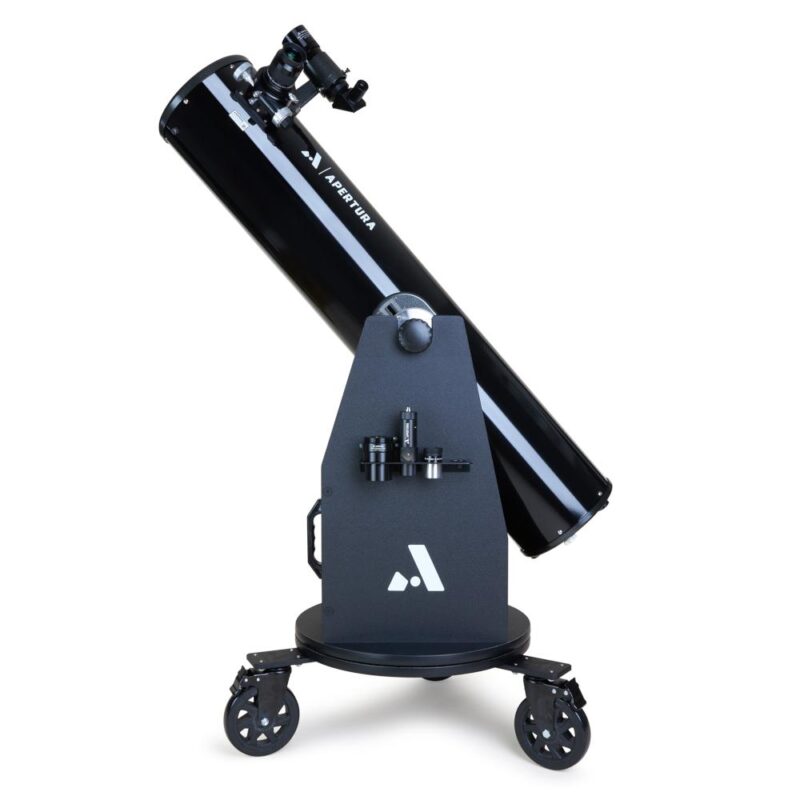
Its 152 mm mirror still provides rewarding views of lunar craters, Jupiter’s cloud belts, Saturn’s rings and numerous brighter deep-sky objects.
The AD8 collects approximately 78% more light than the AD6 by geometric mirror area, giving it an advantage when observing faint objects under suitable conditions.
Our October 2026 regular reference prices were US$699.95 for the AD8 and US$499.95 for the AD6. Check the retailer for current offers.
The trade-off is physical size. Both are substantial instruments, and the AD8 requires more storage and handling space.
If you have to carry your telescope upstairs or regularly transport it to a dark-sky location, the AD6 may be the more practical choice.
The best telescope isn’t necessarily the largest one you can afford. It’s the one you can comfortably use.

Apertura AD8 8-inch manual Dobsonian reflector telescope
The drawback beginners should understand
A manual Dobsonian doesn’t find objects automatically.
You’ll need to learn how to use a finder scope, star chart, or astronomy app.
You’ll also need to move the telescope occasionally to follow objects as Earth rotates.
For some beginners, that’s enjoyable. For others, particularly those observing under heavily light-polluted skies, searching for faint objects can become frustrating.
If learning the sky appeals to you, a manual Dobsonian is an excellent starting point.
If finding objects sounds like an obstacle rather than part of the enjoyment, consider GoTo.
4. When a GoTo Telescope Is Worth the Extra Money
One of the most frustrating experiences in beginner astronomy is knowing an object is somewhere above you but being unable to locate it.
A computerized GoTo telescope can reduce that frustration by using motors and electronic controls to find and track celestial objects.
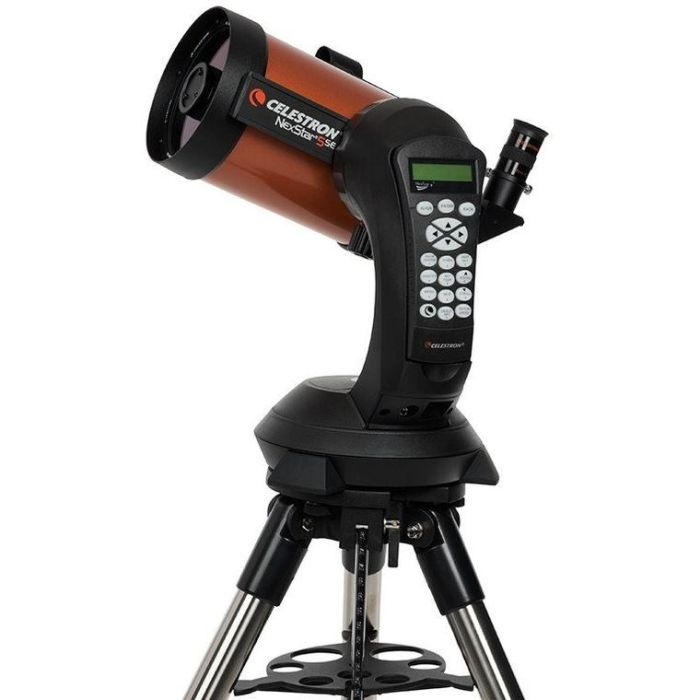
It combines a compact 5-inch Schmidt-Cassegrain telescope with a motorized mount and Celestron’s SkyAlign technology.
After you complete the alignment procedure, you can select an object from the telescope’s database and let the mount locate it.
But this convenience comes with trade-offs involving aperture, cost, power, and additional equipment.
Let’s look at what you’re actually getting.
What the larger aperture means in practice
The NexStar 5SE has a 125 mm aperture, with a secondary mirror that obstructs about 40% of its diameter.
After accounting for that obstruction, its unobstructed collecting area is equivalent to a circular aperture of about 115 mm.
The AD6’s 152 mm primary mirror has roughly 1.7 times that geometric collecting area before accounting for its own secondary obstruction, mirror reflectivity, and other optical losses.
That doesn’t mean every object will appear 70% brighter through the AD6. The actual visual result depends on the complete optical system and observing conditions.
But it demonstrates why a larger-aperture manual Dobsonian can offer more light-gathering capability for considerably less money.
Compare what’s included in the box.
The AD6 includes two eyepieces: a 25 mm providing 48× magnification and a 9 mm providing approximately 133×.
The standard NexStar 5SE package includes one 25 mm eyepiece providing 50×.
That means an AD6 buyer can explore the Moon and planets at useful higher magnification without buying another eyepiece right away.
It’s a small detail, but an important one when comparing the total cost of getting started.
The portability advantage
The NexStar 5SE has one practical advantage that’s easy to overlook: it packs into a relatively compact arrangement.
You can separate its optical tube, motorized mount, and tripod for storage and transport.
The telescope’s principal components weigh approximately 6, 7, and 10 pounds, respectively, for a combined weight of around 23 pounds.
Compare that with approximately 42.9 pounds for the Apertura AD6.
Although the exact packed dimensions and handling arrangements matter as much as the total weight, the 5SE can be more convenient for someone living in a flat, carrying equipment upstairs or storing a telescope in a cupboard.
A telescope that is easy to take outside is more likely to be used regularly.
For some beginners, portability may matter more than the 5SE’s computerized pointing system.
The power requirement
The NexStar 5SE can operate using eight AA batteries or a suitable external 12-volt power supply.
The AA batteries aren’t included in the standard package, so you’ll need to arrange a power source.
Some retailer packages include an external power adapter as a promotional extra. Check the exact package you’re purchasing.
Without a suitable power supply, you won’t have the normal motorized GoTo experience.
The included eyepiece
The standard telescope package includes a 25 mm eyepiece.
The telescope has a focal length of 1,250 mm.
That means the included eyepiece provides:
1,250 ÷ 25 = 50× magnification.
That’s a useful starting magnification, particularly for locating objects and observing the Moon.
But if you want to examine Jupiter or Saturn at around 130–200×, you’ll generally need a shorter-focal-length eyepiece or suitable additional optical accessory.
For example:
- A 9 mm eyepiece provides approximately 139×.
- A 6 mm eyepiece provides approximately 208×.
Atmospheric conditions won’t always support the higher magnification.
You don’t need to buy every accessory immediately, but the additional eyepiece cost belongs in your budget.
What does the 5SE actually show?
There’s another distinction worth making.
Celestron promotes the NexStar 5SE as capable of revealing deep-sky objects, including the Whirlpool Galaxy.
That’s technically reasonable: the galaxy is within the reach of a 5-inch telescope under suitable conditions.
But recognizing a galaxy isn’t the same as seeing the detailed spiral structure shown in promotional astrophotographs.
Through a 5-inch telescope, the Whirlpool Galaxy will generally appear as faint, diffuse light, with its two main galactic components potentially visible under favorable skies.
Its spiral arms are much harder to detect visually and require excellent conditions, experience, and suitable equipment.
A beginner shouldn’t expect the Whirlpool Galaxy to look like a colorful photograph through the eyepiece.
That doesn’t make the telescope disappointing.
It means understanding the difference between what the instrument can detect and what your eyes can resolve.
The optical trade-off: 5SE versus AD6
The NexStar 5SE uses a compact Schmidt-Cassegrain optical design.
Its f/10 focal ratio and 1,250 mm focal length make it relatively narrow-field compared with some shorter-focal-length telescopes.
The Apertura AD6 uses a larger 6-inch mirror and an approximately f/7.9 optical system with a 1,200 mm focal length.
The AD6 therefore offers greater light-gathering capability for considerably less money.
However, there’s an important qualification.
Focal ratio alone doesn’t determine the field of view. The eyepiece, its apparent field, and the telescope’s focal length also matter.
Because the 5SE and AD6 have similar focal lengths, they can produce similar magnifications and fields of view with the same eyepiece, subject to optical and mechanical limitations.
The AD6’s main optical advantage is its larger aperture, not a dramatic, automatic difference in field width.
The 5SE’s advantages are compactness, automated pointing and tracking.
That is the trade-off you’re paying for.
What does the 5SE cost?
High Point Scientific’s November 2026 reference price for the NexStar 5SE was US$1,114.84, although packages and promotions can change.
That’s substantially more than our October reference prices for the manual AD6 and AD8.
You’re paying for the compact optical design, motorized mount, object-location system, and tracking convenience.
You’re not paying for greater aperture.
And GoTo cannot make a faint galaxy brighter or overcome severe light pollution. It can point accurately towards an object that remains difficult to see.
A GoTo telescope makes sense if you want direct eyepiece observing but value automated navigation, tracking, and compact storage.
GoTo makes finding objects easier. It doesn’t remove every part of the learning process.

Celestron NexStar 5SE computerized GoTo telescope with hand controller
5. Smart Telescopes: When Digital Imaging Is the Better Choice
Smart telescopes offer a different kind of excitement.
Traditional visual observing depends on light reaching your eye in real time.
A smart telescope uses a camera to collect light over multiple exposures, then combines those images through software.
This process, commonly called live stacking, can reveal faint details and colors that aren’t normally apparent through a small visual telescope.
Imagine choosing the Whirlpool Galaxy on your phone.
The telescope points towards it, begins capturing images, and gradually reveals more of its spiral structure.
You can save the result, examine it later, and share it with someone who wasn’t there.
For astrophotography enthusiasts, that is a real draw.
What a Smart Telescope Actually Is
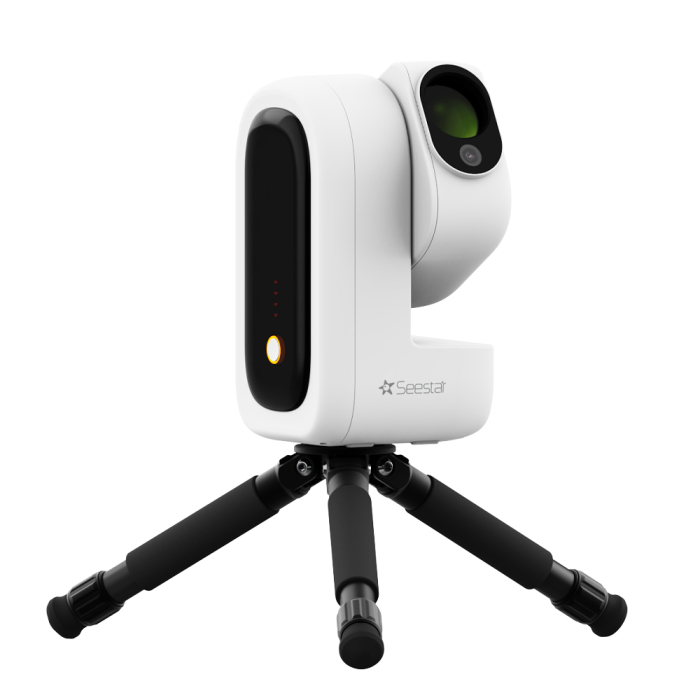
The ZWO Seestar S50 Pro illustrates how an integrated smart telescope works. It combines a 50 mm optical system, a digital camera, a motorized mount, electronic focusing, and app-based control.
The original S50 has been discontinued. Its successor, the Seestar S50 Pro, has a regular listed price of US$999.
The S50 Pro’s portability and convenience make it particularly appealing. At approximately 6.2 pounds, with 128 GB of internal storage and a claimed battery life of up to nine hours, it’s a very different proposition from the 42.9-pound Apertura AD6. ZWO also promotes a quick app-guided setup that can get beginners capturing images within minutes.
If you want something lightweight that you can carry outside, set up quickly, and use for digital astronomy without transporting a substantial telescope, the S50 Pro deserves serious consideration.
The Planetary Limitation You Need to Know
High Point Scientific’s own buying guidance makes an important distinction about the Seestar S50 Pro: it does not recommend this telescope for anyone whose main priority is resolving detail on Jupiter, Saturn, Mars, or the other planets. That is worth paying attention to. Even the retailer selling the telescope recognizes that planetary detail is not its main strength.
The original Seestar S50 has a 250 mm focal length. Its successor, the S50 Pro, uses an upgraded four-element optical system with a slightly longer 260 mm telephoto focal length, a larger sensor and 4K imaging capability. These are meaningful improvements, particularly for photographing nebulae, galaxies and wider areas of the night sky.
However, both instruments retain a 50 mm aperture and relatively short focal lengths. That limits the fine planetary detail they can resolve compared with larger visual telescopes or dedicated planetary imaging equipment. The S50 Pro can photograph bright solar-system objects, including the Moon and planets. Still, you shouldn’t expect the detailed cloud belts or sharply defined ring structures associated with specialized planetary imaging systems. That doesn’t make the S50 Pro a poor telescope. It simply means its strengths lie elsewhere.
If seeing Saturn’s rings directly through an eyepiece inspired you to explore astronomy, a traditional visual telescope such as the Apertura AD6 or AD8 is likely to provide a more satisfying result. If you’re more interested in capturing colorful nebulae, galaxies, and wide-field images, the S50 Pro may be a better match.
The important decision isn’t whether a smart telescope can photograph a planet. It’s whether planetary photography is the reason you’re buying it.
ZWO Seestar S50 compact smart telescope on tripod
What about light pollution?
Smart telescopes can have an advantage when capturing certain faint objects from suburban skies.
Their cameras collect light over time, and some models include filters that help with particular emission nebulae.
But digital processing doesn’t eliminate light pollution.
Galaxies and other broadband targets remain challenging under bright skies, and darker locations still produce better results.
A smart telescope is a powerful convenience, not a replacement for good observing conditions.
6. What Will You Actually See?
Let’s compare four popular targets.
The Moon
With a manual Dobsonian or GoTo telescope, you look directly through an eyepiece and see craters, mountain ranges, and shadows along the terminator.
The GoTo system can track the Moon automatically, while the manual Dobsonian requires occasional repositioning.
A smart telescope produces a digital view and can capture images, depending on its capabilities.
Saturn
A capable visual Dobsonian can reveal Saturn’s rings directly through an eyepiece.
A GoTo telescope provides a similar visual experience, with motorized tracking.
A compact smart telescope designed for deep-sky imaging is generally a less suitable choice for detailed planetary observations.
The Orion Nebula
Through a visual telescope, the Orion Nebula often appears as a luminous, misty region surrounding bright stars.
A GoTo telescope can locate it automatically, but the eyepiece view remains a visual observation.
A smart telescope can build a digital image over time, revealing colors and faint structures that are difficult to see directly.
The Pleiades: Why field of view matters
The Pleiades, also known as the Seven Sisters, are among the most beautiful and recognizable star clusters in the night sky.
They’re also an excellent example of why magnification isn’t everything.
The cluster’s bright central grouping spans roughly 1.8 degrees of sky.
The Apertura AD6 has a focal length of 1,200 mm. With a 25 mm eyepiece, it produces:
1,200 ÷ 25 = 48× magnification.
If that eyepiece has an apparent field of view of approximately 52 degrees, the resulting true field is about 1.08 degrees.
That’s narrower than the full bright grouping of the Pleiades.
You’ll see individual stars beautifully, but the wider cluster won’t fit comfortably into a single view.
The NexStar 5SE has a similar focal length and faces a comparable limitation with a typical 25 mm eyepiece.
This is an important reminder that a telescope designed for detailed views isn’t necessarily the best instrument for sweeping across large star clusters.
A wider-field eyepiece can help within the limits of the telescope’s optical design, but it won’t necessarily accommodate the entire cluster.
For the Pleiades, a good pair of binoculars may provide a more satisfying view.
Sometimes the best way to see more of the sky is to use less magnification, not more.
7. Automation Doesn’t Always Mean Easier
Here’s a distinction worth understanding before spending your money.
Every telescope has a learning curve.
A manual Dobsonian is mechanically simple but requires you to learn how to find objects.
A GoTo telescope reduces the searching but introduces alignment, power, and electronic controls.
A smart telescope automates much of the imaging process but introduces app setup, charging, software, and digital image capture.
Automation doesn’t remove difficulty. It often replaces one kind of difficulty with another.
If you enjoy finding your way around the sky, learning to use a Dobsonian may be satisfying.
If locating objects feels frustrating, GoTo could remove an important obstacle.
If you enjoy photography and digital technology, learning a smart telescope’s imaging workflow may be part of the fun.
The easiest telescope isn’t necessarily the most automated.
It’s the one whose learning process you actually want to undertake.
8. There’s Also a Middle Ground: Smartphone-Assisted Telescopes
Before deciding between manual and fully computerized equipment, consider a fourth approach.
Some telescopes use smartphone-assisted navigation to show you where to point without automatically moving the telescope.
You attach a compatible smartphone, select an object in the app, and follow the on-screen directions.
You still move the telescope yourself and observe through an eyepiece.
This approach can make finding objects easier without requiring a fully motorized GoTo system.
It doesn’t provide automatic tracking, but it may offer an appealing compromise for beginners who want guidance while retaining hands-on observing.
9. Three Beginners, Three Sensible Decisions
Sometimes the easiest way to choose is to imagine how you’ll actually use the equipment.
David wants to discover the sky himself.
David has always been fascinated by Saturn and the Moon.
He’s happy to spend time learning constellations and finding objects. He wants satisfying visual views without complicated electronics.
A manual Dobsonian is probably his best choice.
He can put more of his budget towards aperture and enjoy the satisfaction of finding objects himself.
Helen wants to spend more time observing and less time searching.
Helen enjoys astronomy but worries she’ll struggle to locate objects beyond the Moon.
She wants to show her grandchildren Jupiter and Saturn without constantly repositioning the telescope.
She’s comfortable with electronic controls and following an alignment procedure.
A computerized GoTo telescope may suit her better.
Automated pointing and tracking support the kind of night sky she wants to observe.
Michael wants to photograph what he discovers.
Michael is fascinated by colorful nebulae and distant galaxies.
He enjoys photography and wants to share his images with family and friends.
He’s less interested in traditional eyepiece observing.
A smart telescope may be his strongest starting point.
Its integrated camera and imaging software match his interests.
None of these beginners has made a better decision than the others.
Each has chosen equipment around a different motivation.
And that’s exactly how telescope buying should work.
Frequently Asked Questions
Is a Dobsonian better than a GoTo telescope?
For beginners who want generous aperture, straightforward operation, and traditional visual observing, a manual Dobsonian often offers excellent value. GoTo is better suited to people who prioritize automated object location and tracking. Some Dobsonians also include GoTo systems.
Can you look through a smart telescope with your eyes?
Most compact integrated smart telescopes use cameras and screens rather than conventional eyepieces. Check the particular model because designs vary.
Does GoTo make objects look brighter?
No. GoTo helps locate and track celestial objects. Their visual brightness and detail still depend on aperture, optical quality, atmospheric conditions, and light pollution.
Are smart telescopes good for planets?
Some can photograph the Moon and planets, but many compact smart telescopes are designed primarily for wide-field and deep-sky imaging. Traditional visual telescopes or dedicated planetary imaging systems are usually better suited to detailed views of Jupiter and Saturn.
Do Dobsonian telescopes need electricity?
Traditional manual Dobsonians don’t require electricity for ordinary observing. Motorized GoTo Dobsonians do require power for their electronic functions.
Can a beginner use a GoTo telescope?
Yes. Many GoTo telescopes are designed for beginners, although setup and alignment still take practice.
Is a smart telescope cheating?
Not at all. Digital imaging is a legitimate and rewarding form of astronomy. It simply offers a different experience from direct visual observing.
Final Thoughts: Choose the Experience Before the Equipment
There’s something wonderful about finding Saturn yourself and seeing its rings through an eyepiece.
There’s also satisfaction in selecting a distant galaxy and letting a computerized telescope locate it.
And there’s genuine excitement in watching the faint colors of a nebula emerge through digital imaging.
All three experiences belong in astronomy.
For most beginners who want direct visual observing, our top recommendation is the Apertura AD8 8-inch Dobsonian. It offers an excellent balance of aperture, stability, and value, as long as you have the space and can comfortably handle its size.
If you prefer something lighter and less expensive, the Apertura AD6 6-inch Dobsonian is a capable alternative.
But if automated navigation or digital imaging is what will keep you interested, choose the technology that supports that goal.
The mistake isn’t choosing a Dobsonian, GoTo, or smart telescope.
It’s buying one without knowing how you will actually use it.
A telescope isn’t successful because it has the most impressive specifications.
It’s successful because you enjoy using it.
And the best first telescope is the one that encourages you to keep exploring.
Ready for Your First Night Under the Stars?
You don’t need to know every constellation or own expensive equipment to begin enjoying astronomy.
Our free beginner resource will help you take those first steps, prepare for an observing session, and build confidence before spending money on equipment.
If you’ve decided that traditional visual astronomy is right for you, continue with our Buying Your First Telescope guide to understand the next steps before purchasing.

Explore beginner telescopes, binoculars, and the best stargazing apps for beginners here:
Affiliate disclosure: White Star Outdoors may earn a commission from qualifying purchases made through some retailer links in this article, at no additional cost to you. Our recommendations are based on product specifications, practical considerations, and established astronomical principles.
Price note: Prices are in US dollars and are reference figures only. Check current retailer pricing, included accessories, availability, and delivery costs before purchasing.