Best Telescope for Beginners to See Planets
If your main reason for buying a telescope is to see Saturn’s rings, Jupiter’s cloud bands, and Mars’s surface markings, the Apertura AD8 8-inch Dobsonian is our top recommendation for most beginners. It offers an excellent combination of planetary viewing capability, simple operation, and value for money.
But it isn’t the right telescope for everyone.
The smaller Apertura AD6 is worth considering if you want something more manageable and affordable. And if you would rather have a telescope that can locate and track planets electronically, the Celestron NexStar 5SE offers a different kind of convenience.
The important question isn’t simply which telescope is the most powerful. It’s which one will give you the observing experience you’re hoping for — and which one you’ll actually enjoy using.
Let’s look at what these telescopes can realistically show you before you spend your money.
What Can You Actually See Through a Beginner Telescope?
Envision setting up your first telescope on a clear evening. You’ve been looking forward to seeing Saturn, perhaps after admiring photographs of its rings or watching videos of the planet.
You finally locate it, adjust the focus, and look through the eyepiece.
What appears is not a huge, colorful planet filling your field of view. It’s a small, bright object, surrounded by a delicate ring system.
And yet, recognizing that you’re looking at Saturn with your own eyes can be an extraordinary experience.
That’s what makes planetary astronomy so rewarding. You’re not looking at a photograph or an image on a screen. You’re observing another world directly.
Here’s what you can reasonably expect.
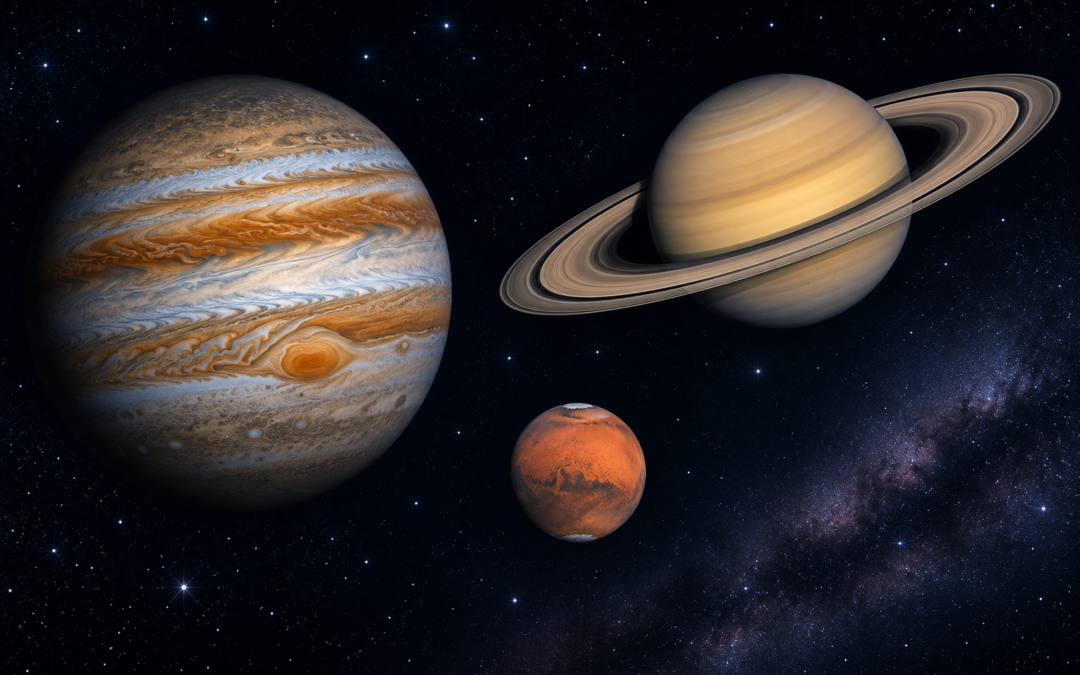
Jupiter: Cloud Bands and Four Bright Moons
Jupiter is one of the most satisfying planets for beginners.
Even a modest telescope can reveal its four largest moons — Io, Europa, Ganymede and Callisto — appearing as tiny points of light near the planet.
With a good 6-inch or 8-inch telescope, you can also begin to distinguish Jupiter’s main cloud belts.
On particularly steady nights, an 8-inch telescope may reveal additional detail, including variations within the cloud bands and occasionally the Great Red Spot when it is facing Earth.
The planet will still appear relatively small, but you’ll be seeing genuine features in its atmosphere.
Saturn: The Rings That Make It Worthwhile
For many beginners, Saturn is the reason they want a telescope in the first place.
Its rings can be visible through considerably smaller telescopes than the ones we’re recommending here.
A good 6-inch Dobsonian can show Saturn’s ring system clearly when the rings are favorably tilted towards Earth.
An 8-inch telescope offers additional resolving power, which can reveal more subtle detail when atmospheric conditions cooperate.
You may also identify Titan, Saturn’s largest moon.
Remember that the rings change their apparent tilt over Saturn’s orbit. When they’re nearly edge-on, they become much harder to appreciate, regardless of how good your telescope is.
Mars: A More Difficult Target
Mars deserves a little more caution.
It can look surprisingly small through a telescope, especially when Earth and Mars are far apart.
Around favorable oppositions, when Mars is relatively close to Earth, a good 8-inch telescope may reveal its polar cap and some darker surface markings.
But these details aren’t guaranteed every night.
Mars rewards patience, careful focusing, and good atmospheric conditions. Buying an expensive telescope won’t overcome an unfavorable observing season.
Venus: Beautiful Phases Rather Than Surface Detail
Venus is another rewarding beginner target, though not for the reasons you might expect.
The planet’s dense clouds prevent ordinary visual observation of the planet’s surface.
Instead, you can observe its changing phases, much like the Moon’s.
Even a relatively modest telescope can show Venus as a small disc, half-lit or crescent-shaped depending on its position relative to Earth.
The Three Telescopes We’d Recommend for Planetary Viewing
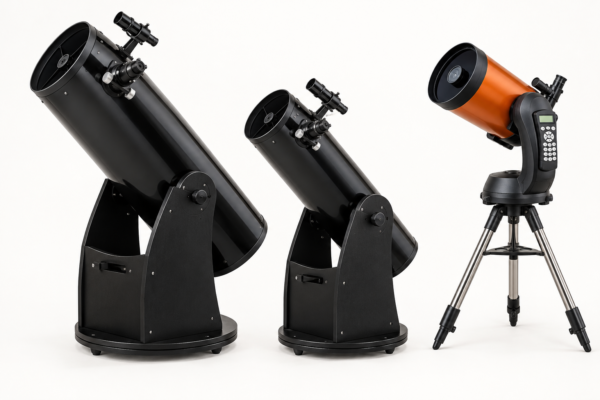
For beginners primarily interested in observing planets, these are the three telescopes we’d consider first.
| Telescope | Aperture | Best suited to |
| Apertura AD8 Dobsonian | 8 inches (203 mm) | Beginners prioritizing planetary detail |
| Apertura AD6 Dobsonian | 6 inches (152 mm) | Beginners wanting a smaller, less expensive Dobsonian |
| Celestron NexStar 5SE | 5 inches (125 mm) | Beginners who prefer computerized finding and tracking |
All three can show Jupiter’s moons and Saturn’s rings.
The differences matter more when you consider the finer details you want to observe, how much equipment you’re willing to move, and whether you enjoy finding objects manually.
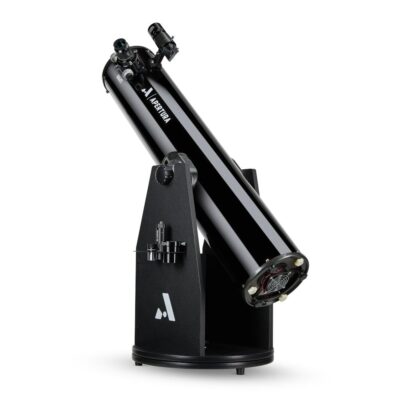
 1. Apertura AD8: Our Best Overall Choice for Viewing Planets
 1. Apertura AD8: Our Best Overall Choice for Viewing Planets
The Apertura AD8 is an 8-inch Newtonian reflector telescope mounted on a simple Dobsonian base.
Its main advantage is the size of its primary mirror.
At 203 mm across, the mirror collects considerably more light than a smaller telescope and provides greater theoretical resolving power.
For planetary viewing, that resolving power matters because you’re trying to distinguish relatively small details — Jupiter’s cloud bands, subtle features on Saturn and occasional markings on Mars.
The AD8 has a focal length of 1,200 mm, making it well suited to a useful range for planetary magnifications with appropriate eyepieces.
It also includes practical accessories, including a finder scope, eyepieces, and a collimation tool.
What makes the AD8 appealing?
You get substantial optical capability without paying for a computerized mount.
The Dobsonian base moves up and down and from side to side. Once you understand the basic movements, operating it becomes quite intuitive.
You locate a planet, bring it into the eyepiece, and gently move the telescope to follow it while Earth rotates.
There are no electronic alignment routines or motorized controls to learn.
For someone who wants to spend their funds primarily on the telescope’s optical performance, that’s an attractive arrangement.
What should you know before buying?
The AD8 isn’t a small telescope.
Its optical tube and base are sizable pieces of equipment, and you’ll need somewhere suitable to store them.
You’ll also need to learn how to align the finder scope, occasionally check the mirrors’ alignment, and allow the telescope to adjust to outdoor temperatures.
And because it doesn’t track automatically, you’ll move it by hand to keep a planet centered at higher magnifications.
None of these are unreasonable demands, but they are worth understanding before purchasing.
Our verdict: If you have suitable storage space and are comfortable handling a full-sized Dobsonian, the AD8 is our first choice for a beginner who wants to see as much planetary detail as their observing conditions will allow.
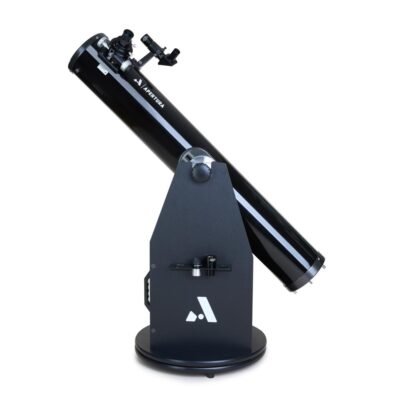
2. Apertura AD6: A More Manageable Alternative
 2. Apertura AD6: A More Manageable Alternative
The Apertura AD6 uses the same basic Dobsonian design but with a smaller 6-inch mirror.
It has a 1,200 mm focal length and can show the principal features that make planetary astronomy enjoyable.
Jupiter’s major cloud belts, its four bright Galilean moons, and Saturn’s rings are all realistic targets.
Under favorable conditions, the AD6 can also reveal additional planetary detail.
Why choose the AD6 instead of the AD8?
There are two good reasons: cost and practicality of implementation.
The AD6 is less expensive, and its smaller optical tube can be easier to manage.
For someone who needs to carry a telescope outside regularly, these considerations matter.
A telescope that is convenient enough to use on a typical evening may provide more enjoyment than a larger one that rarely leaves storage.
What are you giving up?
The AD8 has approximately 78% more light-collecting area than the AD6, based on their nominal mirror diameters.
It also offers greater theoretical resolving power.
That doesn’t mean every view through the AD8 will be dramatically better. Atmospheric turbulence can limit both instruments.
But when conditions are good, the larger telescope has more potential to reveal fine planetary detail.
Our verdict: Choose the AD6 if budget, storage, or handling are important considerations. It’s a capable planetary telescope, not simply a compromise.
3. Celestron NexStar 5SE: For Beginners Who Want Computerized Assistance
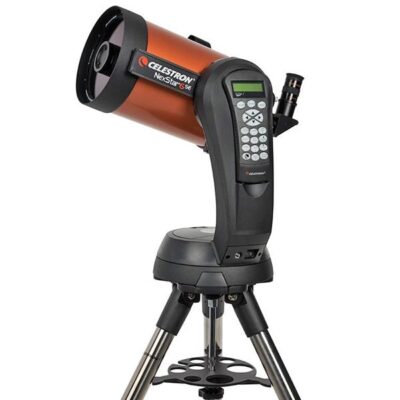
The Celestron NexStar 5SE takes a different approach.
Instead of a long reflector tube on a manual Dobsonian base, it uses a compact Schmidt-Cassegrain optical design with a computerized GoTo mount.
Its 125 mm aperture is smaller than that of either Dobsonian. Still, it offers an important convenience: once properly aligned, the telescope can locate selected objects electronically and track them as they move across the sky.
Why might that matter?
Finding a planet manually isn’t necessarily difficult, especially when Jupiter or Saturn is prominent in the sky.
But keeping a planet centered at higher magnification can require frequent adjustments with a manual telescope.
The NexStar 5SE’s motorized tracking reduces that interruption.
That can be especially attractive if you’re sharing the view with family members or prefer spending more time observing and less time repositioning the telescope.
What are the trade-offs?
Computerized operation introduces its own learning curve.
You’ll need to set up and align the telescope correctly, provide power, and become familiar with its hand controller.
The smaller aperture also means it cannot match the AD8’s theoretical ability to resolve fine planetary details.
And you generally pay more for the electronics and tracking system rather than receiving a larger mirror.
Our verdict: Choose the NexStar 5SE if computerized finding and tracking are more important to you than maximizing planetary detail for the money.
Why Aperture Matters More Than Advertised Magnification
One of the easiest mistakes a beginner can make is choosing a telescope because the packaging promises enormous magnification.
You might see inexpensive telescopes advertised with claims of 400×, 500×, or even 600× magnification.
Those numbers can sound impressive, but they tell you very little about the quality of the view.
A telescope’s aperture—the diameter of its main lens or mirror—determines how much light it can collect and sets a fundamental limit on the detail it can resolve.
Magnification enlarges the image that the telescope produces. It cannot create detail that the optics and observing conditions haven’t captured.
This is why an 8-inch Dobsonian can be a better planetary instrument than a much smaller telescope advertised with an enormous magnification figure.
For a fuller explanation, read our guide to aperture versus magnification.
What Magnification Do You Need to See Planets?
You don’t need extreme magnification to enjoy Jupiter or Saturn.
In fact, a clear view at moderate magnification is often more satisfying than a larger, blurry image.
As a practical starting point:
- 50×–100×: Useful for locating planets and beginning to see their main features.
- 100×–150×: Often a rewarding range for Jupiter and Saturn.
- 150×–200×: Can reveal additional detail when the telescope and atmosphere cooperate.
- Above 200×: Sometimes worthwhile, but increasingly dependent on steady conditions and optical performance.
These aren’t rigid rules. The best magnification changes from night to night.
For example, the AD8’s 1,200 mm focal length produces approximately 133× magnification with a 9 mm eyepiece.
That’s a useful starting point for planetary observing.
A shorter focal-length eyepiece can provide greater magnification, but only when the conditions justify it.
Don’t assume that buying the most powerful eyepiece will automatically improve your experience.
Atmospheric turbulence can make Jupiter appear blurry even through a good telescope. Image credit: Steve Marsh.
Why Planets Sometimes Look Blurry — Even Through a Good Telescope
This is one of the most important things to understand before buying.
A telescope can be well made, properly focused, and perfectly capable of showing planetary detail — yet still produce a disappointing image on a particular night.
There are several reasons.
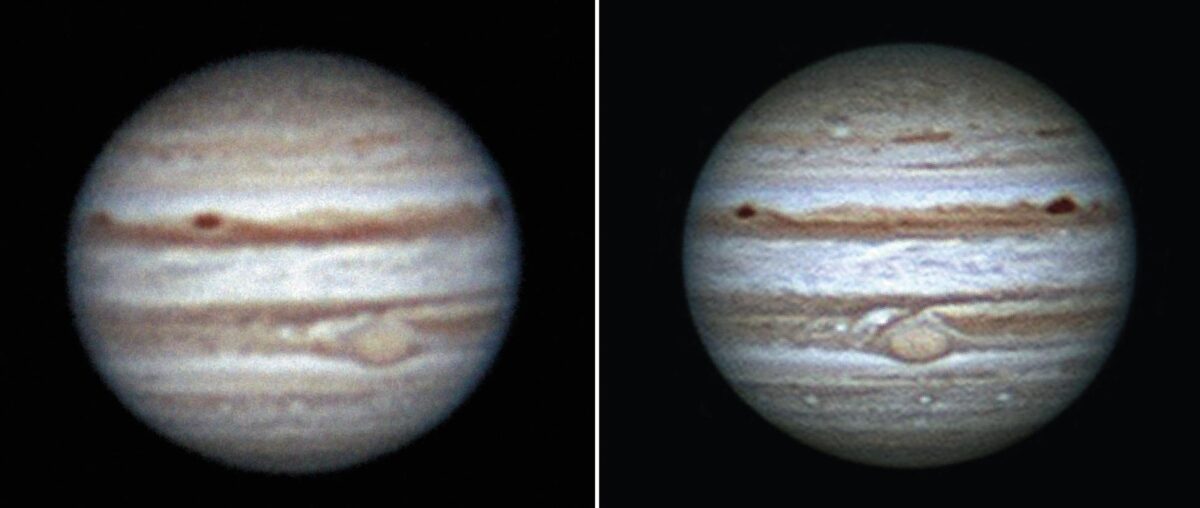
Atmospheric turbulence
You’re observing planets through Earth’s atmosphere.
Moving layers of air can distort the image, causing fine details to fluctuate in visibility or disappear.
Astronomers call this effect seeing.
Some nights are noticeably more stable than others, even when the sky looks equally clear.
Telescope temperature
A telescope moved from a warm house into cooler evening air may need time to reach a suitable temperature.
Until then, temperature differences inside the optical tube can disturb the image.
This is especially relevant to larger reflectors.
Mirror alignment
Newtonian reflectors such as the AD6 and AD8 occasionally require collimation — the process of aligning their mirrors.
Poor collimation can reduce the sharpness for planetary views.
It’s a skill worth learning, but it shouldn’t discourage you from choosing a Dobsonian.
Planet altitude
Planets generally look better when they’re higher above the horizon.
When a planet is low, its light passes through more atmosphere, increasing the potential for distortion.
Light pollution
Here’s some encouraging news for suburban observers.
You don’t necessarily need a remote dark-sky location to observe bright planets.
Jupiter, Saturn, Venus and Mars can all be rewarding targets from suburban backyards.
Light pollution is much more troublesome when observing faint galaxies and nebulae than when viewing bright planets.
Atmospheric steadiness, local heat sources, and the planet’s altitude are often more important for planetary detail.
Should You Buy a 6-Inch or 8-Inch Dobsonian?
For many beginners, this is the real buying decision.
Both instruments can show the planets, and both use simple manual mounts.
The AD6 is the more economical and manageable choice.
The AD8 offers greater optical potential, particularly when conditions are steady enough to reveal additional detail.
But don’t decide on aperture alone.
Think about where you’ll store the telescope, how far you’ll carry it, and whether you’ll regularly have time to set it up.
If you can comfortably accommodate the AD8, we’d favor the larger aperture.
If the AD6 fits your circumstances better, it’s still an excellent way to begin observing the planets.
We’ve examined the practical differences in our 6-inch versus 8-inch Dobsonian telescope comparison.
Do You Need a Computerized Telescope to Find Planets?
Not necessarily.
Jupiter and Venus are often among the brightest objects in the night sky, and you can also locate Saturn with a little guidance.
A beginner-friendly stargazing app can help you identify their positions.
Once you know where to look, a manual Dobsonian telescope and a properly aligned finder scope can make locating them straightforward.
The advantage of a computerized telescope isn’t that planets are otherwise impossible to find.
It’s the convenience of electronic object location and tracking.
That’s useful, but it’s a preference rather than a requirement.
For some beginners, finding one’s way around the night sky is part of the pleasure. For others, computerized assistance makes observing more relaxing.
Neither approach is wrong.
Which Telescope Should You Buy?
Here’s how we’d decide.
Choose the Apertura AD8 if:
You want our strongest overall recommendation for planetary viewing, have room for a full-sized telescope, and are happy to learn manual operation.
Choose the Apertura AD6 if:
You want satisfying views of Jupiter and Saturn without spending as much money or handling quite as much equipment.
Choose the Celestron NexStar 5SE if:
You value a compact optical tube, computerized finding and motorized tracking, and you’re comfortable with the added setup and electronics.
The best telescope isn’t necessarily the most expensive or technologically advanced.
It’s the one that suits your expectations, your circumstances and the way you want to enjoy astronomy.
Frequently Asked Questions
Can a beginner telescope really show Saturn’s rings?
Yes. Saturn’s rings can be visible through relatively small telescopes when their orientation is favorable. A good 6-inch or 8-inch Dobsonian can provide particularly satisfying views.
What size telescope is best for viewing Jupiter?
A 6-inch telescope can show Jupiter’s main cloud belts and its four largest moons. An 8-inch telescope offers greater potential for fine detail when sky conditions are steady.
Can you see the surface of Mars through a beginner telescope?
You may see darker surface markings and polar features through a suitable telescope when Mars is favorably positioned. At other times, it may appear as a small disc with little visible detail.
Is an 8-inch telescope too powerful for a beginner?
No. An 8-inch Dobsonian can be an excellent first telescope. The main considerations are its physical size, manual operation, and the need to learn basic setup and maintenance.
Is a GoTo telescope better for observing planets?
Not automatically. A GoTo telescope makes locating and tracking objects easier, but planetary detail depends mainly on the optics, aperture, and observing conditions.
Can you observe planets from a city?
Yes. Bright planets are generally suitable targets from suburban and urban locations. You don’t need exceptionally dark skies, although clear, steady air is important.
Final Verdict: Buy for the Views You’ll Actually Enjoy
If we were choosing a first telescope primarily to observe Jupiter, Saturn, and Mars, the Apertura AD8 would be our first recommendation.
Its 8-inch mirror offers strong optical performance for the price, and its uncomplicated Dobsonian mount keeps the focus on observing rather than electronics.
But the AD6 deserves serious consideration if its smaller size and lower cost make it easier for you to enjoy the hobby regularly.
And the NexStar 5SE is a sensible alternative if computerized tracking and convenience matter more to you than maximum aperture.
Whichever you choose, remember what you’re buying.
You’re not buying the enormous, colorful planetary photographs produced by spacecraft and sophisticated imaging equipment.
You’re buying the opportunity to look through an eyepiece and recognize the rings of Saturn, the moons of Jupiter, or the changing phases of Venus with your own eyes.
That experience can be remarkable without being exaggerated.
Ready to choose your first planetary telescope?
Explore the Apertura AD8, Apertura AD6, and Celestron NexStar 5SE at High Point Scientific, compare their current prices, and select the instrument that best suits your needs.
And once your telescope arrives, our First Night With Your Telescope guide will help you get started with confidence.
Explore beginner telescopes,binoculars and best stargazing apps for beginners here:
Affiliate disclosure: White Star Outdoors may earn a commission when you purchase through qualifying links, at no additional cost to you. Our recommendations are based on the equipment’s suitability for beginner observers.