Apertura AD8 Review
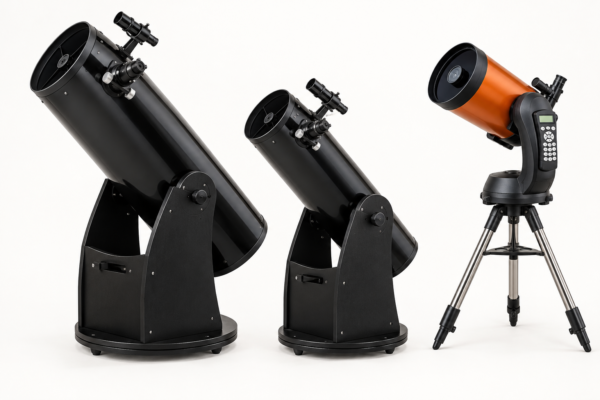
The Apertura AD8 8-inch Dobsonian telescope is our top recommendation for beginners who want serious visual observing capability without paying for computerized controls. At a regular listed price of US$699.95, its 8-inch mirror offers excellent views of the Moon, planets and brighter deep-sky objects. But this is not a small telescope.
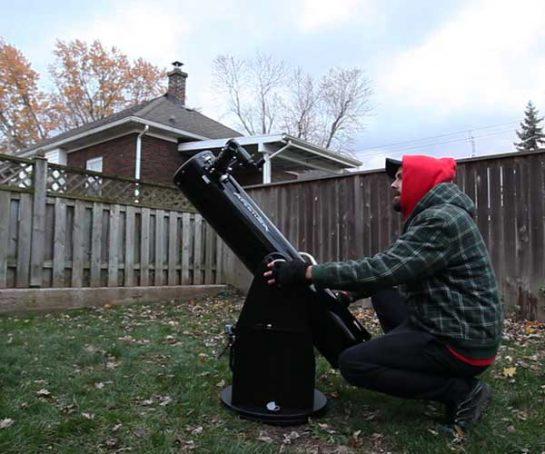
Weighing approximately 52 pounds (23.7 kg) across two substantial pieces, it needs storage space and a manageable route outdoors. If carrying bulky equipment is difficult, consider the smaller AD6. If you want a telescope that finds objects for you, consider the Celestron NexStar 5SE instead.
The AD8 is not the right telescope for everyone. But for someone who enjoys exploring the night sky, has room to use it, and wants equipment they can grow with, it represents excellent long-term value.
1. Apertura AD8 Specifications: What Comes in the Box?
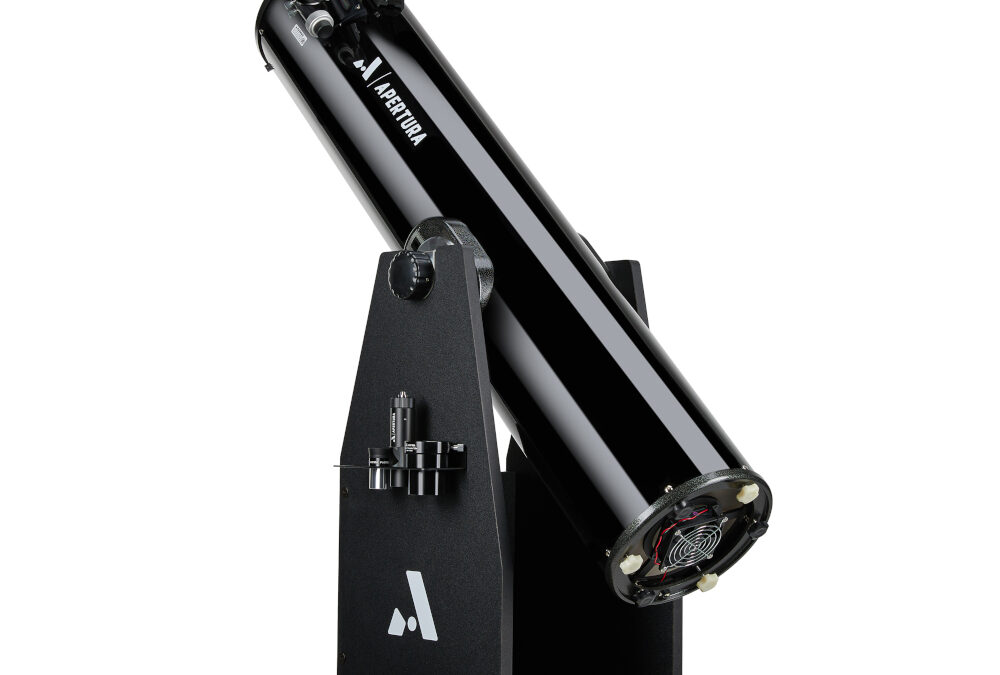
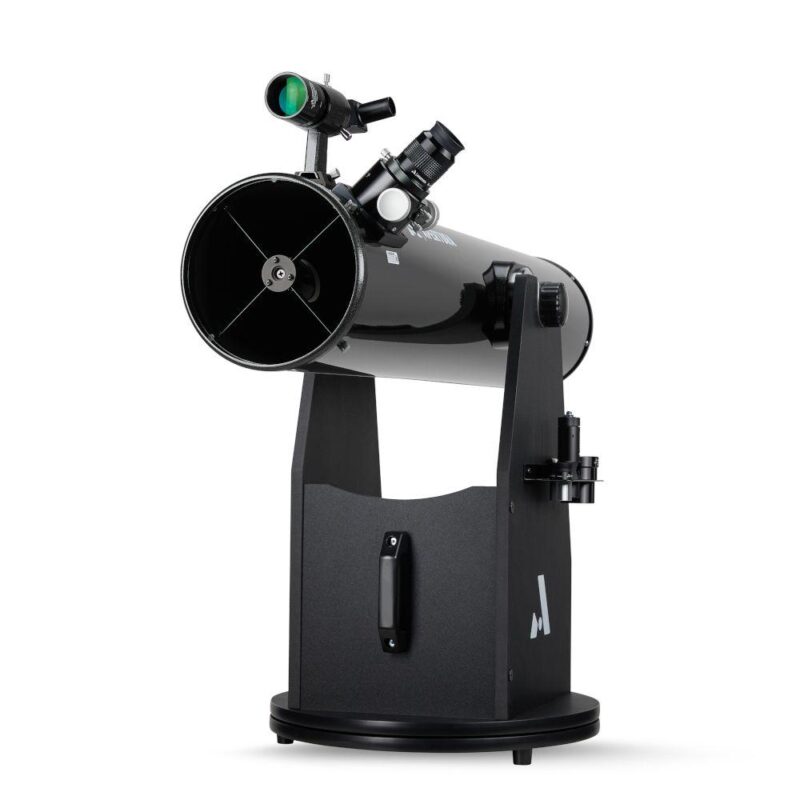
The Apertura AD8 is an 8-inch Newtonian reflector telescope mounted on a manual Dobsonian base.
Its design is straightforward. A large primary mirror collects light, while the stable base allows you to move the telescope up, down, left, and right by hand.
Here are the important specifications.
| Specification | Apertura AD8 |
| Optical design | Newtonian reflector |
| Aperture | 203.2 mm (8 inches) |
| Focal length | 1,200 mm |
| Focal ratio | Approximately f/5.9 |
| Mount | Manual Dobsonian |
| Total weight | Approximately 52.2 lb (23.7 kg) |
| Low-power eyepiece | 30mm, 68° Super View, 2-inch |
| Higher-power eyepiece | 9mm, 52° Plössl, 1.25-inch |
| Finder | 8×50 right-angle finder |
| Focuser | 2-inch dual-speed Crayford |
| Additional accessories | Laser collimator, Moon filter and cooling fan |
| Regular listed price | US$699.95 |
Specifications and regular listed price checked against High Point Scientific, November 2026. Prices and packages may change.
The two supplied eyepieces provide approximately 40× and 133× magnification.
That is a useful starting combination. The 30mm eyepiece gives you a wider view for locating objects, while the 9mm allows closer examination of the Moon and planets.
You do not need to purchase additional eyepieces before your first observing session.
The included laser collimator helps with mirror alignment, while the cooling fan can help the primary mirror adjust to the outdoor temperature.
The telescope arrives with a separate optical tube and Dobsonian base, which requires initial assembly.
The important practical detail is its size. Although you can move the tube and base separately, neither component is particularly compact.
Before buying, consider where you will store it and how you will get it outside.
2. What Can an 8-Inch Dobsonian Telescope Actually See?
This is the question that matters most.
An 8-inch telescope can reveal extraordinary sights, but those views will not resemble the colorful, highly processed photographs produced by space telescopes and astrophotographers.
Visual astronomy is a different experience.
You are observing light that has traveled through space and entered your telescope, often from objects far beyond our solar system.
What you see depends on atmospheric conditions, light pollution, your observing experience, and the object itself.
The Moon: Your Best First Target
The Moon is where the Apertura AD8 immediately demonstrates its capabilities.
Along the terminator — the boundary between the illuminated and dark portions of the lunar surface — sunlight casts long shadows across mountains, craters and valleys.
Those shadows make surface features stand out.
You can examine the walls of prominent craters, the dark lunar plains and the rugged highlands.
The view changes as the Moon moves through its phases, making it an object worth returning to repeatedly.
For a beginner, the Moon provides some of the most immediately rewarding views available through this telescope.
Jupiter: Cloud Bands and Four Tiny Moons
Jupiter will appear as a small, bright disc rather than the enormous planet shown in astronomy photographs.
Under suitable conditions, you can distinguish its two principal brownish cloud belts.
Nearby, you may see up to four tiny points of light—Io, Europa, Ganymede and Callisto—although their positions change and some may be hidden or pass in front of the planet.
On nights with particularly steady atmospheric conditions, additional cloud detail may become visible.
The important expectation is scale.
Jupiter will look small through the eyepiece, but recognizing its cloud bands and watching its moons change position can be enormously satisfying.
Saturn: Rings You Can Really See
Saturn is often the planet that inspires someone to buy their first telescope.
And the Apertura AD8 can show its rings.
However, Saturn will remain much smaller than the photographs you have seen online.
Depending on the ring system’s angle towards Earth, you may see the rings clearly separated from the planet or presented at a much narrower angle.
When conditions are favorable, you may also detect Titan, Saturn’s largest moon.
The first sight of Saturn through a telescope can be memorable precisely because you are seeing the real planet, not a photograph.
Globular Star Clusters: Thousands of Stars Together
Globular clusters are among the most rewarding deep-sky targets for an 8-inch Dobsonian.
These enormous, roughly spherical collections contain thousands to hundreds of thousands of stars.
For Northern Hemisphere observers, Messier 13 (the Great Hercules Cluster) is an excellent example. Under suitable conditions, the AD8 can begin to resolve individual stars in its outer regions.
For Southern Hemisphere observers, Omega Centauri is a particularly impressive target. It is one of the brightest and most spectacular globular clusters visible from Earth.
From a suitably dark observing location, an 8-inch telescope can reveal a remarkable concentration of stars.
Unlike planets, globular clusters often reward patience and careful observation rather than simply increasing magnification.
The Orion Nebula: A Cloud Where Stars Are Born
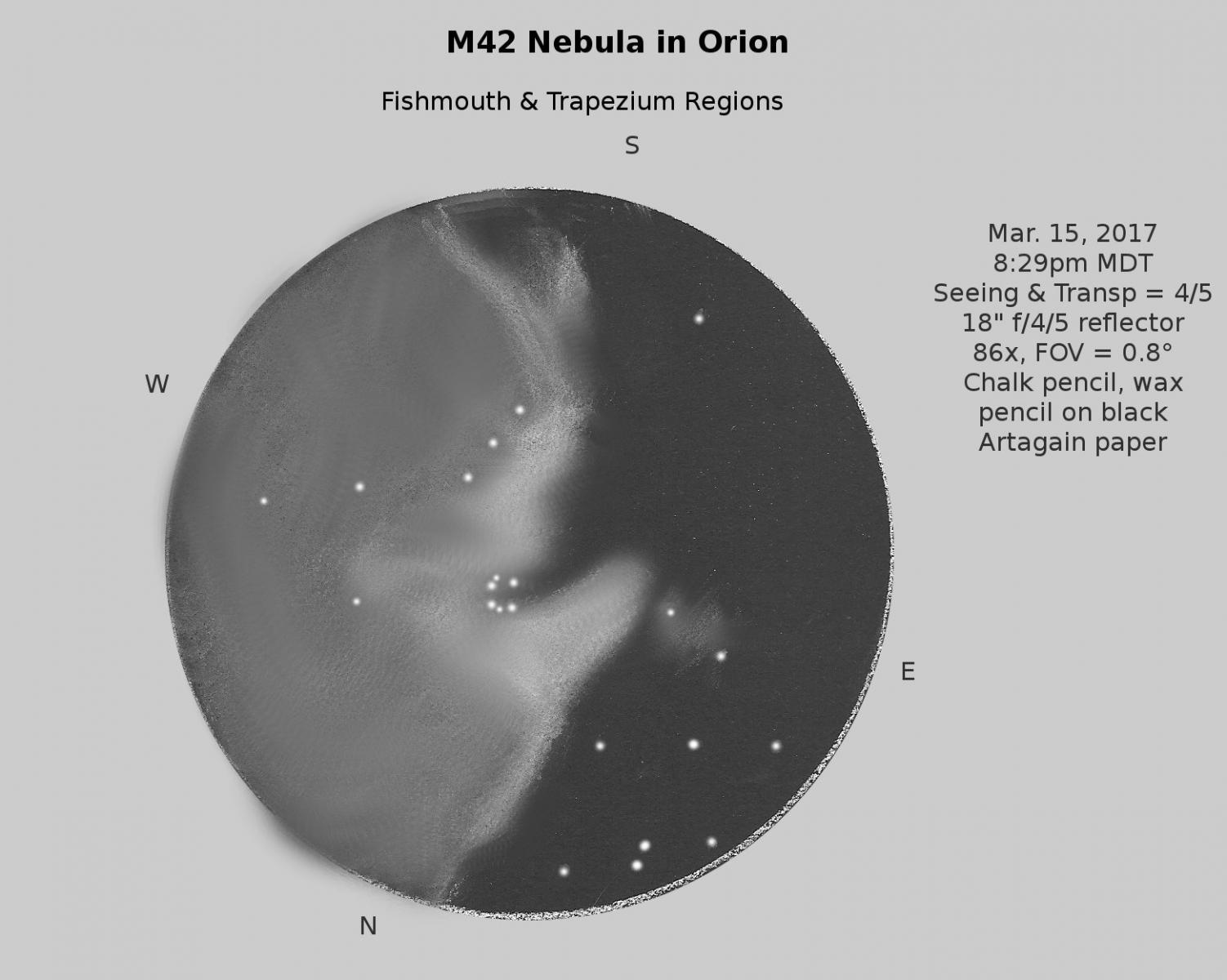
The Orion Nebula, also known as M42, is one of the best deep-sky objects for beginners.
Through the AD8, you can observe a luminous cloud surrounding the young stars of the Trapezium.
Under darker skies, the nebula’s irregular structure becomes more apparent, with faint extensions spreading away from its brighter central region.
Most beginners will see predominantly grey or pale greenish tones rather than the vivid reds and purples common in photographs.
That does not make the view disappointing.
You are observing a vast region of gas and dust where new stars are forming, approximately 1,350 light-years away.
Galaxies: Faint Light From Far Beyond Our Own
Galaxies require the most realistic expectations.
An 8-inch Dobsonian can reveal numerous galaxies, particularly from dark observing sites.
However, most will appear as faint grey patches or elongated smudges rather than detailed, color-filled spirals.
The Andromeda Galaxy, for example, may reveal a bright central region surrounded by a much fainter glow.
Under excellent conditions, experienced observers can detect additional structure in selected galaxies.
A useful technique is averted vision: looking slightly to one side of a faint object rather than directly at it.
This allows the more light-sensitive regions of your retina to help detect subtle detail.
Light pollution makes a substantial difference. A galaxy that is difficult to detect from a suburban garden may become noticeably easier under a dark rural sky.
The AD8 gives you the aperture to explore these objects, but darkness, patience and experience remain important.
How Much Magnification Is Useful?
The AD8’s supplied 30mm eyepiece produces 40× magnification, while its 9mm eyepiece produces approximately 133×.
For many observing sessions, these are already useful powers.
Around 200× is a sensible practical benchmark for higher-power planetary observing when conditions allow, although some nights will support less and exceptionally steady nights may support more.
The theoretical optical limit is higher, but that does not mean increasing magnification will always improve the image.
At excessive magnification, planets become dimmer and atmospheric turbulence makes fine details harder to distinguish.
A sharp view at 133× can be far more rewarding than a large, blurry view at 300×.
The AD8’s greatest advantage is not an enormous magnification number. It is the amount of light its mirror collects and the detail that aperture can potentially resolve.
3. Your First Night With the Apertura AD8
Imagine the telescope has arrived, the sky is clear, and you are ready to begin.
The temptation is to search immediately for Saturn or a distant galaxy.
A better approach is to make your first session as straightforward as possible.
Start by assembling the Dobsonian base. Follow the manufacturer’s instructions, ensuring the base moves smoothly and the optical tube sits securely in its supports.
Check the mirror alignment. This process is called collimation. The AD8 includes a laser collimator, but you should also check the tool for accuracy.
Align the finder during daylight. Point the telescope at a distant, stationary object such as a tree or building, never anywhere near the Sun. Center the object in the main telescope, then adjust the finder until it points to the same location.
Insert the 30mm eyepiece. Its wider field of view makes locating objects easier than starting with high magnification.
Begin with the Moon. It is bright, relatively easy to locate, and forgiving of small beginner errors.
Once you are comfortable focusing and moving the telescope, try Jupiter, Saturn, or a bright star cluster when they are visible.
You do not need to learn the entire night sky in one evening.
The first session is about becoming comfortable with your equipment and enjoying what you can see.
4. Is the Apertura AD8 Worth the Money?
At its regular listed price of US$699.95, the Apertura AD8 sits above entry-level telescopes but below many sophisticated computerized systems.
The important comparison is what your money actually buys.
The Apertura AD6 has a 6-inch mirror and a regular listed price of US$499.95.
That makes the AD8 approximately US$200 more expensive.
For that additional money, you get an 8-inch mirror that collects about 78% more light than a 6-inch mirror of comparable design, before accounting for differences in optical transmission.
That is a meaningful improvement.
The larger aperture can make faint objects easier to detect and provide greater potential for resolving fine detail when conditions are suitable.
The AD8 also includes a useful accessory package, including a larger finder, a wide-field eyepiece, a cooling fan, and a laser collimator.
But there is something the extra money does not buy.
The AD8 will not find objects for you.
It is a completely manual telescope.
You move it by hand, locate objects using the finder and gently adjust its position as Earth rotates.
For many observers, learning to navigate the sky is part of the enjoyment.
For others, it becomes a source of frustration.
If you would prefer computerized assistance, the Celestron NexStar 5SE is a different proposition. It has a smaller 5-inch aperture but includes a GoTo mount that can locate and track objects after proper setup and alignment.
The 5SE costs more, but the extra cost goes toward its computerized system rather than a larger mirror.
The AD8 is therefore excellent value for someone who prioritizes visual performance and is comfortable finding objects manually.
It is less attractive for someone who values automation above aperture.
5. Who Should Not Buy the Apertura AD8?
This is just as important as explaining why we recommend it.
The Apertura AD8 is not suitable for every beginner.
You Have to Carry It Up and Down Stairs
The complete telescope weighs approximately 52.2 pounds, divided between the optical tube and base.
Although you can carry the components separately, their size makes them awkward in stairwells and narrow spaces.
If you have several flights of stairs between your storage area and observing location, consider whether you would genuinely enjoy moving the equipment regularly.
You Have Very Limited Storage Space
An 8-inch Dobsonian is a substantial piece of equipment.
If you live in a small flat, have no convenient outdoor area, or must store the telescope in a shared hallway, the practical difficulties may outweigh its optical advantages.
You Need to Transport It Frequently
You can transport the AD8 by car, but you need enough room for its long optical tube and separate base.
If you have a small vehicle or regularly travel to observing locations, measure the available space before purchasing.
You Want the Telescope to Find Objects Automatically
The AD8 has no motors, electronic object location, or automatic tracking.
If you want a telescope that helps locate celestial objects, the NexStar 5SE may be a more appropriate choice.
You Want Something You Can Carry Outside in One Easy Trip
The smaller Apertura AD6 is still a substantial telescope, but it is lighter and generally easier to manage.
If the AD8’s size makes you hesitate, that is a legitimate reason to choose the AD6.
A telescope that is easier to use regularly may provide more enjoyment than a larger instrument that rarely leaves storage.
The best telescope is not necessarily the biggest one. It is the one you will actually use.

6. Apertura AD8 vs AD6 vs Celestron NexStar 5SE
These three telescopes serve different priorities.
| Apertura AD8 | Apertura AD6 | NexStar 5SE |
US$699.95 | US$499.95 | US$1,114.84 |
| 8-inch aperture | 6-inch aperture | 5-inch aperture |
| 52.2 lb | 42.9 lb | Approx. 28 lb |
| Manual Dobsonian | Manual Dobsonian | Computerized GoTo |
| Best for maximum visual capability | Best for lower cost and easier handling | Best for assisted object finding |
Regular listed US prices, checked in November 2026. Weight figures are approximate and include the principal observing equipment. Retailer discounts may change.
The AD8 is our preferred choice for beginners who want more light-gathering power and can manage its size.
The AD6 is the sensible alternative when cost, weight and storage matter more.
The 5SE is the option for someone who values computerized assistance and tracking.
These are different ways of enjoying astronomy, and there is no reason to pretend one telescope suits everyone.
If the AD8’s size or weight makes you hesitate, the Apertura AD6 is worth considering. Its smaller 6-inch mirror gathers less light, but the telescope is easier to handle and costs approximately US$200 less.
Check the Apertura AD6 at High Point Scientific
If finding objects manually sounds more frustrating than enjoyable, the Celestron NexStar 5SE offers a different approach. Its computerised GoTo system can locate and track celestial objects after alignment, although its smaller aperture collects less light than the AD8.
Check the Celestron NexStar 5SE at High Point Scientific
7. What Should You Buy With the Apertura AD8?
One advantage of the AD8 is that its standard accessory package already includes much of what a beginner needs.
There is no reason to order an expensive collection of additional equipment before using the telescope.
Four items are worth considering.
Collimation tool: The AD8 already includes a laser collimator. Learn to use it and check it before purchasing another alignment tool.
Red-light torch: A dim red torch helps you read charts and handle equipment while preserving more of your night vision.
Planisphere or astronomy app: A simple star chart or free astronomy app can help identify constellations and locate suitable observing targets.
Additional eyepiece: Consider one later, after you understand what the supplied 30mm and 9mm eyepieces do well and where you would genuinely benefit from another magnification.
The most useful first investment may be time spent learning the sky rather than more equipment.
8. Apertura AD8 Review: Our Final Verdict
The Apertura AD8 is an excellent first telescope for beginners who want rewarding visual views of the Moon, planets and deep-sky objects, and who have the space and willingness to handle a full-size Dobsonian.
If you can comfortably move it, store it, and enjoy finding objects yourself, the AD8 is our preferred long-term beginner telescope.
And if you are choosing a telescope as a Christmas or birthday present, see our Telescope Gift Guide before purchasing. A telescope should suit the person who will actually use it, not simply the expectations of the person buying it.

Explore beginner telescopes, binoculars, and the best stargazing apps for beginners here:
Affiliate disclosure: White Star Outdoors may earn a commission if you purchase through our retailer links, at no additional cost to you. Our recommendations are based on suitability, practical limitations, and the observing experience each telescope offers.